
The Solemn Consecration of the Belmont Abbey Cathedral
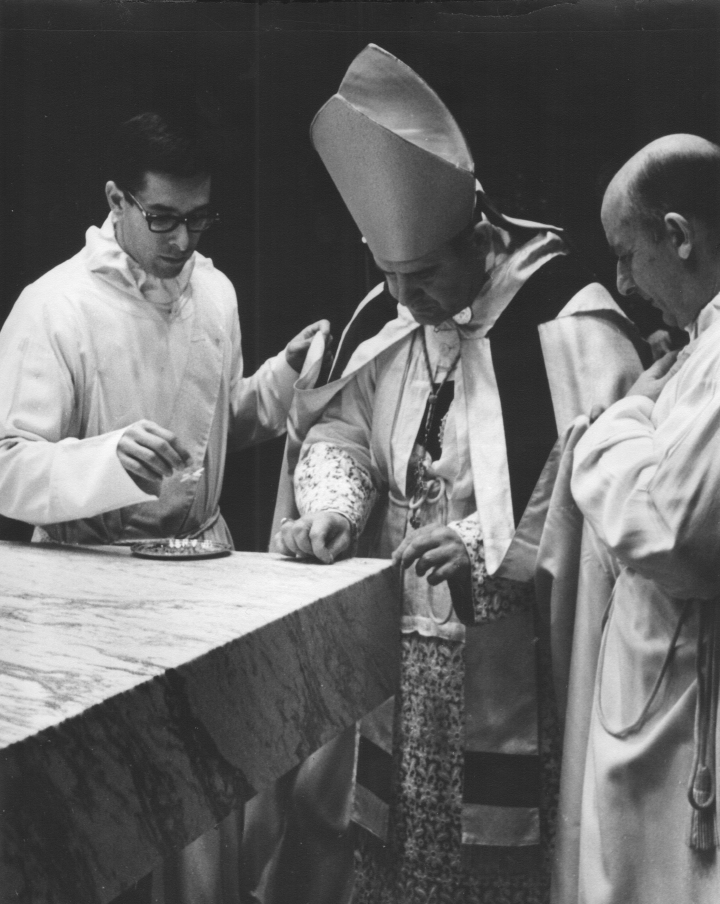
On March 28, 1965, Abbot Walter Coggin O.S.B. consecrated the newly renovated Belmont Abbey Cathedral. To the Abbot, the need for renovation was clear, due to the increasingly obvious decay and dilapidation of the church. According to a 1964 report, “The walls were dingy; the floor was close to collapsing; the beauty that was once the Cathedral was faded.” It was thus incumbent upon Abbot Walter to rectify the situation.
Jarring though it was, the renovation simplified the original design. The ceiling became cedar, while the plaster on the walls was replaced with plain brick. The floor was laid with undyed flagstone and the altars and ambos were cut of Georgia marble. Yet the painted windows, Stations of the Cross and the venerated statue of Maryhelp all remained. To the exterior of the building, however, the narthex was added and the granite arch surmounting the original doors was moved to this new location. Additionally, before the entrance, an expansive piazza was created. Facing west on the piazza in front of the church, the Italian-made statue of Saint Benedict was placed, obtained and blessed by Leo Haid in 1924. As has been noted, the “evocative simplicity was soon understood as an authentic expression of the monastic values that underscored the Cathedral’s use” (Baumstein 14).
As we celebrate our Solemnity today, let us reflect on the words of our late great Abbey historian, Father Pascal Baumstein.
In his “A Carolina Basilica” pamphlet, he writes:
“The beauty and history of the Abbey Basilica of Maryhelp testify today to the reality that resided in the dream of her Benedictine founders. More importantly, though, to her many worshippers through the years—the succession of monks who have sought God there, the sequence of Abbeymen (and in more recent times, of Abbeywomen) who have studied in her shadow and prayed there, and to the generations of the faithful, clergy, and guests who have been invigorated and comforted amid her spiritual atmosphere and liturgies—the Abbey Basilica is an enduring symbol of the reality of God’s grace, bountifully given and felicitously enjoyed” (Baumstein 16).
Let us pray in thanksgiving, then, to God for the gift of our Abbey Church and all the blessings He has bestowed upon us through this sacred place, and all the graces that continue to flood into our lives through it, today and in the years to come.
NB: In 1910, our church become a cathedral when the Abbey was elevated to the rank of a nullius ‘diocese,’ the only Abbey Cathedral ever erected in the country. The Abbey Cathedral was then enhanced with a new distinction in 1973 with its entry into the National Register of Historic Places. However, when the nullius was suppressed the Abbey lost its classification as a cathedral and was reclassified in 1977 as an ordinary monastic church. In 1993, however, the church gained a second listing on the National Register, this time as part of the Belmont Abbey National Historic District. Finally, on July 27, 1998, our church received what seems to be its greatest honor when “(now Saint) Pope John Paul II recognized the spiritual, historical, pastoral, and aesthetic significance (of the Abbey Church)…by naming her a Minor Basilica. Belmont is only the third abbey in this county to be elevated to this dignity” (Baumstein 16).
Work Cited: Baumstein, Pascal. “A Carolina Basilica.” North Carolina: The Southern Benedictine Society, 1999