
The Show Goes On: Honoring Simon Donoghue
Laura Schaffer, Editor
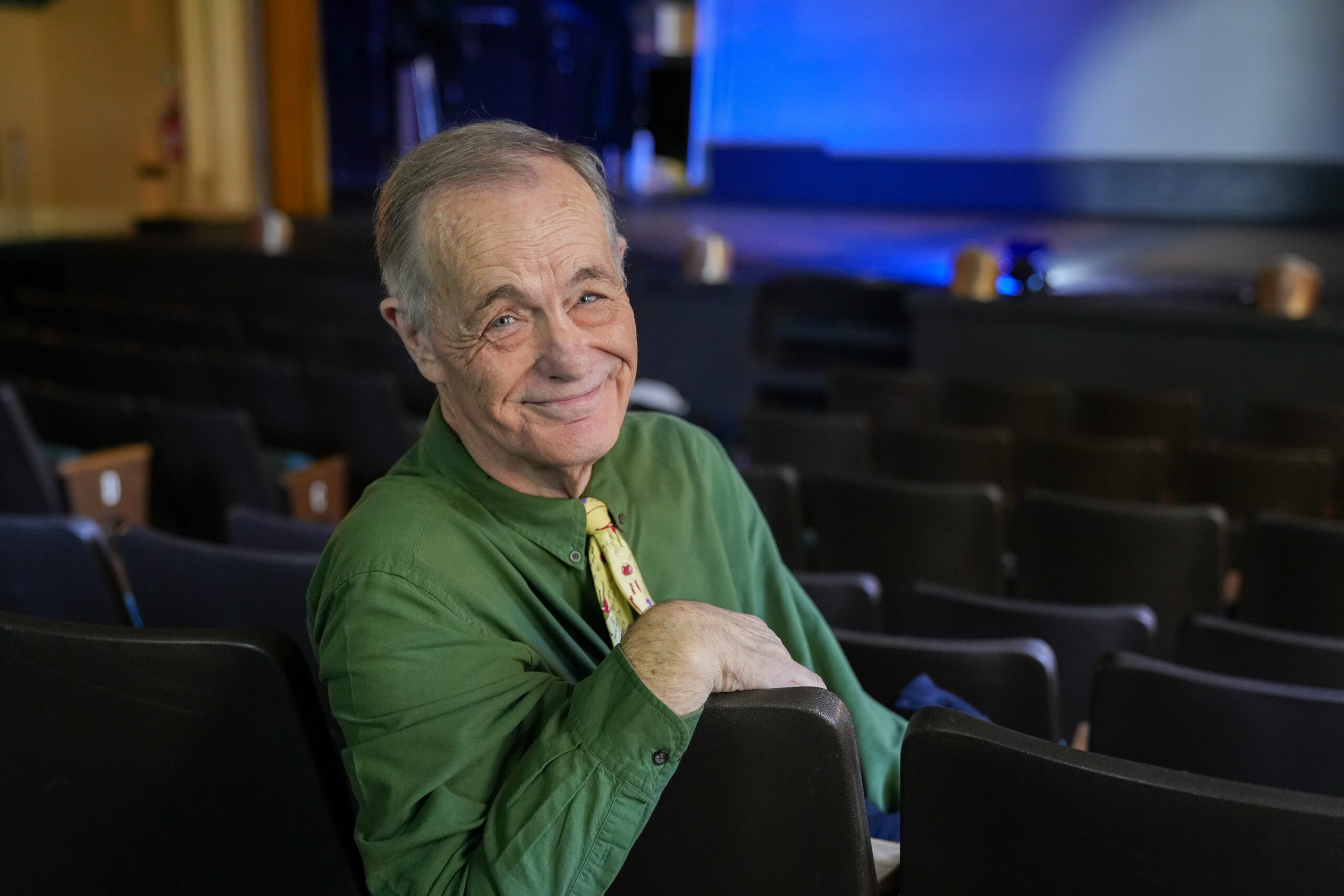
“If you work for the Abbey Players, they give you scope,” Simon Donoghue said, his face folding from deadpan into the singular, signature grin that generations of Abbey Players have come to know and love. Scope. It was the perfect word, and he knew it.
Scope, after all, captures not just the resourcefulness of Abbey Players through the years – as they face creative challenges and master a wide variety of skills – but also the breadth of experience they still explore and express each semester on stage. No wonder there’s such a culture of resilience and humor in the Belmont Abbey Performing Arts.
It was my pleasure to interview Simon in the weeks before he received his Lifetime Achievement Award. Here is a small part of what I learned that day about this kind and extraordinary man.
Simon Donoghue came to Belmont Abbey to discern monastic life. Entering the monastery after graduating from the University of Virginia, he made Simple Vows in 1975 and remained in discernment with the community until 1978.
What began as a young man discerning religious life would remain a vocation story, though the path would unwind in unexpected ways as Simon brought his considerable and attentive energy, his creativity, and his responsive care to the campus community. It would lead him to marriage, and to a different kind of service than he envisioned on arrival in 1974.
Over the years, Simon’s many roles at the Abbey have included reference librarian; professor of Theatre Arts; Chair of the Faculty Assembly; instructor of History, German and Great Books;
founding editor of the monastery’s Crescat publication; archivist; and Interim Library Director. However, the almost five decades he served as Director of the Abbey Players speak to his greatest Belmont Abbey legacy: as a teacher, mentor, friend, and inspiration to generations of Abbey students.
Alongside legends like Frs. John Oetgen and Paschal Baumstein – both of whom were close personal friends and mentors – Simon Donoghue has taken his place as an Abbey Players icon.
Early years
Simon’s relationship with his wife, Debbie, itself hearkens back to Abbey theater. While on a monastic visit to St. Gertrude’s, a Richmond Benedictine high school, Simon had noticed the young woman who swept onstage at the end of 7 Nuns in Las Vegas. And when Debbie auditioned for Anastasia as an Abbey undergraduate the next year, he recognized the commanding mother superior.
Debbie was a dynamo. She led Student Government, became the first female Student of the Year, and danced through every “Friday Night Thing” in original dresses sewed the day of the party. After Anastasia rehearsal one night, Simon told his college roommate, “I have no intention of leaving the monastery, but I have the weirdest feeling I’m going to marry that woman.” Five years later, Debbie walked to the basilica in a wedding dress she’d made herself, and she and Simon were married. Christopher was born a year and a half later.
Prior to Simon’s tenure, the theatre temporarily occupied St. Leo’s ground floor. With Grace Auditorium condemned and crumbling overhead, the Abbey Players had salvaged the original (1904) lighting board, uprooted the auditorium chairs, and erected a stage. They’d spray-painted paint cans and used them to rig lights. And sometimes they’d make stage exits out the window.
A new theatre
By 1979, three years after Abbot Jude Cleary asked Simon to be the Abbey Players’ Director, the theatre had relocated to the Haid. And while 1987 would see a full renovation, in the meantime the Abbey Players continued practicing resourcefulness. They built a 3-foot stage with a screen behind it, stacked chairs between performances, and even painted unclaimed objects black to appropriate them for theatrical use.
In the end, makeshift space never phased the Abbey Players, who dove into everything from You’re a Good Man, Charlie Brown (Simon’s musical directorial debut) to Follies, and from Fr. Paschal’s original adaptation of Come Rack, Come Rope to the musical Godspell or Shakespeare’s Richard III. Fr. Paschal inspired a Shakespearean series and continually challenged students and Simon alike to shatter their comfort zones. Today, the same joyful, creative ambition remains an Abbey Players hallmark, cultivating a vibrant campus culture which, under Simon’s leadership, extended to include members of the external community, further enriching student experience and expanding performing local arts networks.
Simon also played a vital role in establishing the performing arts as a recognized academic department at Belmont Abbey College, with majors, minors, and a premier scholarship named for Fr. John Oetgen.
If you ask Simon about his story, you’ll inevitably hear more about student and colleague accomplishments than about his own, a fact which perfectly underscores the profound sincerity, kindness, tenacity, and generosity that has impacted so many community members throughout his nearly 50 years as Director of the Abbey Players.
Today, Belmont Abbey Performing Arts continue to thrive under the leadership of Kristin Hayes, Chair of the Performing Arts Department, and Christopher Donoghue, Director of the Abbey Players. That students with diverse views and backgrounds continue to build flourishing community on the Abbey stage is, in no small part, thanks to Simon Donoghue’s legacy. “Theater opens people up,” Simon notes. It gives them scope.