
Here at the Abbey, just as we’re just noticing the first signs of drifting leaves and slipping temperatures, it’s already time for fall break. Students have traveled home, classes have passed the midterm crunch, and several things have paused momentarily, including the weekday Adoration that runs throughout our academic year.
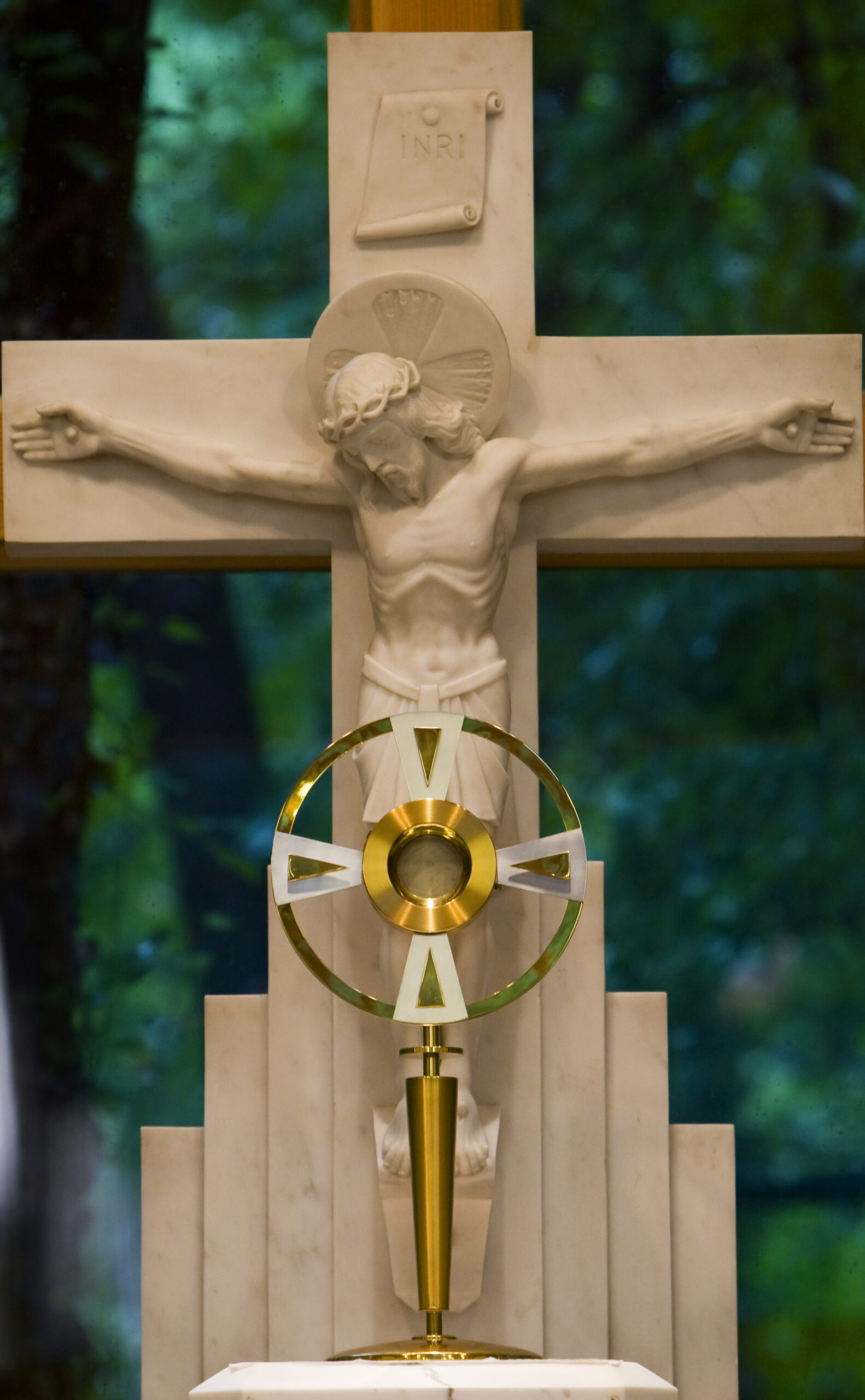
As someone who works on campus year-round, I tend to forget about fall break, at least until its natural consequences crop up… so when I stopped into the St. Joseph Adoration Chapel this Wednesday, at first I wondered why Our Lord was still closed in the tabernacle. And while it was a lovely, quiet visit – and certainly He was no less present than when visibly throned in the monstrance – those few minutes of prayer raised a question: Why is it such a gift to see Him, when His Eucharistic form embodies, too, a kind of hiddenness, at least to physical sight?
The question, in its way, brought to mind a liturgical moment and a particular word, about which I’ve wondered off and on… “behold.”
“Behold the Lamb of God, who takes away the sins of the world. Happy are those called to the supper of the Lamb.” Just before Communion, the priest speaks these words as he lifts the Host, to which we, as a congregation, respond: “Lord, I am not worthy that You should come under my roof, but only say the word, and my soul shall be healed.” Yet even before we borrow the Centurion’s words, there is something about the call to “behold” that invites an act of faith, and even makes it natural to address Christ directly in the Eucharist.
Vision-centered verbs don’t tend to have particularly bold or active connotations. “Behold,” however, seems to reach out with intention and directness, not even requiring a preposition to engage the object or clarify its relation to the viewer. We look “at” or “over” or “through” something, but we “behold” the thing itself. The word seems to leap us toward something significant, focusing our attention with epiphanic intensity. So, when the priest says, “Behold the Lamb of God” and lifts the Eucharist up before the congregation, the liturgy itself is urging us to hold Christ actively in our vision, fixing our gaze on Him with all our attention and will. It is an affirmation, a silent Amen that is essentially an act of contemplation.
Of course, we can turn to God in contemplation at any place and time. Because He is present to us in so many merciful and mysterious ways, every beauty and suffering can be an invitation to turn our gaze to Him in faith.
But in the realm of earthly contemplation, the Eucharist – and Adoration – invites an encounter unlike any other. Here, with Christ’s characteristically profligate generosity, He makes Himself not only present but also visible, and not only visible, but visible in mystery.
Because Christ’s Body and Blood retain the appearances of bread and wine, willingly “beholding” the Lord we love in what seems like a wafer of bread is choosing to go out in faith to meet His promise, His Word: that this is His Body, given for us.
When we look to the Eucharist, we really are looking at God. And yet, He is present in a way that does not obviate, but directly invites, the act of faith which draws us more deeply into relationship with Him. He comes to meet us in our need and at the same time allows us the opportunity to respond in freedom and will.
“Behold the Lamb of God.” Placing our full confidence in Christ, we can turn our gaze to Him. Just as contemplation is never a truly static act, “beholding” the Lamb becomes much more than a silent statement of what we believe – because we are turning our eyes to the One who loves us, who is so deeply present to us in mystery and fact, and who will never disappoint our trust.
Let’s rejoice to behold Him in sacrament today – and one day in the perfect vision of His Love. Alleluia!