Classical Education Statistics USA 2025 | Belmont Abbey College

Classical education is often discussed in abstract or idealized terms, shaped by tradition, philosophy, and historical reputation rather than by students’ lived experiences. Public conversations tend to focus on what classical education ought to be, leaving less room for how it is actually delivered, understood, and applied by graduates as they move through advanced, text‑centered classical study and into professional environments.
To better understand the realities of classical education in the United States, we polled 500 university- or college-level classical education graduates to get a practical look at where and how classical education is taught, which subjects and frameworks receive the most emphasis, and how this form of study shapes careers, skills, and long-term satisfaction beyond graduation.
Index
- 39% of university or college-level classical education graduates graduated with a classical or liberal arts degree from a state or public university.
- Our survey shows that a classical education prepares students for virtually any career, with the largest proportion of respondents pursuing a business executive or management position.
- A preponderance of university or college-level classical education graduates describe their institution’s curricular approach to the Western canon as providing comprehensive coverage across ancient, medieval, and modern periods.
- 80.5% of university or college-level classical education graduates’ institutions taught the quadrivium or trivium either informally, formally, or systematically.
- The variety of responses among university or college-level classical education graduates indicated that classical education had the potential for balance across the major disciplines.
- 73% of university or college-level classical education graduates rate their professors’ expertise in classical texts and traditions as exceptionally to very knowledgeable.
- Of the many professional benefits to classical formation, the preponderance of university or college-level classical education graduates make most consistent use of the critical thinking and analysis skills they developed through their education.
- 77% of university or college-level classical education graduates are satisfied with the outcomes of their education.
- 67% of university or college-level classical education graduates are extremely likely or very likely to recommend classical education to prospective students.
- 76.4 % of university or college-level classical education graduates would likely still choose classical education if they were to start over.
- Classical Study Shaping Modern Careers
- About The Data
Which Type Of Institution Did You Graduate From With Your Classical Or Liberal Arts Degree?
39% of university or college-level classical education graduates graduated with a classical or liberal arts degree from a state or public university.
Graduates obtained their degrees from different types of institutions:
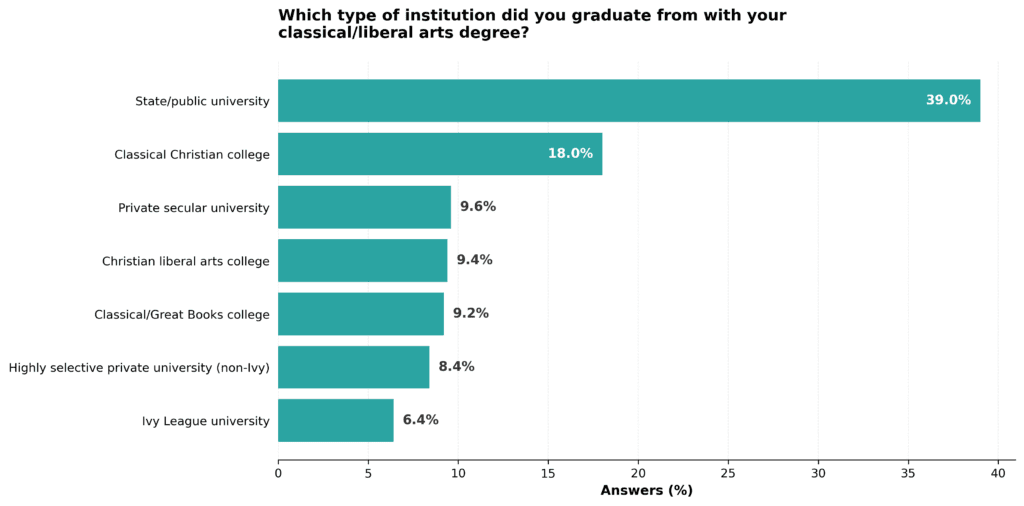
The many different types of higher educational institutions in the US are reflected in our polled group’s answers. 39% graduated with a classical or liberal arts degree from a state or public university, while 18% say they graduated from a classical Christian college; possibly for the reasons mentioned above.
Interestingly, while these institutions remain popular and prestigious, they’re fewer in number than other institutions. According to the National Center for Education Statistics, there are approximately 1,900 to 2,000 public postsecondary institutions in the US, including four-year universities and community colleges. However, these are outnumbered by the 3,900 to 4,000 degree-granting private colleges in total.
As for the rest of our audience, 10% say they graduated from a private secular university, while another 9% say their alma mater is a classical or Great Books college. An additional 9% say they received their degrees from a Christian liberal arts college, again highlighting preferences for faith-based institutions. Only 6% name an Ivy League university, while the remaining 8% say they graduated from a highly selective private university (non-Ivy). The latter two types of institutions are known for their exclusivity due to stringent entrance requirements and high tuition costs.
A Note from the Abbey:
The fact that only 27.4% of respondents attended a Classical Christian or Christian liberal arts college, while 39.1% attended a State or public university and 9.6% a Private secular university, suggests two important features of the Classical education landscape.
First, the value of a classical education does not require adherence to any particular faith but is readily demonstrable through reason and experience. Second, the additional benefit to framing classical education within the Christian tradition, a rich and deeply intellectual tradition that has preserved and sustained the classical tradition itself for centuries, still presents an underutilized opportunity. Even taking into consideration the additional 8.4% of respondents who attended highly selective private universities – some proportion of which may also be Christian institutions – well under half (and potentially under one-third) of respondents received a classical education in the Christian tradition.
Read more about the Christian approach to Truth, Goodness, and Beauty in classical education here >>
Which Best Describes Your Institution’s Approach To The Western Canon Curriculum?
A preponderance of university or college-level classical education graduates describe their institution’s approach to the Western canon curriculum as providing comprehensive coverage across ancient, medieval, and modern periods.
Curriculum approaches differ somewhat:
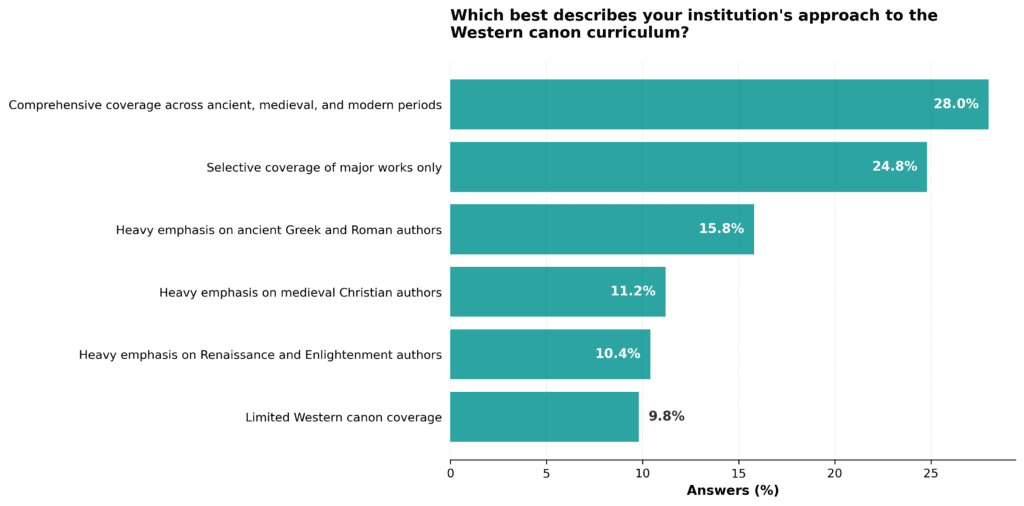
Approaches to the Western canon curriculum are as varied as the institutions attended by the US university or college-level classical education graduates in our poll. Slightly more than a quarter (27%) of our audience says their institution provides comprehensive coverage across ancient, medieval, and modern periods, while slightly less than a quarter (24%) says their institution offers selective coverage of major works only. The latter approach may be due to these institutions’ need to cover a vast period of history in a shorter timeframe – i.e, within two years, rather than four.
15% say their institution emphasizes ancient Greek and Roman authors heavily, while 12% say the emphasis at their institution leans heavily on medieval Christian authors, which may be because those institutions are faith-based. 9% say their institution offers limited coverage of the Western canon, which may be due to inclusivity or decolonization efforts, while another 9% say their institution places heavy emphasis on Renaissance or Enlightenment authors.
It’s interesting that roughly a quarter of our audience received comprehensive coverage over a variety of historical periods, while all other segments received education emphasizing particular works or periods. There’s something to be said for expanding the scope of the Western canon. According to EBSCO, the major reasons for doing so include broadening perspectives by including authors with different views informed by different experiences, to correct the historical exclusion of women, people of color, and minority cultures from the traditional Western canon, to better reflect contemporary society, and to promote literary innovation.
A Note from the Abbey:
While the incarnational reality of human experience certainly invites us to engage a variety of authors and perspectives in the centuries-long and ever lively pursuit of Truth, Beauty, and Goodness, it is important not to neglect the foundational texts of Western culture, which have formed our societies and guided our thinkers for generations.
Thanks to the universal element of human nature, we can ask the same essential questions that Homer and Plato did; we can empathize with the fears and desires of Jane Austen’s characters and follow John Locke’s train of thought. But it is also true that our understanding, as we explore the continued conversation of human culture, ideas, and ideals, deepens and grows richer as we engage with the authors who influenced each other across centuries.
In the great, ongoing conversation that is Western culture, we become more effective and active participants when we understand what others have said and how the greatest authors of antiquity influenced those who came after them: how Enlightenment thinkers influenced the Romantics or how twentieth-century authors responded in their turn.
Which Classical Framework Did Your Institution Teach Most Systematically?
80.5% of university or college-level classical education graduates’ institutions taught the quadrivium or trivium at least informally, formally, or systematically.
Classical frameworks were taught in varying ways:
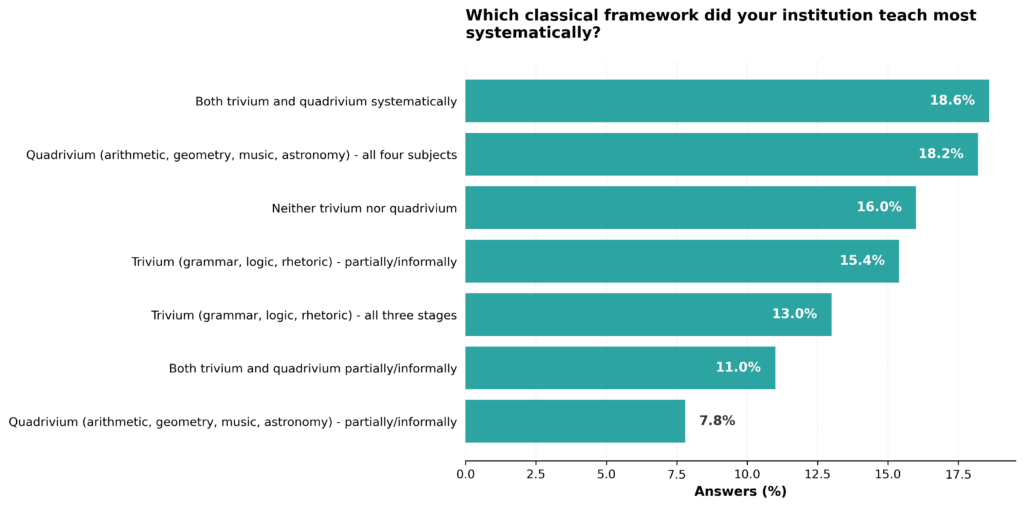
The many different institutions attended by our audience teach classical frameworks in varied ways. Three approaches stood out from the rest. 18% say their institution teaches all four subjects of quadrivium (arithmetic, geometry, music, and astronomy) most systematically, while another 18% say their institution teaches both trivium and quadrivium systematically. This suggests that at least some institutions still value a thoroughly traditional approach to teaching classical frameworks, aiming to do so as comprehensively as possible.
14% of those we polled say their institution teaches trivium partially or informally, while another 14% say they were taught all three stages of trivium systematically. However, 11% say their institution has a partial or informal approach to teaching both trivium and quadrivium, and 7% say their institution teaches quadrivium partially or informally. Another 18% say their institution teaches neither trivium (grammar, logic, rhetoric) nor quadrivium systematically.
That so few institutions take a systematic approach to teaching trivium or quadrivium is possibly due to much of the content of these subjects being outdated when compared to modern STEM and humanities, which many institutions prefer to focus on. It’s highly likely that teaching students modern subjects increases the scope of their potential career opportunities after graduation.
A Note from the Abbey:
The trivium and quadrivium, which comprise the liberal arts, and from which the tradition of classical education springs, offer an essential foundation to any career or vocation because they aim at forming the student for human excellence: to seek the Good and develop our natural gifts. In particular, the trivium – Grammar, Logic, and Rhetoric – cultivate critical thinking, communication, and ordered thought, all of which contribute immeasurably not only to STEM fields but also to personal and professional life as a whole.
Often, systematic approaches, especially to the trivium, occupy primary and secondary school curricula. Systematic instruction in grammar, logic, and rhetoric all lend themselves to the kind of student formation preceding the college or university level, which tends to embrace application, analysis, and synthesis to a greater degree. This may be why comparatively few colleges and universities, in the experience of those polled, employ a systematic approach to these subjects. Classical programs could certainly engage the trivium in robust ways without systematically addressing it.
It is perhaps more interesting to note the comparative lack of systematic attention to the quadrivium, which naturally succeeds the trivium in terms of curricula. The liberal arts traditionally include not only grammar, logic, and rhetoric, but also arithmetic, geometry, music, and astronomy, but many liberal arts programs tend to focus on philosophy, theology, history, literature, and other areas of the humanities. In fact, it would be worth exploring how closely the humanities and the liberal arts have become associated in common parlance, thus effectively comparing ancient and contemporary understandings of what is necessary and sufficient to a full liberal arts education.
Which Single Subject Area Received The Greatest Emphasis As A Core Component Of Your Institution Classical Education Program?
A majority of university or college-level classical education findings show that classical education had the potential for balance across the major disciplines.
Core components of classical education systems show specific areas of focus:
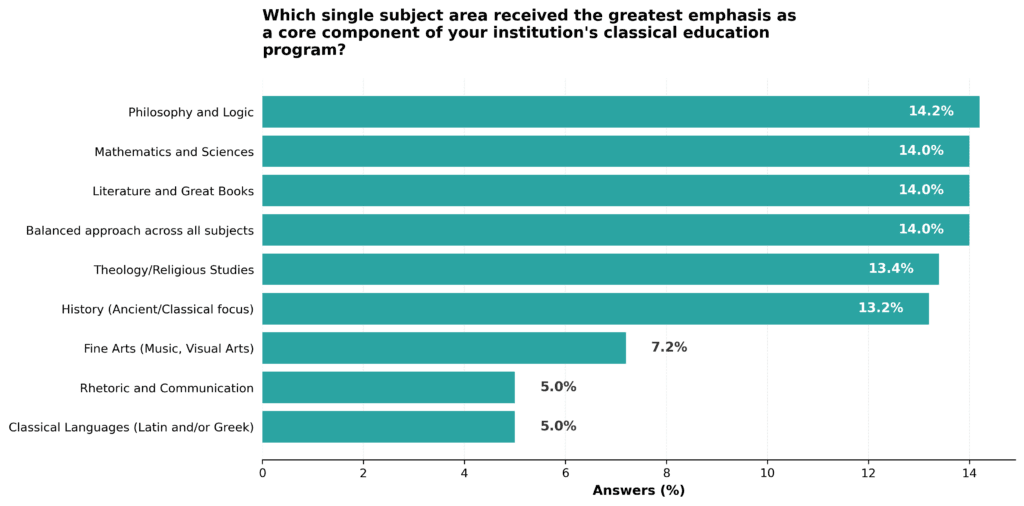
The single subject areas that received the greatest emphasis as a core component of the classical education program vary significantly from institution to institution. Interestingly, no single subject area emerged as a clear leader in our poll. 14% say theology or religious studies received the greatest emphasis, possibly due to them studying at a faith-based institution, while another 14% say their institution places the greatest emphasis on philosophy and logic, highlighting reason, thought, and metaphysics from a secular perspective.
For another 14%, the emphasis is on mathematics and sciences (whether thoroughly classical or modern STEM is unclear), while, for yet another 14%, it’s on literature and Great Books. An additional 14% say their institution places the most emphasis on history, with the focus being on ancient and classical history.
Yet another 14% say their institutions take a balanced approach across all subjects, offering a well-rounded classical education. Only 9% say their institution emphasizes fine arts (music and visual arts) over other subjects. As for the remainder of our audience, 5% say the greatest emphasis is on rhetoric and communication, while another 5% say classical languages, including Latin and/or Greek.
The continued teaching of Latin, which has long been regarded as a dead language, remains a topic of debate in educational institutions. Even though there are no first-language Latin speakers, and the language isn’t used in everyday conversations, there are significant benefits to studying it.
Among these benefits is the advantage that knowledge of Latin offers when studying other languages, particularly other inflected languages such as German or Russian and Romance languages such as Portuguese, Romanian, Spanish, or Italian. The study of Latin can help students in various professions in which many terms or phrases have Latin origins. Additionally, learning Latin allows students to read numerous classical works in their original language, the impact of which can be profound.
A Note from the Abbey:
Classical study approaches great works and ideas as more than artifacts of historic interest. Students read and explore Plato, Aristotle, Rousseau, Dostoevsky, and others not simply because these individuals were significant to their own cultures and times but also because of the essential continuity between past and present.
Certainly those living in ancient Greece or nineteenth century Russia view the world and their place in it differently than contemporary American students do, but across eras and cultures, there are also universals rooted in human nature, objective reality, and natural law. Across all human experience, the driving question of what it means to be human and to live well remains comprehensible. Within and through all cultural expressions, we grapple with the same essential questions, recognizing our own limitations, fears, desires, and characters in the humanity of those who lived across the world thousands of years ago.
By a similar token, no language that connects us to these great thinkers can ever be fully dead.
Particularly within the Catholic liberal arts community, the Latin language has enjoyed a certain renaissance even outside its ongoing liturgical use in the Church. A “Living Latin” contingent advocates for conversational use of the classical tongue, and during international conferences and gatherings of both an ecclesial and scholarly nature, Latin sometimes provides the necessary bridge in communication by offering a common language.
How Would You Rate Your Professors’ Expertise In Classical Texts And Traditions?
73% of university or college-level classical education graduates rate their professors’ expertise in classical texts and traditions as exceptionally to very knowledgeable.
Overall, classical knowledge is high amongst professors:
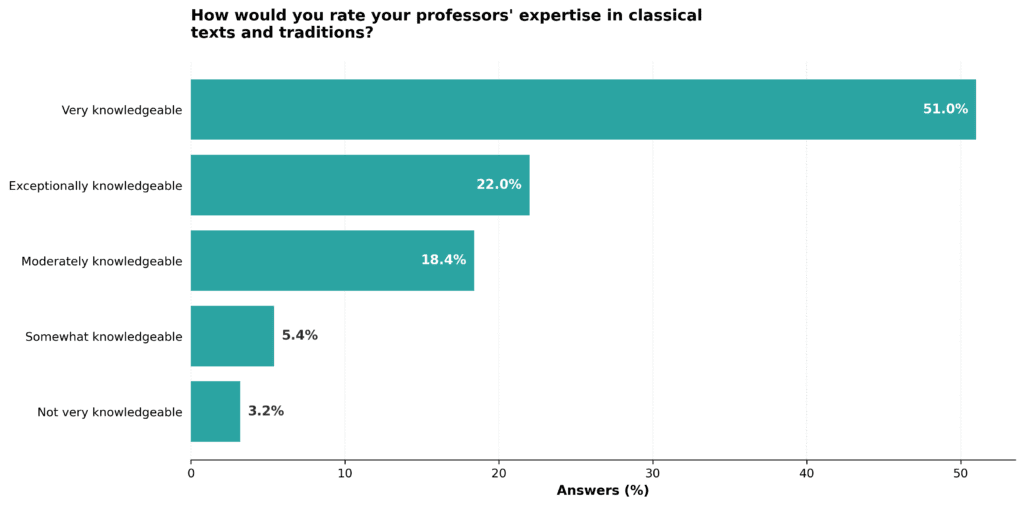
The thought that we live in a country where even some university or college professors are not particularly knowledgeable about various aspects of their areas of expertise is concerning. However, we were pleased to see that most university- or college-level classical education graduates polled hold a high regard for their professors’ expertise in classical texts and traditions. 50% say their professors are very knowledgeable, while 23% describe their professors as exceptionally knowledgeable.
The rest of our audience was somewhat less generous in their assessments, with 18% saying their professors are moderately knowledgeable and 5% saying theirs are somewhat knowledgeable. Only 3% say their professors are not very knowledgeable.
Which Of The Following Best Describes Your Primary Career Path Since Completing Your Classical Education?
Our survey shows that a classical education prepares students for virtually any career with the largest proportion of respondents pursuing a business executive or management position.
Career paths reflect similar trends for graduates:
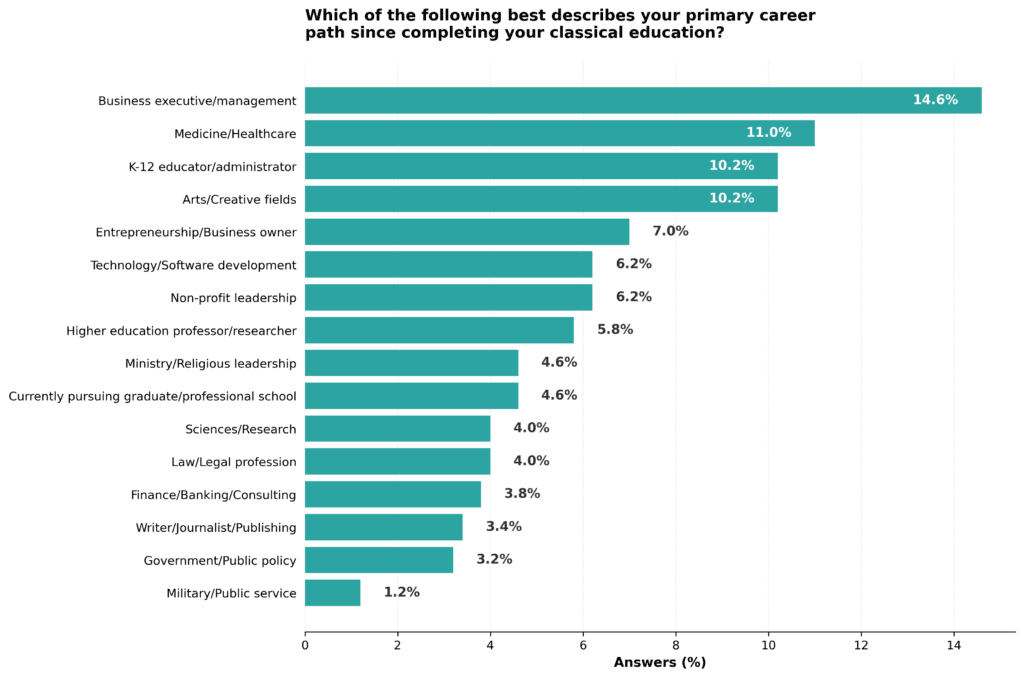
A classical education can open doors to a wide range of career opportunities or provide a solid foundation for studies in preparation for various professions. 16% of those we polled say their primary career path since completing their education has been that of a business executive or in management, suggesting their courses may have emphasized subjects such as mathematics or philosophy.
For 8%, their career path has been in technology or software development, both of which are built on the foundations of logic. Another 8% followed a career in nonprofit leadership, while an additional 8% entered ministry or religious leadership. It’s likely these graduates studied at a faith-based university or college for this purpose.
Yet another 8% say their career path has been in medicine or healthcare. K-12 educator or administrator best describes the path of 8%, while an additional 8% became higher education professors or researchers, indicating they opted for further studies after completing their bachelor’s degrees. 8% became entrepreneurs or business owners, another 8% say they’re currently pursuing graduate or professional school, and 8% found employment in the arts or creative fields.
A Note from the Abbey:
The fact that classical graduates go on to a comparatively wide variety of careers indicates that this education provides an effective foundation across numerous fields and disciplines. The kinds of skills that classical, liberal arts education cultivates are profound assets to many careers because they develop fundamental human capacities and understandings.
At its best, classical study forms essential analytic and communication skills, while the Socratic seminars typical of classical programs exercise creativity, intellectual honesty, empathy, and collaboration. The greater proportion of business executive and management employees among the classical graduates polled perhaps highlights this character of classical education, which blends interpersonal, communication, and critical thinking skills so effectively.
Alongside the broad applicability of classical programs, it is also worth noting that institutions that combine a classical or liberal arts approach with options for more career-specific programs might have particular impact. For this reason, in addition to the full, eight-semester complement of Great Books courses, Belmont Abbey’s Honors College offers alternative credit level options, which enable students to study Great Books as a major or a minor while simultaneously completing another major, reaping the significant benefit of classical formation alongside a more field-specific education.
Which Skill From Your Classical Education Do You Utilize Most Frequently In Your Current Work?
28% of university or college-level classical education graduates use the critical thinking and analysis skills they learnt from their education most frequently in their work.
Multiple skills are used by graduates in the workplace:
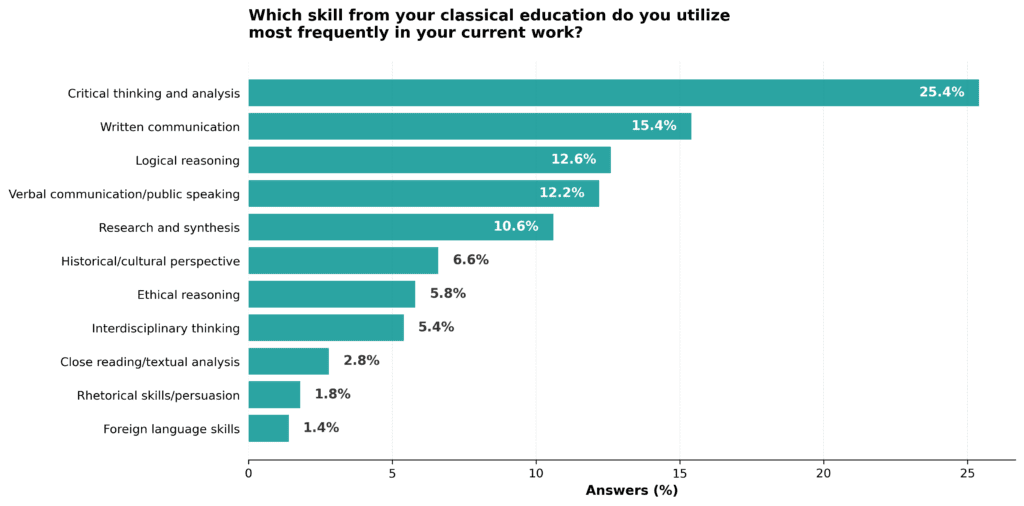
Classical education equips students with a range of skills that can be put to good use in a variety of job roles. More than a quarter (28%) of the university or college-level classical education graduates we polled say the skill they use most frequently in their current work is critical thinking and analysis. This finding is unsurprising, as the World Economic Forum’s Future of Jobs Report 2025 reveals that 69% of employers regard analytical thinking as an essential skill. The second most mentioned skill is written communication (17%), followed by verbal communication or public speaking (11%).
Another 11% say they use research and synthesis skills most frequently, and yet another 11% say they use logical reasoning, which is reinforced by subjects such as mathematics, the sciences, philosophy, and logic. The skills mentioned by the remainder of our audience include interdisciplinary thinking (6%), historical/cultural perspectives (6%), ethical reasoning (6%), and close reading or textual analysis (6%).
How Satisfied Are You With The Outcomes Of Your Classical Education?
77% of university or college-level classical education graduates are satisfied with the outcomes of their education.
The majority are satisfied with their education:
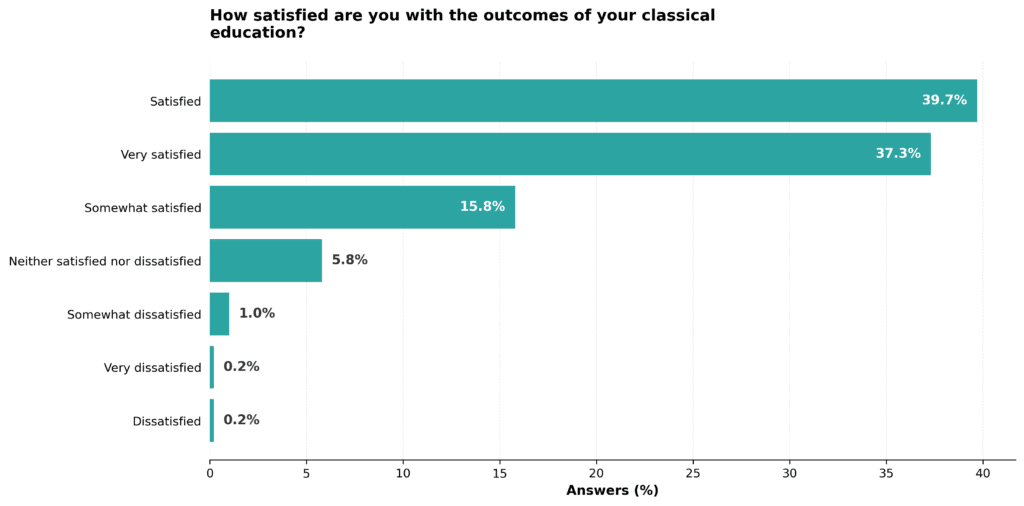
Our poll found that the majority of university or college-level classical education graduates were relatively satisfied with the outcomes of their education. 39% say they’re very satisfied, while another 37% say they’re satisfied, and 16% say they’re somewhat satisfied.
This suggests that the education they received played a role in opening doors to various careers and allowing them to advance in their chosen career pathways. Only 6% say they are neither satisfied nor dissatisfied. No respondents reported dissatisfaction at any level.
How Likely Are You To Recommend Classical Education To Prospective Students?
67% of university or college-level classical education graduates are extremely likely or very likely to recommend classical education to prospective students.
Classical education comes highly recommended:
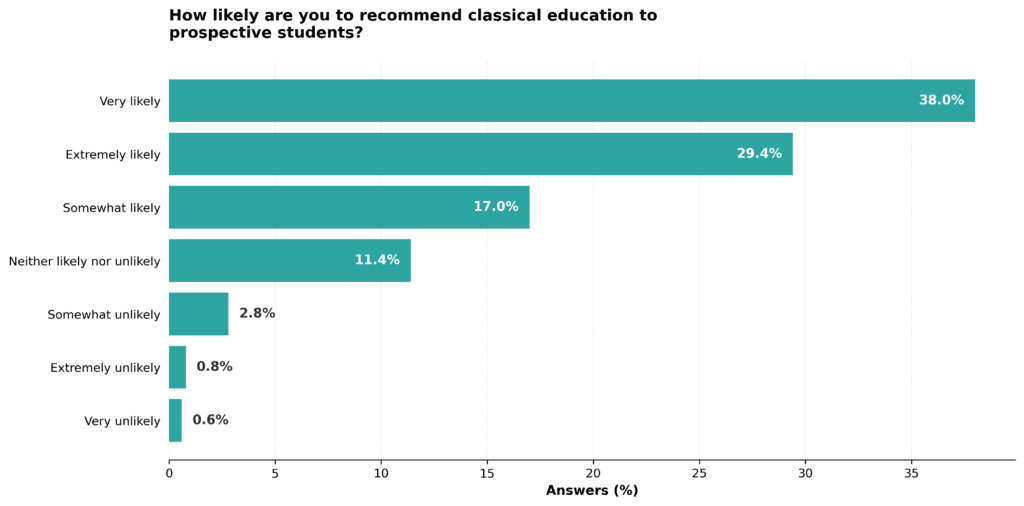
Given the high levels of satisfaction, the skills graduates use, and the varied career paths mentioned earlier in this article, it’s not surprising that the majority of those we polled are happy to recommend classical education to prospective students. More specifically, 38% say they’re very likely, while 29% say they’re extremely likely to recommend it. 17% say they’re somewhat likely to make a recommendation.
However, not everyone in our audience was as committed or enthusiastic about classical education, with 11% saying they’re neither likely nor unlikely and 2.8% saying they’re somewhat unlikely to recommend it.
Regardless of whether graduates encourage or discourage prospective students to choose this academic path, it must be recognized that recommendations by people carry weight. 92% of consumers trust recommendations from friends or family, and 84% trust recommendations from peers, over adverts.
If You Could Start Over, Would You Still Choose Classical Education?
76.4 % of university or college-level classical education graduates would likely still choose classical education if they were to start over.
Classical education remains a top choice:
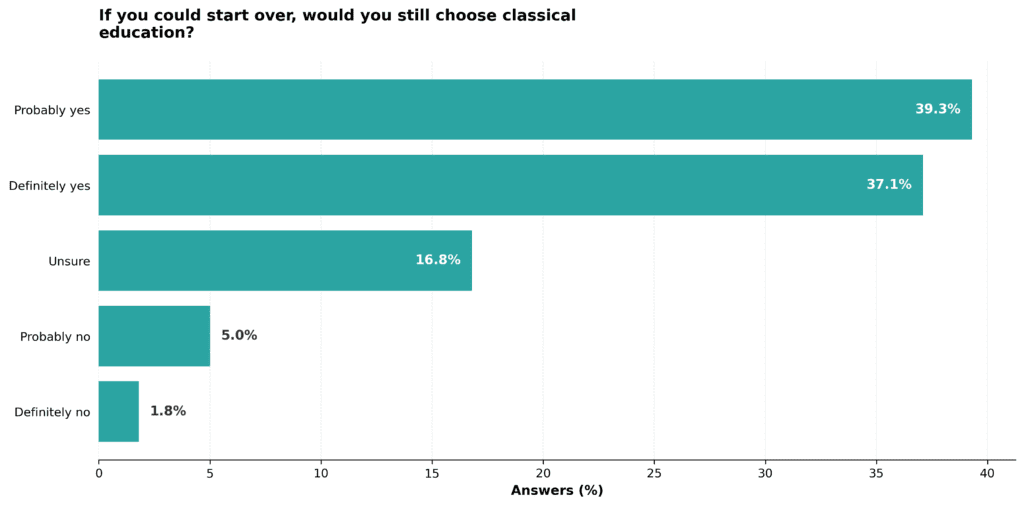
We weren’t surprised to find that the majority of our audience believes they made the right decision regarding their higher education and that, given the opportunity, most would be likely to choose classical education again. Among those who say they would, the degrees of certainty were either ‘probably’ (39%) or ‘definitely’ (37%).
16% of those we polled say they’re unsure, while 5% say they probably wouldn’t, and 1.8% say they definitely wouldn’t choose classical education if they could start over. Those who express uncertainty or refusal are likely among the graduates who expressed neutrality when asked about their level of satisfaction, and those who aren’t likely to recommend classical education to prospective students.
This suggests that, for at least some graduates, the courses they studied, or their career trajectories, did not meet their expectations. It’s also possible their responses were influenced by their experiences as students, such as which subjects were emphasized or how knowledgeable their professors were.
A Note from the Abbey:
It is interesting to consider these three final questions side by side, since even though only 1.4% of participants expressed dissatisfaction with the outcomes of their education (and only 5.8% indicated ambivalence), 6.8% of participants anticipate they would choose not to pursue classical education if they could start over (with an additional 16.8% unsure), while only 4.2% of participants were unlikely to recommend classical education to prospective students (and 11.4% remained ambivalent).
Since the outcomes of classical education received overwhelmingly positive acknowledgement, the effectiveness of such programs and the personal enrichment attendant on this formation seem not to be at issue. It seems probable, rather, that some external factor or factors exert pressure on those participants who would – despite admitted satisfaction with the outcomes – choose a different course if faced with the same decision. The fact that the number of participants unlikely to recommend classical education to prospective students remains smaller than the number who would choose differently for themselves also suggests that personal factors are more likely at issue than the value of the education itself. Such factors might well involve the cost of education and the rising problem of student debt. If participants were swayed primarily by changing attitudes toward education itself, we would expect roughly the number to provide negative responses to both of the final questions.
Classical Study Shaping Modern Careers
Overall, it’s easy to see that classical education in the United States continues to prove its relevance in a rapidly changing world. Grounded in enduring texts, disciplined reasoning, and a broad intellectual tradition, it equips graduates with adaptable skills that extend well beyond the classroom.
Whether applied in leadership, professional practice, or lifelong learning, the principles of classical study remain a strong foundation for thoughtful engagement, ethical decision-making, and meaningful contribution across careers and communities.
About The Data
Sourced from an independent Artios poll of 500 University or college-level classical education graduates in the US. Responses are collected within a 95% confidence interval with a 5% margin of error.
Graduate demographics:
- 55% of university or college-level classical education graduates in the US are between the ages of 22 and 44.
- 56% are employed full-time
- 51% identify as female and 49% as male
- 20% earn between $50,000 and $74,999
- 85% speak no second language
- 67% are classified as white
- The highest number (12%) is in Florida.