
Looking at things in “monastic time”
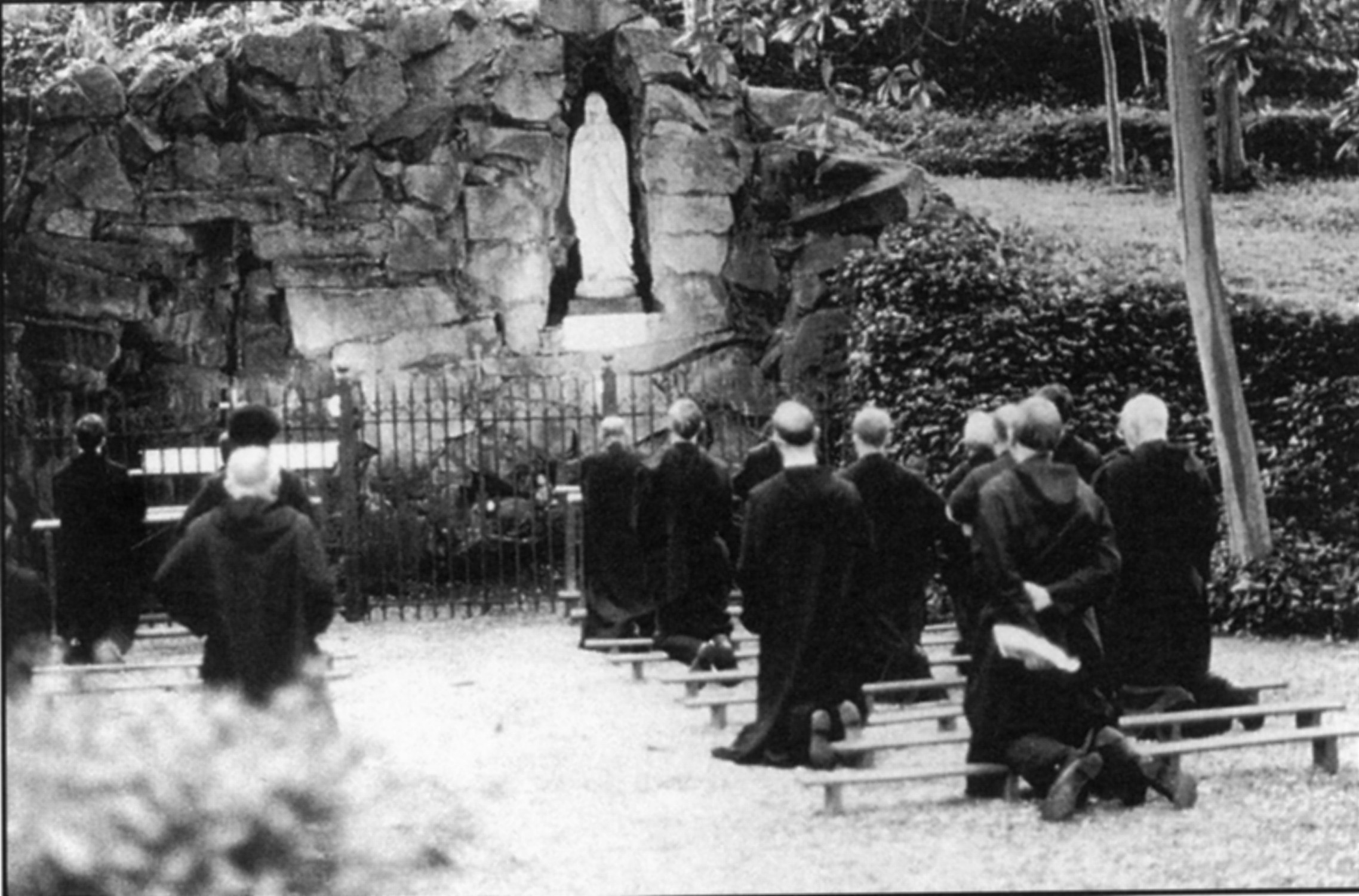
Those of us here on the Belmont Abbey campus sometimes joke about “monastic time.” It’s a quip we’ve borrowed from the monks themselves, though it would be hard to imagine actually applying it to their faithful work, despite their good-humored self-deprecation. In the course of our teaching or administrative work, however, if some objective seems slow in approaching or a goal aims far in the future, we can always tease ourselves with the playfully applied truth: that this is just the monastic way. In an overarching, historical sense, the scale of Benedictine time responds to a 1500 year tradition, after all; its units are more properly centuries than days or weeks. But even on an individual scale, the Abbey monk lives his life in view of eternity.
To be clear, Benedictine monks absolutely get things done. One look at Belmont Abbey history shows dozens of visionary servant-leaders who built and sustained this college and community over the last 150 years, bringing it by the grace of God from two students and a few, old farm buildings to a thriving community of 1700+ and a campus full of beautiful, historic architecture. But in looking back at Abbey history, it’s important to remember that these men didn’t always see the fruits of their labors, which unfolded slowly across generations. They didn’t need to see what would come or know how long it would take. Being human, of course, they may have wondered, but they also drew strength and perspective from a community whose way of life, sense of priority, and attitude toward time look ever more radical by today’s standards.
In the monastery, the daily rhythms are steady and consistent, cultivating a faithful interior space in which to await the still, small voice so easy to miss in our urgent, polarized, and media-saturated world. Those of us outside the monastery are bombarded by a culture that believes everything should be immediate, gratifying, and accessible. And while there are many advantages to modern technology, it can all too quickly drown us in a bizarre cocktail of anxious complacency. Relative to the fragmentary whirl of contemporary life, a monk’s ordered balance of prayer and work, ora et labora, seems almost like slow motion – largely because the Benedictine looks to the eternal.
The structures of our daily lives might differ from a Benedictine monk’s – just as our particular callings are different from his — but something in the idea of monastic time remains necessary to all of us. The invitation to do faithfully the work and prayer of today, trusting to a scale of time and a divine plan that far exceed what we can see or predict, might be more explicit in the Benedictine life, but it belongs to each of us in our shared vocation as human beings. Eternity is not an abstraction unconnected with earthly life. The monks of Belmont Abbey live in its light while embracing, without contradiction, the paradox of stability in a particular time and place. Likewise, orienting ourselves toward eternity doesn’t detach us from our humanity but illuminates its dignity, echoing the reality of sacrament and the mystery of the Incarnation, the eternal Word made flesh.
Changing our perspective is not easy, and personally, I still have a long way to go. But I think in the end the key is, well… time. In the end, the time we give to God — in prayer or work or leisure — participates in eternity. And if we set aside even ten minutes each day with no other purpose than directing our attention to Him, our eternal home – if we sit in what is sometimes very uncomfortable and distracted quiet and just keep trying to turn our eyes back to Him – those moments can help to orient us. They can remind us that all time points toward its eternal source. That no moment is defined by itself alone. And that it is never our responsibility to worry about outcomes or timing. Every day the monks’ patient witness reminds us: just leave those to God.