Abbey Alumni, Future Priests: Diocesan Seminarians receive a Belmont Abbey formation
By: Hannah Martin ‘26
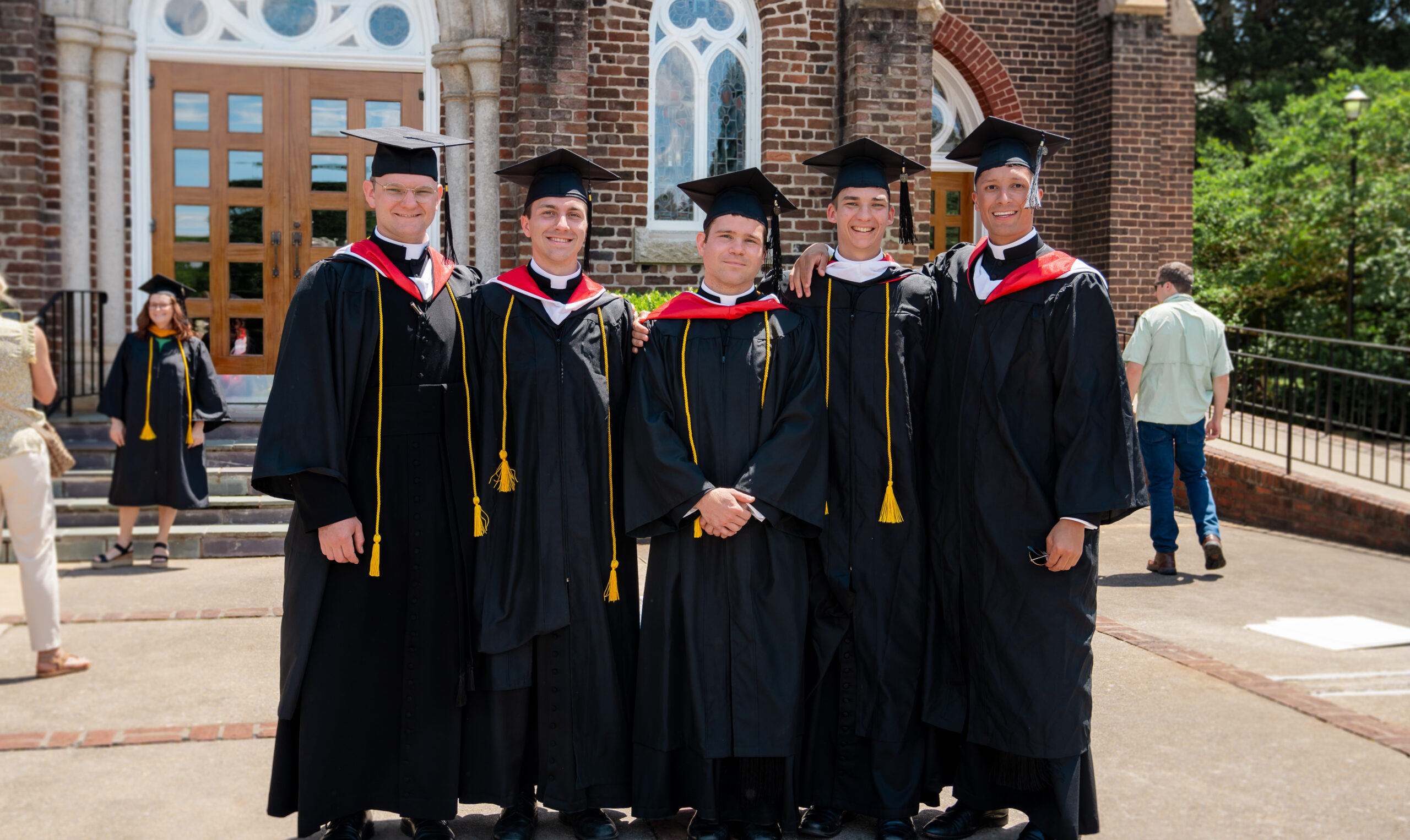
If you visit Belmont Abbey College, you might notice young men in cassocks and backpacks heading to class. As it happens, our connection with the local Catholic seminary just minutes away from campus is a little-known but important fact of college life. St. Joseph College Seminary enjoys a special relationship with the Abbey, and seminarians earn their BA in Philosophy here while living down the road in a house of formation.
These young men navigate the question we must all consider: What is my calling, the living purpose God created for me? The discipline and structure of life in the college seminary minimize distractions and allow seminarians the time and clarity to ask this question and discern the answer: not as a disembodied, heavenly voice, but as the patient unfolding of life in formation. One seminarian suggested that even in a purely practical sense, “A well-ordered daily routine and schedule is extremely beneficial to all aspects of your life.”
Seminarians discern their vocation through honest striving in prayer and community, which reveals over time whether or not a young man was made for this way of life he’s chosen to explore. Seminary formation focuses on cultivating a deep prayer life, practicing the cardinal virtues, developing intellectual gifts, and embracing opportunities for pastoral charity. Assisting at Mass, praying the Liturgy of the Hours and the Rosary, and setting aside time for Adoration establishes a daily life rooted in sacramental grace, and regular spiritual direction guides each seminarian’s journey. This framework of prayer and formation also orients seminarians’ studies, sports, and work and thus helps them seek God’s will throughout all parts of their lives. Ultimately, the seminary enables men to discern their vocations by discovering who they are.
Likewise, Belmont Abbey College strives to form students as the men and women God created them to be. We seek to cultivate a rich faith life rooted in the sacraments and monastic prayer – so that, from this rootedness, our students may thrive in excellence and virtue. Our mission “is to educate students in the liberal arts and sciences so that in all things God may be glorified. …provid[ing]… an education that will enable [students] to lead lives of integrity, to succeed professionally, to become responsible citizens, and to be a blessing to themselves and to others.” “Lives of integrity” necessitate the active self-knowledge that embraces our personal callings, through which alone we become most authentically “a blessing to ourselves and others.”
As part of daily campus life, seminarians offer a visible reminder of the vocation each of us has within. College is a time for young people to grow and discern God’s will for their lives within their degrees, careers, and vocations. It is our duty as a college to foster this discernment, and we strive to provide the tools and the resources students need to become fully themselves. Professors, coaches, faculty, and friends support students throughout their term, while the monastery maintains a prayerful stability at the very heart of campus life, offering friendship, guidance, and sacramental nourishment to the entire Belmont Abbey community. The seminarians’ presence on campus, however, and their integration into academic life, brings close an added and regular witness to committed discernment and inspires all of us to consider more seriously who it is God created us to be.
Since our founding in 1876, Belmont Abbey has played an active role in the life of the Catholic Church in the American South, not only providing a Benedictine liberal arts education but also ministering to North Carolina parishes and communities from the time when the state was considered “mission territory” to the recent past. Abbot Leo Haid presided as bishop over the entire state until the establishment of the Raleigh Diocese in 1924, and from 1890 until 1937 the college itself offered seminary formation, so we are particularly grateful to continue this legacy by providing an undergraduate education to the future priests of the Charlotte diocese.