
As a Benedictine institution rooted in the hallmarks of stability, hospitality, community, and love, Belmont Abbey College has brought to the field of nursing education an unwavering emphasis on exceptional, compassionate, and ethical care. It has been our joy to form nurses who enter the healthcare system well prepared to meet the growing needs of our Gaston County home and beyond.
As part of our dedication to advancing the field and providing the highest quality education to future nurses, Belmont Abbey recently commissioned a study to explore the experience of college-educated nurses within the healthcare industry after graduation. It is our hope that these findings will contribute to an essential and ongoing conversation that bears with such urgency on the health of our communities.
Nursing Education Statistics: US 2026
In the US, there are various educational pathways you can follow if you want to take the standardized National Council Licensure Examination (NCLEX)-RN and become a nurse. These include a diploma, an associate degree, a bachelor’s degree, a master’s degree, a PhD program, and doctoral programs. With so many options, it’s natural for those considering a nursing career to wonder which path they should follow and whether their potential career choice is worth it.
To gain a better understanding of nursing education, we sourced data from an independent poll of 500 college-educated nurses in the US. The responses to various questions ranged from the expected to the surprising and beyond. Here’s what we found.
Index
- A Bachelor of Science in Nursing (BSN) is the highest level of education completed by 44% of college-educated nurses in the US
- 18% of college-educated nurses in the US say pediatric nursing best describes their primary career path since completing their nursing degree
- 34% of college-educated nurses in the US have worked in three different nursing roles or specialties since graduating
- 41% of college-educated nurses in the US say “excellent job security with multiple opportunities” best describes job availability in their nursing career
- 22% of college-educated nurses in the US say career advancement into leadership is the primary opportunity their nursing degree has opened for them
- 31% of college-educated nurses in the US find making a difference in people’s lives the most rewarding
- For 32% of college-educated nurses in the US, maintaining work-life balance is the primary challenge
- 25% of college-educated nurses in the US secured their desired nursing role within six months of graduating
- 55% of college-educated nurses in the US say they would still choose nursing as a career if they could start over
- 39% of college-educated nurses in the US say they are extremely likely to recommend nursing as a career to prospective students
- 19% of college-educated nurses in the US say the most important advice they would give to those considering a nursing career is to find strong mentors early
- The Bottom Line
- Methodology
What Is Your Highest Level Of Education Completed?
A Bachelor of Science in Nursing (BSN) is the highest level of education completed by 44% of college-educated nurses in the US
The nurses in our poll have different levels of education:
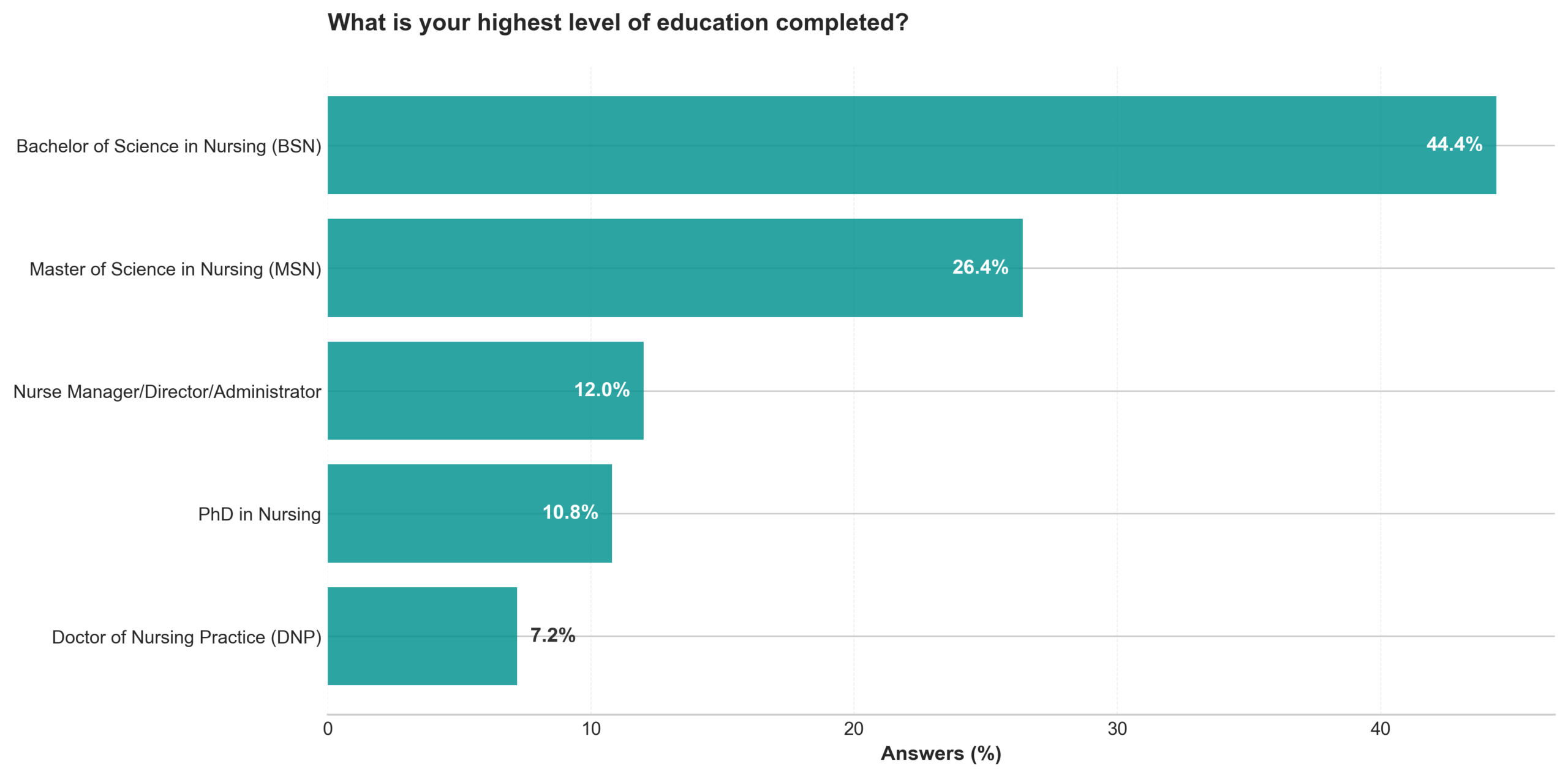
The highest level of education completed by almost half (44%) of our audience is a Bachelor of Science in Nursing (BSN). The popularity of this qualification may be due to it offering higher earning potential and more career opportunities than an Associate Degree in Nursing (ADN). For 26%, their highest education level is a Master of Science in Nursing (MSN), which is an entry-level degree for advanced roles such as nurse educator and clinical nurse leader.
12% have completed nurse manager, director, or administrator courses, and 11% have a PhD in nursing. Only 7% have completed a Doctor of Nursing Practice (DNP) qualification. This suggests slightly more than half of our audience is focused on building their careers to advance beyond basic nursing roles.
Our findings are somewhat different from those published by the American Association of Colleges of Nursing (AACN), indicating nurses’ education levels in 2022. That year, 72% of the registered nurse workforce had a baccalaureate or higher degree as their highest level of nursing education, as this would give them better career prospects. 72% of employers strongly prefer baccalaureate-prepared nurses, while 28% require new hires to have a bachelor’s degree. 17% had a master’s degree and 3% had doctoral degrees.
How Many Different Nursing Roles Or Specialties Have You Worked In Since Graduating?
34% of college-educated nurses in the US have worked in three different nursing roles or specialties since graduating
Role-changing in nursing is certainly not unusual:
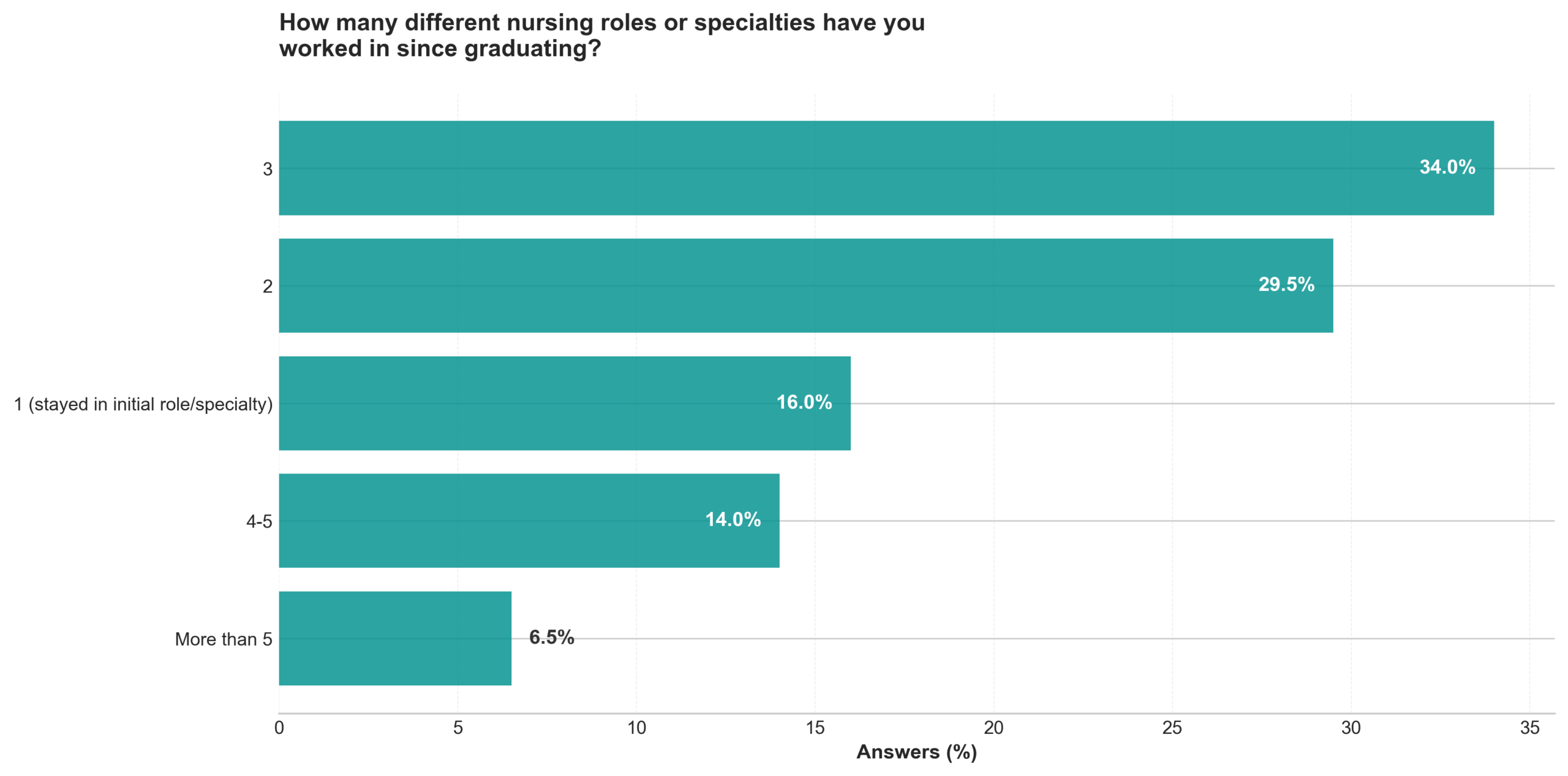
Of our audience, 34% say they have worked in three different nursing roles or specialties since graduating from college. A slightly lower percentage (30%) say they have worked in two roles. 16% have only worked in their initial role or specialty, while 14% have experience in four to five different roles. Only a small percentage (7%) have worked in more than five roles or specialties since graduating.
There are various reasons why some nurses remain in their initial role while others diversify their careers to work in different roles. Some may choose not to specialize because they derive enough satisfaction from their initial role. Others might not be able to afford the additional studies required for specialization.
Among those who have worked in several different roles, some may be motivated by the challenge of learning new things or want to advance their career for the sake of accomplishment, prestige, and better earnings.
According to Nurse Journal, the top five specialty career choices for nurses include certified registered nurse anesthetist, adult-gerontology nurse practitioner, certified nurse midwife, family nurse practitioner, and women’s health nurse practitioner.
84% of respondents noted one or more changes in their roles or specialties since graduation, and while the full weight of this statistic depends on the number of years since graduation, the fact that comparatively few nurses remain in the same position still highlights one of the many benefits of a nursing degree: it helps to prepare nurses for a variety of possible roles.
Completing such a degree could also assist prospective nurses in better discerning the type (or types) of work they wish to pursue within their chosen field, potentially increasing the likelihood of their remaining in that speciality or role. Greater stability would benefit the field, as nurses would bring years of experience to their roles, benefiting not only their own patients but also younger, mentee nurses.
It is also worth noting that, according to a recent AMN Healthcare survey of 12,171 nurses, 61% of respondents planned to change their current position or employment status within 12 months, which seems to confirm a high level of turnover and role-shifting within the nursing field.
Which Statement Best Describes Job Availability In Your Nursing Career?
41% of college-educated nurses in the US say “excellent job security with multiple opportunities” best describes job availability in their nursing career
There are different experiences when it comes to job availability:
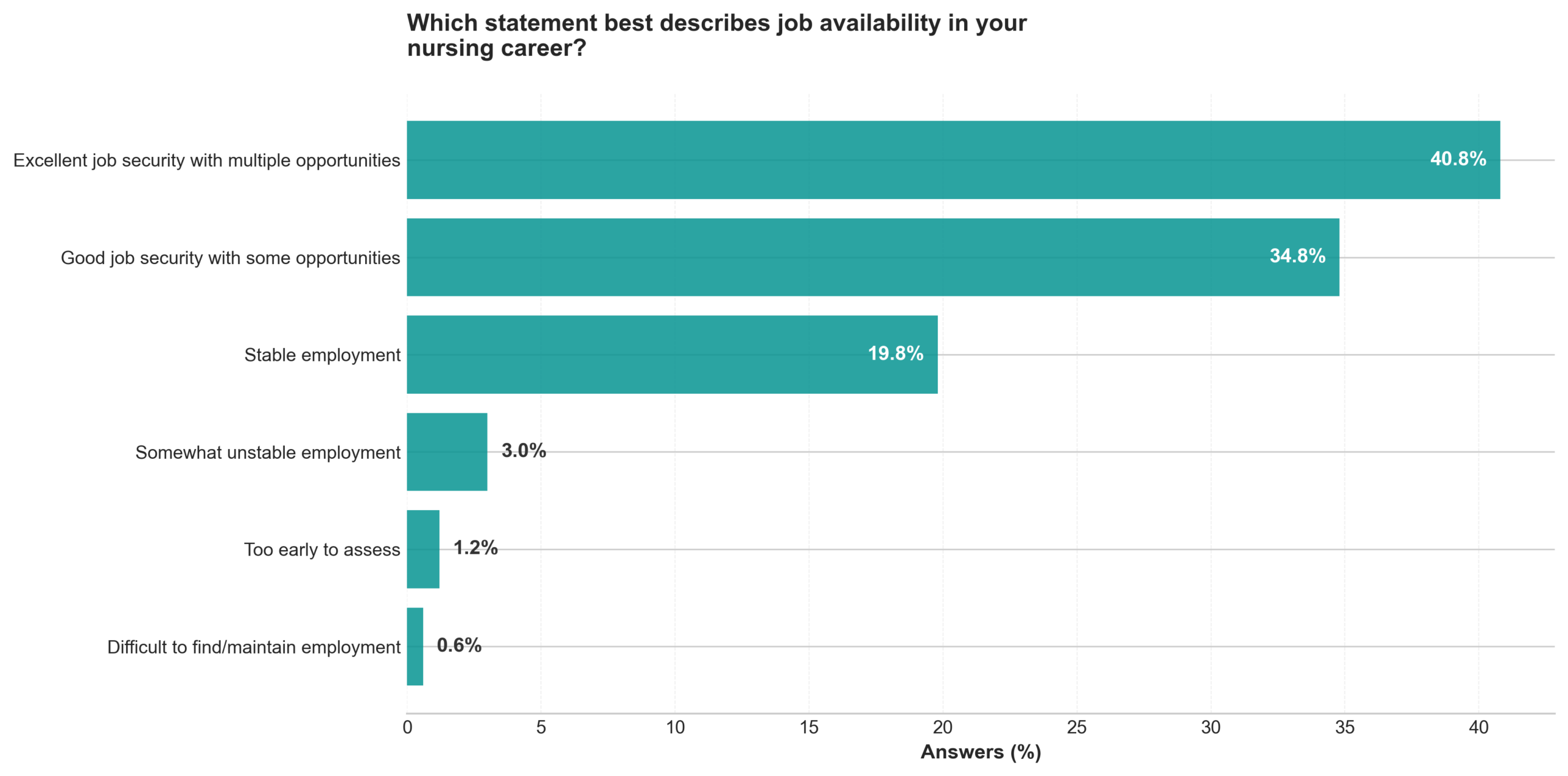
Job availability hasn’t been an issue for almost half of our audience (40%), who say they have excellent job security with multiple opportunities. Considering the shortage of nurses in the US mentioned above, it’s not surprising that this percentage has had a positive experience so far. 35% have had a somewhat similar experience, saying they have good job security with some opportunities.
Another 20% say they have stable employment, while just 3% say they have somewhat unstable employment, and 1% say it’s too early in their careers for them to assess job availability.
Surprisingly, a fifth of our audience didn’t mention having job opportunities, and a small percentage said their employment isn’t stable. According to the Health Resources and Services Administration, there was a 1% increase in the number of registered nurses but a 3% increase in demand between 2022 and 2025. With a deficit of around 295,800 nurses around the country, nurses should have no trouble finding stable employment and exciting career opportunities.
It is well worth noting that over 95% of respondents identified their employment security as stable or better, with over 75% claiming good or excellent security. A dramatic majority of college educated nurses, then, indicate strong job security.
The Benedictine hallmark of stability means that our monks and, by extension, our college community, remain dedicated to living out the Abbey’s mission, rooted in this particular place. The needs of our county, our state, and our country inform the prayers and work of Belmont Abbey and its apostolate, Belmont Abbey College, as we seek to serve our home. Responding to the healthcare crisis and the growing shortage of nurses in our communities, Belmont Abbey both welcomed the construction of a new hospital on Abbey land and established a Nursing program steeped in Benedictine values. It is our hope that this will contribute materially to the health and wellbeing of the place we have called home for 150 years.
What Is The Primary Opportunity Your Nursing Degree Has Opened For You?
22% of college-educated nurses in the US say career advancement into leadership is the primary opportunity their nursing degree has opened for them
A nursing degree can open doors to an impressive range of career opportunities:
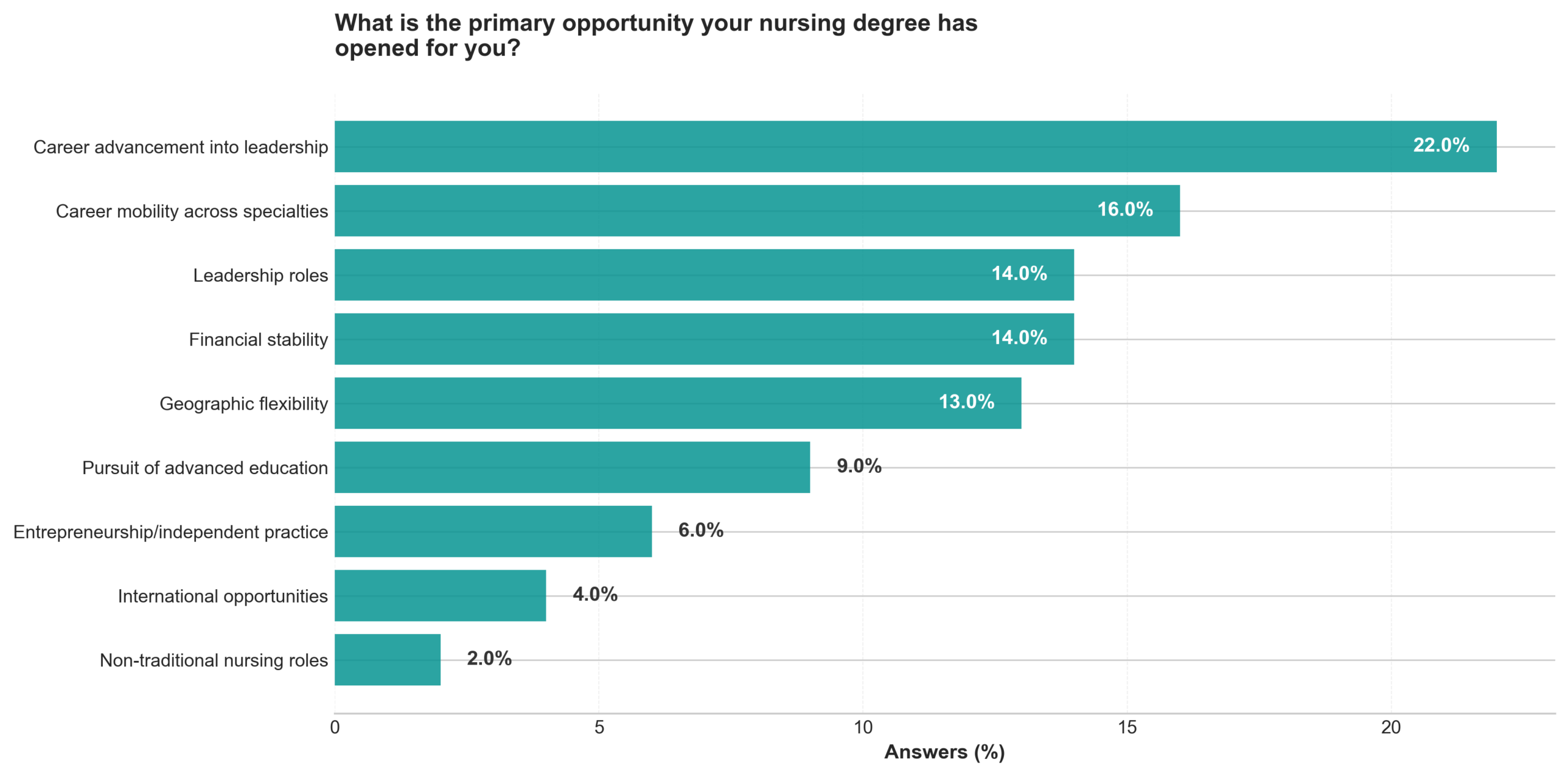
For 22% of our audience, the primary opportunity their nursing degree opened was career advancement into leadership. According to CareRev, these positions may include nurse manager, charge nurse, director of nursing, chief nursing officer, clinical nurse leader, or nurse educator, among others. 16% of our audience say their degree has provided them with career mobility across specialties, suggesting they benefit from diversity while potentially working their way into leadership positions.
For 14%, the primary opportunity has been financial stability, while another 14% mention leadership roles. 13% say geographic flexibility is their main opportunity, suggesting they have been able to work in different locations around the US.
The pursuit of advanced education is what 9% of our audience name, and 6% say their main opportunity is entrepreneurship or an independent practice. Among the entrepreneurial roles nurses can fulfill are medical spa nurse, career coach, script consultant, home health nurse, specialist care provider, and wellness coach.
As for the rest of our audience, 3% say their degrees opened international opportunities, implying they’ve been able to work in countries such as Australia, Canada, or the UAE, and 2% say they’ve had the chance to work in non-traditional nursing roles.
Belmont Abbey College is committed to forming young men and women for leadership across a variety of fields, among which healthcare occupies an essential place. The healthcare industry needs nurses who are prepared to face the profound challenges and pressures of their vital work, equipped not only with the necessary skills, knowledge, and hands-on experience to treat their patients, but also the ethical grounding to evaluate complex circumstances and respond to these with clarity and compassion.
While a nursing degree, in itself, opens up leadership opportunities, the Abbey’s B.S. in Nursing seeks to provide the best possible foundation for assuming these leadership roles. State of the art labs, expert instructors, and rigorous coursework are all critical, but so is a foundation in the Benedictine hallmarks that have inspired men and women in a centuries-long tradition of service to the Good. Great leaders combine expertise with integrity and wisdom, and Belmont Abbey College designed our Nursing program to help our students develop as exceptional professionals and virtuous servant leaders.
If You Could Start Over, Would You Still Choose Nursing As A Career?
55% of college-educated nurses in the US say they would definitely still choose nursing as a career if they could start over
Even an opportunity to start over doesn’t change everyone’s career path:
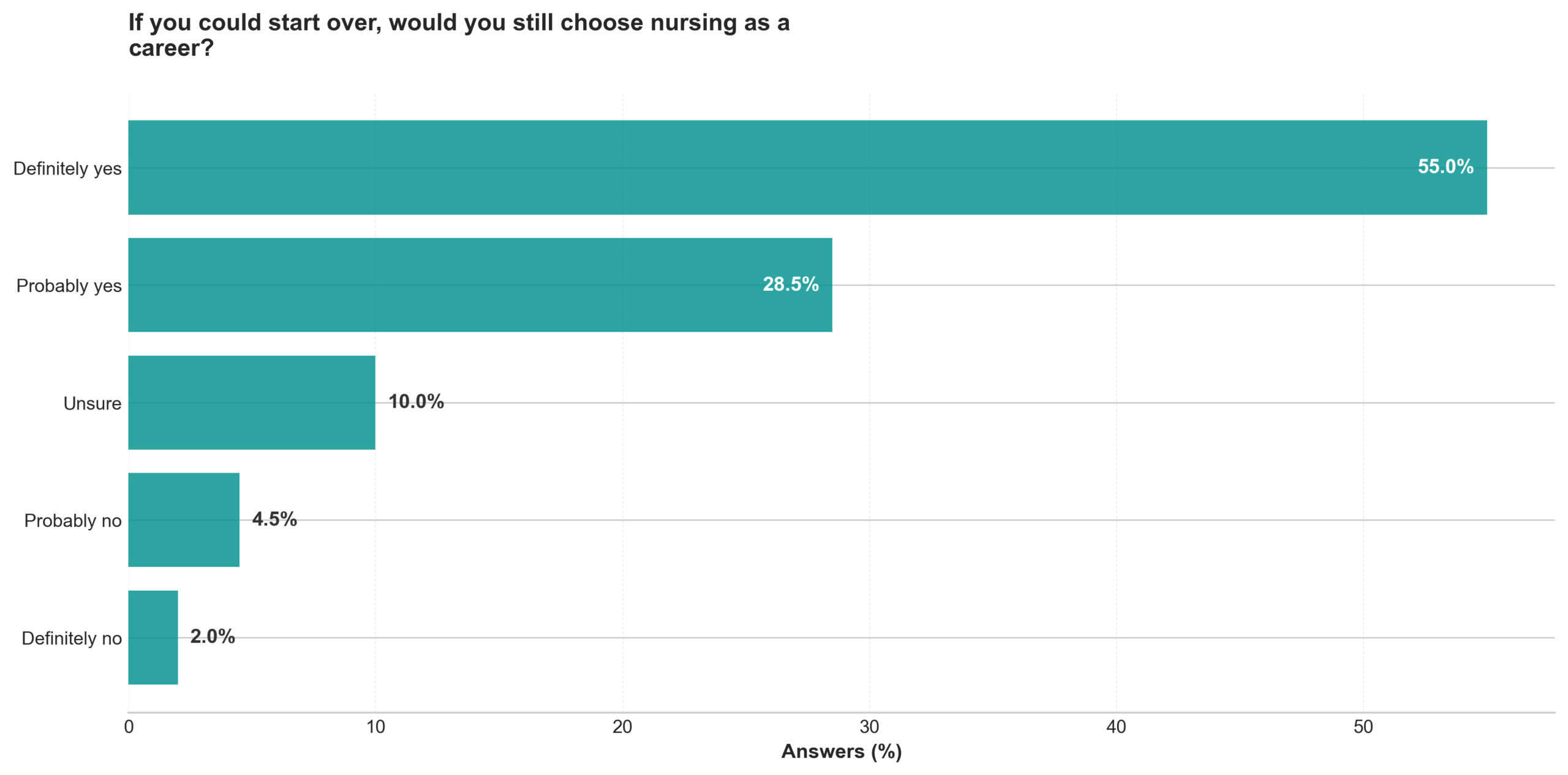
Things don’t always work out as planned, and that’s as true for career choices as it is for anything else in life. On the topic of whether they would still choose nursing as a career if they could start over, 55% of our audience say they definitely would, although 29% are less confident, saying they probably would. This implies these segments of our audience enjoy a great degree of job satisfaction, even if the work they do presents challenges from time to time.
While 10% say they’re unsure they would choose the same career, 5% say they probably wouldn’t. Only 2% say they definitely would not choose nursing again. The attitudes of these audience segments may be due to their experiencing job dissatisfaction.
Research published by the HRSA in 2024 revealed that the percentage of nurses who expressed some dissatisfaction with their job increased from 11% in 2017 to 20% in 2022, with nurses with patient care responsibilities experiencing a greater decline in satisfaction than those without these responsibilities.
Additionally, job satisfaction declined in 20 of the 21 clinical specialties in the same period. The most common reasons nurses gave for switching nursing jobs after December 31, 2021, included burnout, staff shortages, and a stressful work environment.
Comparing participants’ dissatisfaction rate (16.5% answering unsure or in the negative) with the 20% identified by HRSA’s research, it is worth noting that nurses with a college degree seem to express somewhat lower rates of dissatisfaction with their career choice. Whether attributable to more comprehensive preparation or better opportunities, a degree seems to increase the likelihood of satisfaction in Nursing.
How Likely Are You To Recommend Nursing As A Career To Prospective Students?
39% of college-educated nurses in the US say they are extremely likely to recommend nursing as a career to prospective students
Nursing as a recommended career comes highly rated:
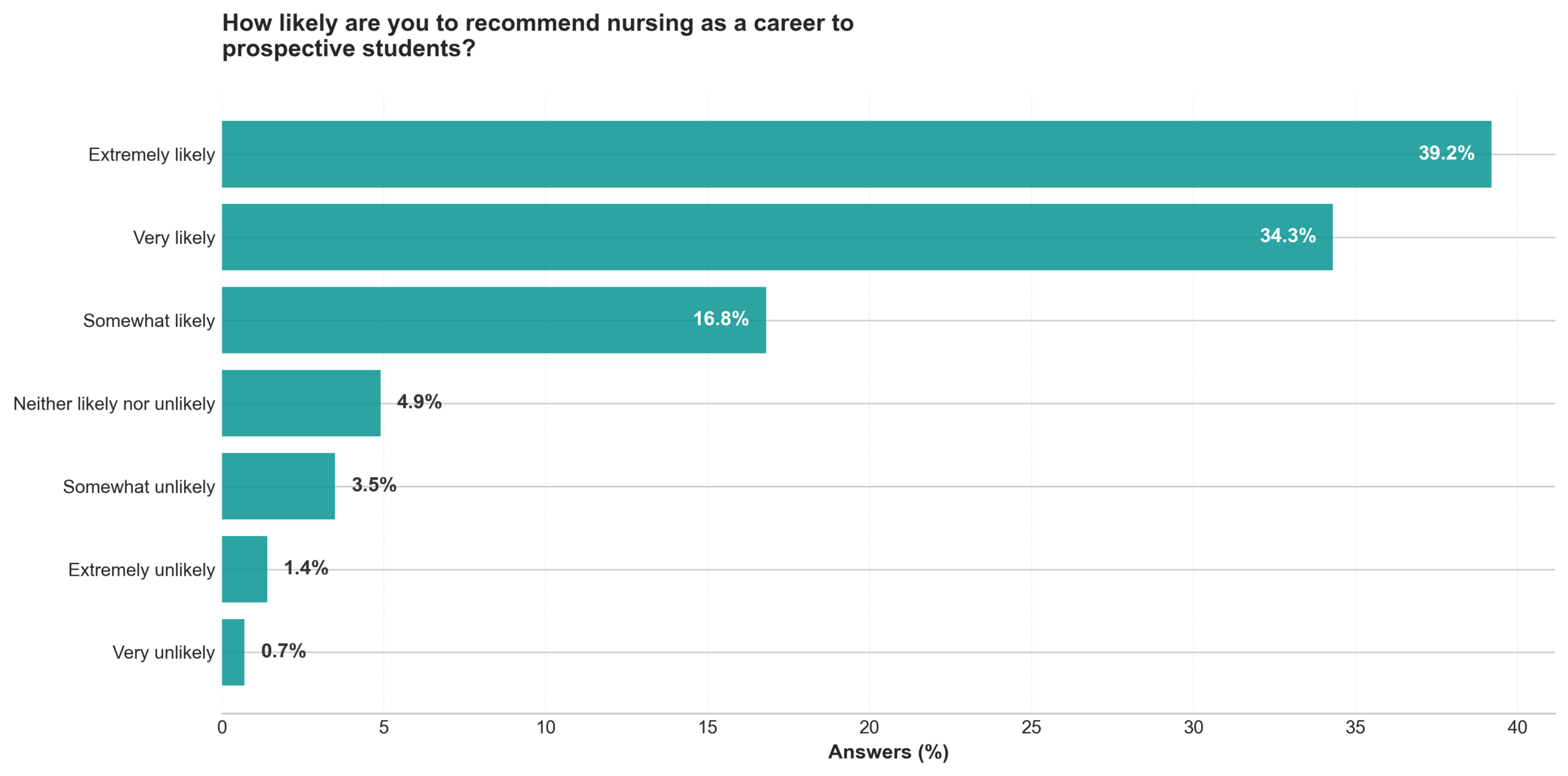
Above, we saw how well over half of our audience would still choose nursing if they could start over. Unsurprisingly, our audience also has largely positive feelings about recommending nursing as a career to prospective students.
39% say it’s extremely likely, and 34% say it’s very likely they would recommend it. 17% weren’t as certain, saying they’re somewhat likely to recommend it. The enthusiasm of these audience members may be due to job satisfaction and their own appreciation of the role nurses play in society. It may also be due to the potential for career diversity and growth, as evident in some of the statistics above.
In comparison, only 5% are uncertain, saying they’re neither likely nor unlikely to recommend a nursing career, while 4% say they’re somewhat unlikely to recommend it. Just 1% say they’re extremely unlikely to recommend nursing, and less than 1% say they are very unlikely to do so. This highlights how many enjoy their careers compared to those who do not.
The fact that 73% of respondents consider themselves extremely or very likely to recommend nursing to prospective students is a strong indicator of career satisfaction. This statistic suggests that college educated nurses enter the field well prepared for its challenges.
Interestingly, only 10.5% of respondents are unsure or unlikely to recommend nursing to prospective students, which is a markedly smaller percentage than the 16.5% who registered ambivalent or negative feelings about their own choice. This discrepancy may suggest that individual regret has more to do with personal circumstances than with disillusionment about the field of nursing itself.
The Bottom Line
These statistics provide thought-provoking insights into the experiences and perceptions of college-educated nurses in the US. For most of our audience, nursing is a rewarding career that offers plenty of scope for growth, development, and specialization, even if it presents a range of challenges.
Encouragingly, most graduates find work relatively soon, if not immediately, after graduating, with many of these nurses being employed in their desired roles. Still, those considering a nursing career need to be fully aware of the advantages and disadvantages involved so they can make an informed decision, bearing in mind the profession’s vocational nature.
Prospective students should also be aware that, given the projected shortage of nurses in the US, they may encounter challenging working conditions. Even so, as many nurses would agree, the rewards of the profession far outrank the downsides.
Methodology
Sourced from an independent Artios poll of 500 college-educated nurses in the United States. Responses are collected within a 95% confidence interval and 5% margin of error.
About the data:
- 72% of college-educated nurses in the United States are between the ages of 22 and 44.
- 55% identify as male and 45% as female.
- 72% are employed full-time.
- 81% speak no second language, while 13% speak Spanish.
- 40% earn between $75,000 and $149,999 annually.
- 55% are classified as white and 27% African American.
- The highest number (10%) is based in New York.