
What Does the Church Teach About AI?
By: Alessandro Rovati
August 27, 2026
Catholic Moral Theology
What Does the Church Teach About AI?
A Primer for Teachers, Students, and All People of Good Will
Where Does the Catholic Church Teach About AI?
At this point, there are four major documents that people can consult to find out what the Church teaches about AI:
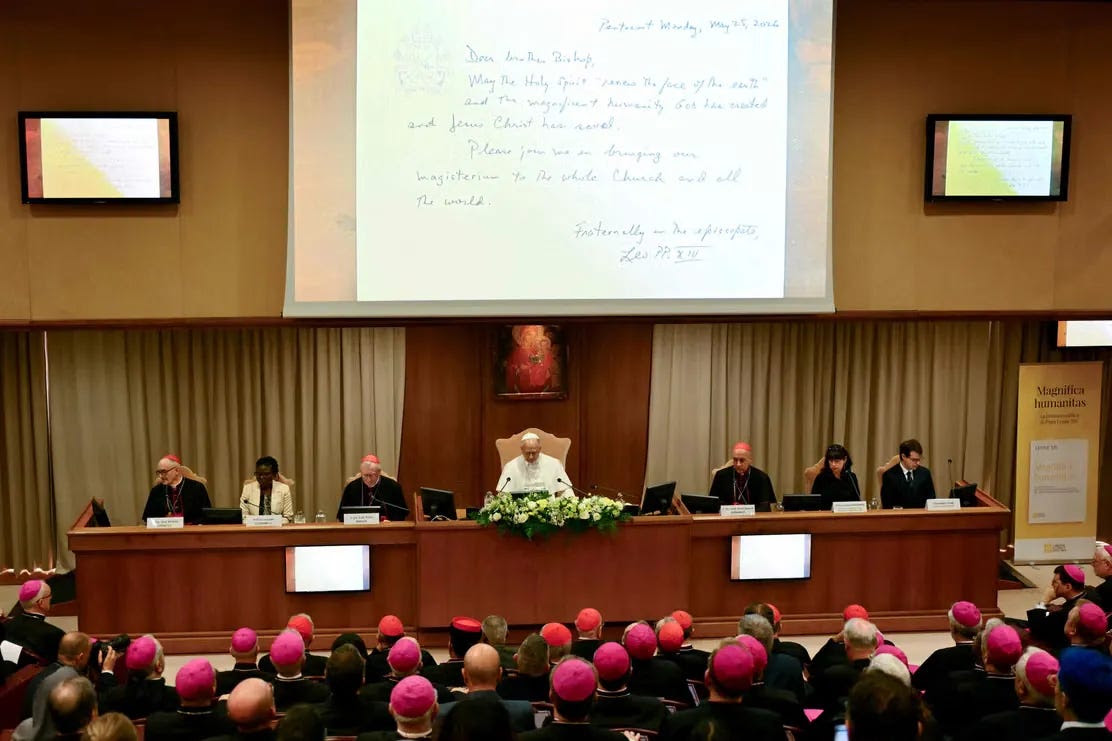
- Magnifica Humanitas, the encyclical that Pope Leo XIV released last May and that represents the most articulate and authoritative teaching on the topic.
- Antiqua et Nova, a note published by the Dicastery for the Doctrine of Faith and the Dicastery for Culture and Education in January 2025 on the relationship between artificial intelligence and human intelligence.
- Quo Vadis Humanitas?, a document of the International Theological Commission published in February 2026 that contains an extensive reflection on what theological anthropology has to say to the challenges of our technological age.
- Message for the 60th World Day of Social Communications, a succinct but comprehensive address in which Pope Leo previewed many of the encyclical’s contents.
As a bonus, one can also learn from the open access books published by the AI Research Group put together by the Dicastery for Culture and Education’s Centre for Digital Culture, a group of scholars who wrote on Catholic social teaching, AI ethics, and human agency (a third volume on education is forthcoming later this year).
What Do We Mean When We Say “AI?”
This is a very important, albeit often overlooked, question. Talk of “artificial intelligence” is as ubiquitous in today’s discourse as it is ambiguous. Alexa Steinbrück puts it succinctly: AI “does not refer to a single technology—it is an umbrella term” that is not new. It can name an entire field of knowledge and computer science research that stretches back to the 1950s devoted to creating machines that would exhibit abilities that we typically associate with human intelligence. In this broader sense, artificial intelligence encompasses all sorts of software and applications that predate the more recent advent of ChatGPT and its competitors and that are fully integrated and necessary to our contemporary technological society. Artificial intelligence can also be a way to refer to machine learning, that is, the creation of models that use algorithms “to make predictions or decisions based on data.” Even in this case, to use artificial intelligence to refer to machine learning is a way to refer to all sorts of models, software, and applications, some of them quite dated.
Recent advances in computational power and breakthroughs in algorithmic techniques have made machine learning more advanced and powerful than ever before, giving rise to what experts in the field call “deep learning,” a type of machine learning that allows models to identify complex patterns and relationships in large amounts of data without constant and direct human intervention. It is from this kind of machine learning that generative AI comes. IBM defines generative AI’s distinctive mark as the ability to create “complex original content such as long-form text, high-quality images, realistic video or audio and more in response to a user’s prompt or request.” It does so by drawing on extensive amounts of data that constitute its training and producing original content that draws on the patterns and relationships the machine detected in the data used in its training. Steinbrück describes large language models (LLMs) as a form of generative AI that have learned “how human language works by analysing vast amounts of text” and can thus produce highly sophisticated outputs based on them via a process called tokenization. These LLMs are what power the chatbots we have come to know (ChatGPT, Claude, Gemini, and the like), and they are what most people refer to when they think of artificial intelligence.
LLMs and generative AI are certainly what the Church’s documents listed above have in mind when wrestling with the opportunities and challenges posed by artificial intelligence. Yet, the technology has not stopped there. What Ethan Mollick helpfully describes as “conversation-first” AIs that depend on users constantly interacting with them by asking questions have now been surpassed by so-called “AI agents,” goal-directed AI systems that, as IBM explains, “can perform tasks and accomplish goals on behalf of a user or another system without human intervention, by designing [their] own workflow and using available tools (other applications or services).” Steinbrück explains that AI agents are “equipped with a kind of ‘executive’ capability, meaning they can not only generate text but also access operating system functions or control entire user accounts.” The user gives them goals, rather than step-by-step instructions, and the AI agents use tools, memory, and external systems to respond to the user’s query. This is the new AI frontier, one that is so recent that, despite being published just three months ago, Magnifica Humanitas does not address directly, although it offers principles for discernment and action that can be easily extended to this latest form of AI technology. The complexity and constant evolution of the multiple technologies that fit under the umbrella term artificial intelligence is one of the reasons why the Catholic Church calls for principled and careful discernment and does not simply arrive at definitive conclusions in favor or against AI – the notable exception being its non-negotiable opposition against fully autonomous weapons systems (Magnifica Humanitas, no. 200).
What Does the Church Teach About AI?
The Church is not against technology. Advancements in science and technology are the fruits of “the potential inscribed within human intelligence,” which God gave us as a gift to collaborate with Him to perfect creation and serve the well being of all (Antiqua et Nova, no. 2). Accordingly, “technology should not be considered, in itself, as a force antagonistic to humanity” (Magnifica Humanitas, no. 4) but as a possible answer to “humanity’s vocation to the good” (Antiqua et Nova, no. 48), provided that it remains always “ordered toward the common good, justice, the care of the vulnerable and creation” (Magnifica Humanitas, no. 129).
Not all technological progress is good. While created to follow God’s love and will for the world, our wounded humanity often succumbs to the logic of pride, domination, and consumption (Quo Vadis Humanitas?, no. 29). Despite the contemporary idolatry of progress that considers all forms of advancement as a good in and of itself, the Church warns us that “technological developments that do not lead to an improvement in the quality of life of all humanity, but on the contrary, aggravate inequalities and conflicts, can never count as true progress” (Antiqua et Nova, no. 54). There is often an imbalance between “the speed of technological growth and the slower development of awareness, norms, safeguards and institutions capable of governing its effects” (Magnifica Humanitas, no. 106). Moral growth should accompany the growth in power that technological progress makes possible, but that is often not the case, and we find ourselves with a deficit of responsibility and values (Antiqua et Nova, no. 108). Pope Leo calls this ever present temptation to turn technology into a dehumanizing force that “excludes God and reduces the other to a means” the Babel syndrome, that is, “the idolatry of profit that sacrifices the weak, a uniformity that neutralizes differences, and the pretense that a single language – even a digital one – can translate everything, including the mystery of the person, into data and performance” (Magnifica Humanitas, no. 106).
Technology is never neutral. “Technological products reflect the worldview of their developers, owners, users, and regulators, and have the power to ‘shape the world and engage consciences on the level of values’” (Antiqua et Nova, no. 41). In fact, they are always controlled by and subordinated to “economic interests intent on dominating the market and, not least, to attempts to impose cultural models that serve ideological and political agendas (Quo Vadis Humanitas?, no. 42). As such, “the use of AI is never a purely technical matter: when it enters processes that affect people’s lives, it touches on rights, opportunities, status and freedom” (Magnifica Humanitas, no. 102). Every technology “embodies choices and priorities through what it measures, ignores and optimizes, and how it classifies people and situations” (Magnifica Humanitas, no. 104). Accordingly, we cannot start our ethical deliberations from scratch, as if AI were a simple tool among many. It is not. Digital technology conditions us because it is “a real living environment, with its own way of structuring human activities and relationships. This technological development has a strong impact on the self-understanding of the individual, inscribed in new cognitive and communicative potentialities” (Quo Vadis Humanitas?, no. 33). The impact of the digital revolution on our lives is so strong that Pope Leo teaches that “artificial intelligence needs to be disarmed. The word is strong, I know,” he commented when presenting the encyclical to the media. It is strong “but deliberately chosen because this moment needs words capable of attracting attention, awakening consciences and indicating paths forward for humanity.”
AI poses an anthropological challenge. Because AI can “simulate aspects of human reasoning and perform specific tasks with incredible speed and efficiency” (Antiqua et Nova, no. 32), we are tempted to let it shape the way we think about human intelligence and personhood. If we do that, we fall trap to a functionalist perspective that values people exclusively for the work they can perform rather than for the intrinsic dignity that comes from being created in the image and likeness of God (Antiqua et Nova, no. 34). When that happens, “everything that appears as a ‘limit’ – incapacity, illness, old age, suffering, vulnerability – tends to be seen primarily as a defect to be corrected” (Magnifica Humanitas, no. 118) and those who cannot perform according to worldly standards – the unborn, the unconscious, the disabled, and the elderly – are dehumanized and treated as disposable (Antiqua et Nova, no. 34). Slowly but surely, we are inching toward a world “enslaved to efficiency, where, ultimately, the cost of humanity must be cut” (Antiqua et Nova, no. 68). We live at a crossroads that summons us to safeguarding our humanity against an anti-human vision in which “the fullness of life is equated with having more, reducing weakness, eliminating uncertainty and exerting total control” and “human beings are tempted to see themselves as a project to be optimized rather than as persons called to relationship and communion” (Magnifica Humanitas, no. 112).
Not fear but vigilance. “Let’s not fear artificial intelligence,” Pope Leo said during the encyclical’s presentation, “but constantly keep the question of the human in play.” Overall, the Church describes AI as a “valuable tool” that calls for a “measured and vigilant approach,” given that its use offers significant opportunities but also risks (Magnifica Humanitas, no. 100). In discerning how to engage with such a novel technology, it is necessary that we remain mindful of its dangers. Here are the ones singled out by Pope Leo in his encyclical:
- Polarization. “Public opinion is gradually being shaped and conditioned by polarizing media narratives, which are often amplified by algorithms that prioritize conflict and confrontation” (no. 190). Contemporary media habituates us to ways of communicating that make listening and careful thinking hard and reward propaganda and emotional responses instead.
- Deskilling. While AI is simply using complex algorithms that analyze data and then create well-formed sentences, people mistake its product as an expression of meaningful judgments that are the fruit of intelligent, conscious, and moral deliberation (no. 99). In the long run, excessive reliance on AI and the search for ready-made answers can weaken personal creativity and judgment and thus diminish our intellectual and moral abilities and skills. Furthermore, this new technology has the potential of disrupting the job market and exacerbating the inequalities and power imbalances that already exist in our society (no. 153).
- Erosion of the distinction between reality and simulation. Generative AI introduces an unprecedented difficulty in distinguishing between what is real and what is simulated. The digital space is now inundated with videos, images, and “persons” that are not real but created by automated agents instead. This is a problem in and of itself, but it is made even graver by the fact that such simulated realities influence public debates and individual choices. AI gives rise to “the power to profile, predict and influence behavior, often without individuals being fully aware of it” (no. 171). Furthermore, the pervasive simulation of human interactions with machines can make people “gradually lose the very desire to form genuine human connections” (no. 100).
- Addiction. We should consider the impact of the digital revolution, which AI simply extends and enhances, on human freedom. In particular, the “subtler forms of addiction linked to the ‘digital attention economy’ should not be underestimated, since platforms and services are often designed to capture users’ time and attention, exploiting their vulnerabilities and weakening their inner freedom. When business models thrive on human weakness, the person is treated as a means rather than as an end; those who design or finance such systems bear a moral responsibility that cannot be ignored” (no. 170)
- Bias. “The apparent objectivity of the responses and suggestions [AI] systems provide can lead us to overlook the fact that they reflect the cultural assumptions of those who designed and trained them, with all their strengths and limitations” (no. 100). While we are conditioned to think of the responses provided by the machine as neutral, they actually reflect and reinforce “the stereotypes or ideological bias of their designers and developers” (no. 102) by exercising covert forms of nudging and control (no. 171).
- Exploitation of people and resources. “The gains in efficiency and the potential to improve certain services [made possible by AI] are clear, yet rapidly and uncritically adopting them exposes us to a range of risks, including the tendency to overlook the environmental impact” (no. 102). Most importantly, we must “recognize the hidden, often exploited workers, who sustain algorithmic systems” (no. 109): “Nothing in the world of AI is immaterial or magical. Every seemingly immediate and flawless response is the result of a long chain of mediation, involving vast networks of natural resources, energy infrastructure and, above all, people” (no. 173).
Conclusion
To summarize, the Church teaches that Christian humanism does not reject science or technology, and thus AI, but embraces them with humility, gratitude, and realism. Aware of their ambivalence, the Church seeks to put all technologies at the service of God’s plan for humanity, a plan in which the dignity of all is protected and fostered. The Church calls us to careful reflection and courageous discernment, one that might call us to swim against the tide of our culture and the powers that be if we want to make AI an ally to authentic human flourishing.
The creative intelligence of humanity is a gift that can alleviate suffering and open up new possibilities, but it must remain ordered toward the common good, justice, the care of the vulnerable and creation. In this sense, the true alternative is not between enthusiasm and fear, but between two paths of development: a progress that serves individuals and peoples, or a progress that subjects them to the mentality of power. Ultimately, the key question remains the one posed by Saint John Paul II: does AI ‘make human life on earth ‘more human’ in every aspect of that life? Does it make it more worthy of man?’ If the answer is yes, then we can recognize it as an opportunity to be embraced responsibly, on a path of patient, shared reconstruction, akin to the rebuilding of Jerusalem narrated in the Book of Nehemiah. If, however, power grows while the heart withers and human bonds fray, then we are faced with a new form of Babel — a construction that is grandiose, yet fundamentally dehumanizing” (Magnifica Humanitas, no. 129)