• Skip to main content
 
About Us Mobile Nav Open Mobile Nav Close
  • About Us
  • About Us
  • Mission & vision
  • Abbey News
  • Leadership
  • Monastery & Basilica
  • Library
  • Performing Arts
  • Accreditation

Belmont Abbey College

The Catholic College of the South

  • VISIT
  • Academics
  • Admissions
  • APPLY
  • GET INFO
  • Search
  • My abbey
  • GIVE

Home

September 24, 2026 By Laura Schaffer Leave a Comment

The Science of Lifelong Learning: Honoring Dr. Mike McLeod

Dr. Abigail Cousino, Asst. Professor of Biology and Biochemistry

Anyone who has stepped foot into the William Gaston Science Building in the last 50 or so odd years has probably heard the ringing baritone of Dr. Michael (Mike) McLeod lecturing on Cell Biology… and trembled at the knees. Known for banging his fist down on the desk to snap his students back to attention, Dr. McLeod has been the gauntlet every biology student must survive to prove his or her mettle. 

Dr. McLeod graduated with his Bachelor of Science in biology in 1969. He then served in the military from 1970-1974, during which time he also completed his Master of Science in biology. He then continued his education, earning his Ph.D. in zoology from Miami University in Oxford, Ohio in 1977. 

Belmont Abbey College hired Dr. McLoed to help rebuild the Biology Department in 1978. Along with two of his colleagues, Betty Baker and Eunice Cronin, the three built the department from the ground up.

A career begins

Prof. McLeod made his way through the ranks, earning full professorship in 1986. While continuing to teach at the Abbey, he also served as an American Council on Education Fellow and Assistant to the Vice President for Academic Affairs at Winthrop College in Rock Hill, SC from 1987-1988. From 1988-1991 he was the Assistant Vice President for Academic Affairs at Belmont Abbey, and in the summers of 1990 and 1992 he served as the Acting and Interim Vice President for Academic Affairs, respectively. In the summer of 1993, he served as the Interim VP of Student Affairs, and from 1991-1995 he was the Director of the Adult Degree Program as well as the Director of the Weekend College, both programs focused on continuing education for non-traditional students. 

Continuing the impressive overlap of duties and responsibilities, from 1991-2001 he served as Associate VP for Academic Affairs and from 1995-2000 as the VP for Student Life and Dean of Students. Exemplifying his dedication to both science and education, McLeod has published over 20 first author papers and coauthored several more, publications which have been cited over 600 times on ResearchGate. His papers cover topics spanning from the early evolution of chili peppers to education at a Liberal Arts College to Pearl Harbor; his impressive breadth of knowledge and curiosity speaks to his role as an academic and a life-long learner.

Local service

Dr. McLeod is committed to community outreach and growth, serving on the Gaston County Urban Water Quality Committee (1996-1998), the Voices and Choices Regional Environmental Planning Committee (1999-2001), the Centrolina Council of Governments Catawba River Corridor Study Steering Committee (1994), the Dropout Prevention Task Force, and much more.

In 2009 he served on a panel for the North Carolina Health Professions Advisors Association, advising pre-medicine students. He has also presented to the Gaston County Community many times, discussing topics such as water supply protection legislation, environmental issues, energy, and peak oil. 

Department leadership

Dr. McLeod has been awarded several grants for the development of math and science programs. Under McLeod’s leadership, the biology department received over $600,000 in grants, with the latest Cannon grants allowing for the renovation of the general biology lab in 2017 and 2019.

From 2006-2018 Dr. McLeod served as the Chair of the Department of Biology, and from 2002 to the present he has been the Director of the Environmental Science Program. From 2017- 2018 he also served as Chair of the Division of Natural Sciences and Mathematics. He has earned many awards and honors, including the Adrian Faculty Excellence Award, which he received in both 2006 and 2021, and the Spirit of St. Benedict Award in 2008.

Joy of 50 years

Mike has been married to his wife Dianne for 53 years, and their daughter, Jessica, who earned her Ph.D. in anthropology, serves on the development staff at Westen Michigan University. He loves traveling and has been to all 7 continents and all 50 states. His latest adventure took him to Antarctica, where he got to practice his wildlife photography skills. He played the bagpipes for many years in Ceol na Gael Irish Pipe Band and acted in several Abbey Player performances, with his favorite role as Prince Escalus in Romeo and Juliet. 

Dr. McLeod strives to offer rigorous courses to prepare students for graduate education or a job. He has been the soul of the department for many years, carrying on beloved traditions, such as Deck the Deer, Senior Night, Senior Brunch, and many more! He can often be found whistling or singing as he preps for labs, and he’s always ready to tell a story about past students or explain the citric acid cycle and the flow of blood through the heart. He cares deeply for the Abbey, the Biology Department, and most importantly, his students. The Abbey has been blessed to have such a great man and teacher dedicate 48 years of service to this community.   
To read more Abbey stories and stay up to date on college news, request your copy of the next Belmont Abbey Magazine here.

Filed Under: Abbey News, Crossroads, Home

September 24, 2026 By Laura Schaffer Leave a Comment

The Show Goes On: Honoring Simon Donoghue

Laura Schaffer, Editor

“If you work for the Abbey Players, they give you scope,” Simon Donoghue said, his face folding from deadpan into the singular, signature grin that generations of Abbey Players have come to know and love. Scope. It was the perfect word, and he knew it. 

Scope, after all, captures not just the resourcefulness of Abbey Players through the years – as they face creative challenges and master a wide variety of skills – but also the breadth of experience they still explore and express each semester on stage. No wonder there’s such a culture of resilience and humor in the Belmont Abbey Performing Arts.

It was my pleasure to interview Simon in the weeks before he received his Lifetime Achievement Award. Here is a small part of what I learned that day about this kind and extraordinary man.

Simon Donoghue came to Belmont Abbey to discern monastic life. Entering the monastery after graduating from the University of Virginia, he made Simple Vows in 1975 and remained in discernment with the community until 1978.

What began as a young man discerning religious life would remain a vocation story, though the path would unwind in unexpected ways as Simon brought his considerable and attentive energy, his creativity, and his responsive care to the campus community. It would lead him to marriage, and to a different kind of service than he envisioned on arrival in 1974. 

Over the years, Simon’s many roles at the Abbey have included reference librarian; professor of Theatre Arts; Chair of the Faculty Assembly; instructor of History, German and Great Books; 

founding editor of the monastery’s Crescat publication; archivist; and Interim Library Director. However, the almost five decades he served as Director of the Abbey Players speak to his greatest Belmont Abbey legacy: as a teacher, mentor, friend, and inspiration to generations of Abbey students. 

Alongside legends like Frs. John Oetgen and Paschal Baumstein – both of whom were close personal friends and mentors – Simon Donoghue has taken his place as an Abbey Players icon.

Early years

Simon’s relationship with his wife, Debbie, itself hearkens back to Abbey theater. While on a monastic visit to St. Gertrude’s, a Richmond Benedictine high school, Simon had noticed the young woman who swept onstage at the end of 7 Nuns in Las Vegas. And when Debbie auditioned for Anastasia as an Abbey undergraduate the next year, he recognized the commanding mother superior. 

Debbie was a dynamo. She led Student Government, became the first female Student of the Year, and danced through every “Friday Night Thing” in original dresses sewed the day of the party. After Anastasia rehearsal one night, Simon told his college roommate, “I have no intention of leaving the monastery, but I have the weirdest feeling I’m going to marry that woman.” Five years later, Debbie walked to the basilica in a wedding dress she’d made herself, and she and Simon were married. Christopher was born a year and a half later.

Prior to Simon’s tenure, the theatre temporarily occupied St. Leo’s ground floor. With Grace Auditorium condemned and crumbling overhead, the Abbey Players had salvaged the original (1904) lighting board, uprooted the auditorium chairs, and erected a stage. They’d spray-painted paint cans and used them to rig lights. And sometimes they’d make stage exits out the window.

A new theatre

By 1979, three years after Abbot Jude Cleary asked Simon to be the Abbey Players’ Director, the theatre had relocated to the Haid. And while 1987 would see a full renovation, in the meantime the Abbey Players continued practicing resourcefulness. They built a 3-foot stage with a screen behind it, stacked chairs between performances, and even painted unclaimed objects black to appropriate them for theatrical use. 

In the end, makeshift space never phased the Abbey Players, who dove into everything from You’re a Good Man, Charlie Brown (Simon’s musical directorial debut) to Follies, and from Fr. Paschal’s original adaptation of Come Rack, Come Rope to the musical Godspell or Shakespeare’s Richard III. Fr. Paschal inspired a Shakespearean series and continually challenged students and Simon alike to shatter their comfort zones. Today, the same joyful, creative ambition remains an Abbey Players hallmark, cultivating a vibrant campus culture which, under Simon’s leadership, extended to include members of the external community, further enriching student experience and expanding performing local arts networks.   

Simon also played a vital role in establishing the performing arts as a recognized academic department at Belmont Abbey College, with majors, minors, and a premier scholarship named for Fr. John Oetgen.

If you ask Simon about his story, you’ll inevitably hear more about student and colleague accomplishments than about his own, a fact which perfectly underscores the profound sincerity, kindness, tenacity, and generosity that has impacted so many community members throughout his nearly 50 years as Director of the Abbey Players.

Today, Belmont Abbey Performing Arts continue to thrive under the leadership of Kristin Hayes, Chair of the Performing Arts Department, and Christopher Donoghue, Director of the Abbey Players. That students with diverse views and backgrounds continue to build flourishing community on the Abbey stage is, in no small part, thanks to Simon Donoghue’s legacy. “Theater opens people up,” Simon notes. It gives them scope.

To read more Abbey stories and stay up to date on college news, request your copy of the next Belmont Abbey Magazine here.

Filed Under: Abbey News, Crossroads, Home

September 18, 2026 By Laura Schaffer Leave a Comment

Our Lady of Sorrows, Pray for Us!

This week the Church marked both the Feast of the Exaltation of the Cross and the Memorial of Our Lady of Sorrows. And while this pairing has always felt natural, I’d never paused to consider, before, the more-than-surface relationship between them. This week, however, the readings from Monday’s feast and Tuesday’s memorial have stuck with me, and I’m beginning to realize that together they offer an invitation to a deeper identity with Christ.

Monday’s first reading presents salvation history in microcosm. The Israelites complain against the Lord, a plague of serpents infests their camp, they repent, and God instructs Moses to lift up a bronze serpent in the desert. Anyone suffering the venomous snakebite can look at this bronze figure – the sign of their punishment transformed to a terrible mystery of mercy – and live. In the Gospel that follows, Christ references this story in explicit connection to being lifted up, Himself, “so that everyone who believes in [the Son of Man] may have eternal life” (John 3:14-15).

Together, these readings draw our gaze to the Cross, the sign of our guilt and our salvation by the grace of God. They ask us to acknowledge our own sins and fix our eyes on our Savior, recognizing that salvation history continues to work itself out in our lives and in the sacramental life of the Church, the Body of Christ. But with Tuesday’s Memorial of Our Lady of Sorrows, the Body of Christ comes into focus even more explicitly, with St. Paul stating: “As a body is one though it has many parts, and all the parts of the body, though many, are one body, so also Christ… you are Christ’s body, and individually parts of it” (1 Cor 12:12, 27).

Always before, I saw Our Lady of Sorrows primarily as an onlooker, however affected by the pain she observed. I knew that Christ entrusted His mother to us on Calvary, that she prays for us and points us toward her Son at all times. But as the readings remind us, we are members of the Body of Christ, and as a consequence, her presence at His sacrifice, together with St. John and the holy women, becomes something more. It becomes a sign of our participation in His Passion.

Christ saved us. Christ alone. But by the incomparable mystery and mercy of His divine Love, He draws us into this act and its glorious reward, each so far beyond our human capacities. Just as Mary is, in a real way, the first Christian, she is also the first to suffer with Him and to unite her human suffering, her human love, with His. The Memorial of Our Lady of Sorrows reminds us to place ourselves at the foot of the Cross, not as bystanders, but as members of Christ’s Body.

We are all called to carry our crosses. The Feast of the Exaltation of the Cross promises that the Way of the Cross leads, in Christ, to resurrection. But the Memorial of Our Lady of Sorrows follows to remind us that we are never alone. There is no dimension of human suffering that Christ’s Passion does not embrace and sanctify. We are the Body of Christ; we are called to love with His Love, as Mary did: to recognize His sufferings in those of our brothers and sisters and not to turn away. Christ is with us. Hope in Him.

Our Lady of Sorrows, pray for us.

Filed Under: Abbey News, Cultivation Blog, Home

September 10, 2026 By Sarah Bolton Leave a Comment

Belmont Abbey College to Establish Patrick McHenry Papers in Abbot Vincent Taylor Library Archives and Host Highway Dedication in His Honor

Belmont Abbey College to Establish Patrick McHenry Papers in Abbot Vincent Taylor Library Archives and Host Highway Dedication in His Honor

Belmont, N.C. (September 10th, 2026) – Belmont Abbey College is thrilled to celebrate the legacy of alumnus Patrick McHenry with the addition of his papers to the Abbot Vincent Taylor Library’s Special Collections. The collection preserves the story of one of the college’s distinguished alumni and his nearly two decades of public service to North Carolina and the nation. The college will mark the occasion with a special ribbon-cutting of the collection on October 3 during its annual Homecoming festivities. The event will also include a dedication of the “Congressman Patrick McHenry Highway,” courtesy of the North Carolina Department of Transportation (NCDOT), following legislation led by Senator Brad Overcash.

The addition of the Honorable Patrick McHenry Papers represents a landmark acquisition for the Abbot Vincent Taylor Library’s Special Collections and Belmont Abbey College as a whole. The archive significantly expands the Library’s holdings, adding more than 58,000 files documenting two decades of congressional service. 

The collection includes committee files, policy research, correspondence, press materials, and awards. These materials create new opportunities for research in modern American history, political science, financial regulation, digital asset policy, and North Carolina political history, while providing students and faculty with access to a substantial body of contemporary primary sources. 

For Belmont Abbey, the acquisition strengthens the college’s research capacity and extends the reach of the Abbot Vincent Taylor Library to researchers and educators both regionally and nationally. As a Belmont Abbey alumnus, McHenry’s papers hold particular significance for the college, connecting his professional legacy and decades of public service with the institution that helped shape his early life and education. 

Alexxis Lynn, Director of Library Services at Belmont Abbey College, emphasized the significance of preserving McHenry’s legacy at his alma mater. “We are honored to preserve Congressman McHenry’s papers here at Belmont Abbey. As an alumnus of the college, his story is an important part of our institutional history. This collection will preserve that history while providing valuable primary sources for generations of students, faculty, researchers, and educators.”

The event will also include the dedication of the “Congressman Patrick McHenry Highway,” in partnership with the North Carolina Department of Transportation. The highway designation recognizes McHenry’s nearly two decades of service representing the people of North Carolina in Congress and his longstanding commitment to the region. The designation provides a lasting public tribute to his leadership and contributions to the state. 

“Congressman McHenry accomplished so much during his landmark 20 years in Congress,” said Senator Brad Overcash. “That’s why I was honored to lead the effort, supported by our Gaston Delegation, in the NC General Assembly to name a section of Highway 16 in his native Gaston County after him.”

This special ribbon-cutting and dedication will bring together representatives from Belmont Abbey College, NCDOT, government and community leaders, the McHenry family, alumni, students, and friends of the college to celebrate McHenry’s legacy and the preservation of his papers at his alma mater. 

For more information about Belmont Abbey College, please visit www.belmontabbeycollege.edu.

About Belmont Abbey College: Founded in 1876, Belmont Abbey College is a private, Catholic baccalaureate and liberal arts institution. Our mission is to educate students in the liberal arts and sciences so that in all things God may be glorified. Guided by the Catholic intellectual tradition and the Benedictine spirit of prayer and learning, we welcome a diverse body of students and provide them with an education that will enable them to lead lives of integrity, to succeed professionally, to become responsible citizens, and to be a blessing to themselves and to others. Our beautiful and historic campus is conveniently located just 10 miles west of Charlotte, N.C., and is currently home to more than 1500 students. For more information, visit belmontabbeycollege.edu.

For Immediate Release

Contact: Sarah Bolton

P: 704-461-7016 E: sarahbolton@bac.edu

Download Now.

Filed Under: Abbey Excellence, Abbey News, Alumni News, Home Tagged With: Graduation

August 31, 2026 By radefolaju Leave a Comment

Nursing Education Statistics: USA

As a Benedictine institution rooted in the hallmarks of stability, hospitality, community, and love, Belmont Abbey College has brought to the field of nursing education an unwavering emphasis on exceptional, compassionate, and ethical care. It has been our joy to form nurses who enter the healthcare system well prepared to meet the growing needs of our Gaston County home and beyond.

As part of our dedication to advancing the field and providing the highest quality education to future nurses, Belmont Abbey recently commissioned a study to explore the experience of college-educated nurses within the healthcare industry after graduation. It is our hope that these findings will contribute to an essential and ongoing conversation that bears with such urgency on the health of our communities.

Nursing Education Statistics: US 2026

In the US, there are various educational pathways you can follow if you want to take the standardized National Council Licensure Examination (NCLEX)-RN and become a nurse. These include a diploma, an associate degree, a bachelor’s degree, a master’s degree, a PhD program, and doctoral programs. With so many options, it’s natural for those considering a nursing career to wonder which path they should follow and whether their potential career choice is worth it.

To gain a better understanding of nursing education, we sourced data from an independent poll of 500 college-educated nurses in the US. The responses to various questions ranged from the expected to the surprising and beyond. Here’s what we found.

Index

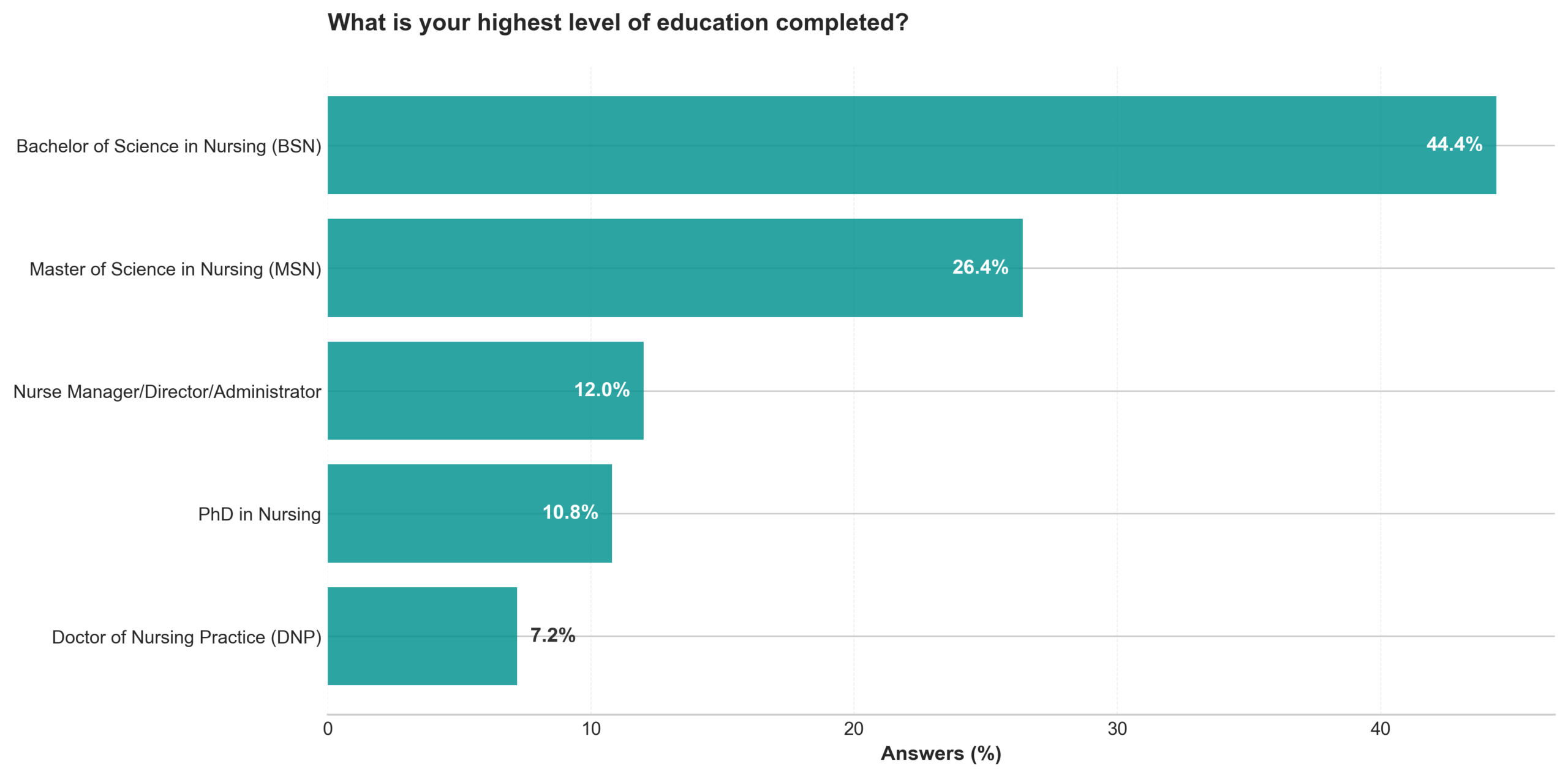
  • A Bachelor of Science in Nursing (BSN) is the highest level of education completed by 44% of college-educated nurses in the US
  • 18% of college-educated nurses in the US say pediatric nursing best describes their primary career path since completing their nursing degree
  • 34% of college-educated nurses in the US have worked in three different nursing roles or specialties since graduating
  • 41% of college-educated nurses in the US say “excellent job security with multiple opportunities” best describes job availability in their nursing career
  • 22% of college-educated nurses in the US say career advancement into leadership is the primary opportunity their nursing degree has opened for them
  • 31% of college-educated nurses in the US find making a difference in people’s lives the most rewarding
  • For 32% of college-educated nurses in the US, maintaining work-life balance is the primary challenge
  • 25% of college-educated nurses in the US secured their desired nursing role within six months of graduating
  • 55% of college-educated nurses in the US say they would still choose nursing as a career if they could start over
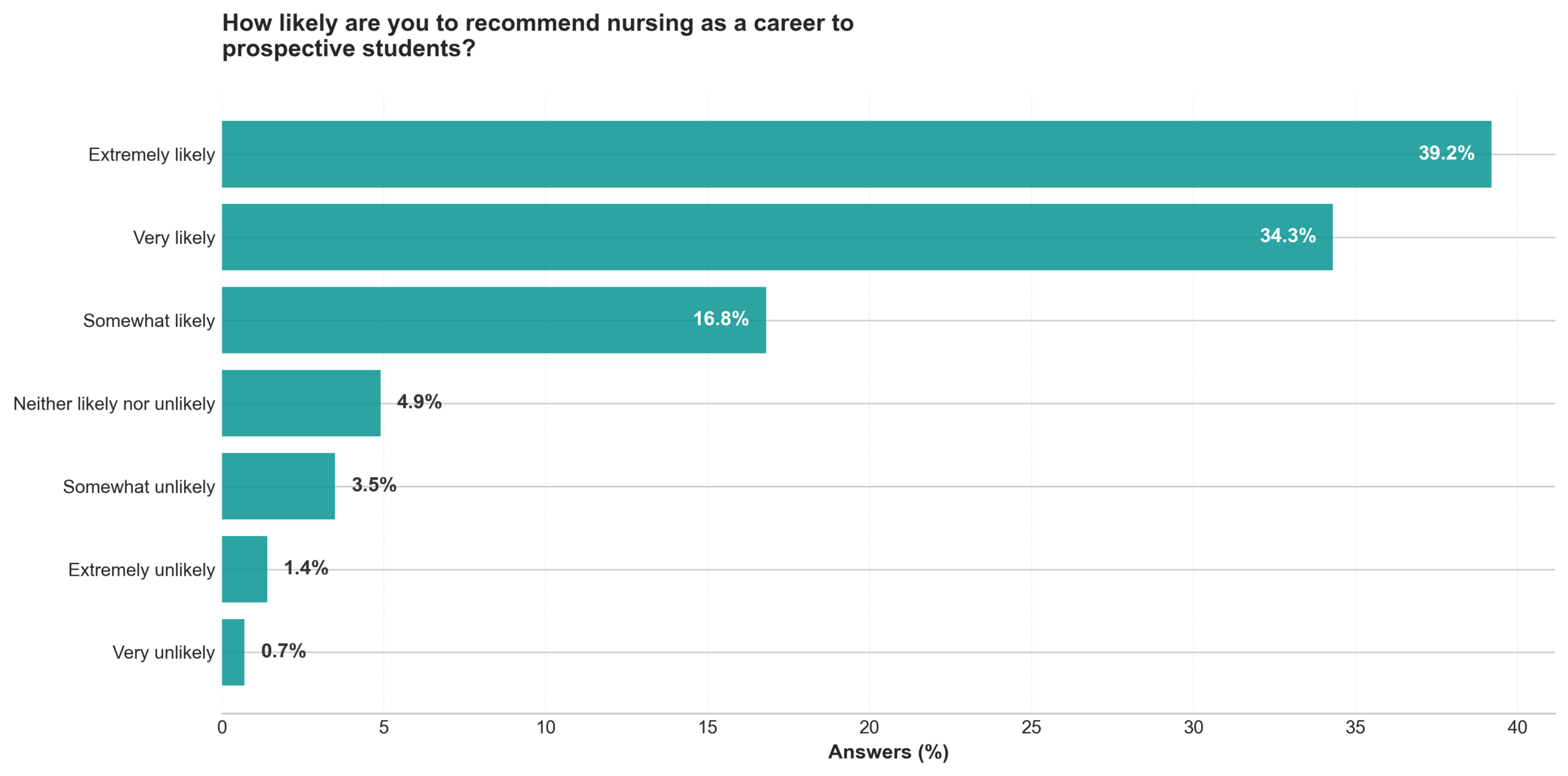
  • 39% of college-educated nurses in the US say they are extremely likely to recommend nursing as a career to prospective students
  • 19% of college-educated nurses in the US say the most important advice they would give to those considering a nursing career is to find strong mentors early
  • The Bottom Line
  • Methodology

What Is Your Highest Level Of Education Completed?

A Bachelor of Science in Nursing (BSN) is the highest level of education completed by 44% of college-educated nurses in the US

The nurses in our poll have different levels of education:

Q1 What is your highest level of education completed

The highest level of education completed by almost half (44%) of our audience is a Bachelor of Science in Nursing (BSN). The popularity of this qualification may be due to it offering higher earning potential and more career opportunities than an Associate Degree in Nursing (ADN). For 26%, their highest education level is a Master of Science in Nursing (MSN), which is an entry-level degree for advanced roles such as nurse educator and clinical nurse leader.

12% have completed nurse manager, director, or administrator courses, and 11% have a PhD in nursing. Only 7% have completed a Doctor of Nursing Practice (DNP) qualification. This suggests slightly more than half of our audience is focused on building their careers to advance beyond basic nursing roles.

Our findings are somewhat different from those published by the American Association of Colleges of Nursing (AACN), indicating nurses’ education levels in 2022. That year, 72% of the registered nurse workforce had a baccalaureate or higher degree as their highest level of nursing education, as this would give them better career prospects. 72% of employers strongly prefer baccalaureate-prepared nurses, while 28% require new hires to have a bachelor’s degree. 17% had a master’s degree and 3% had doctoral degrees.


How Many Different Nursing Roles Or Specialties Have You Worked In Since Graduating?

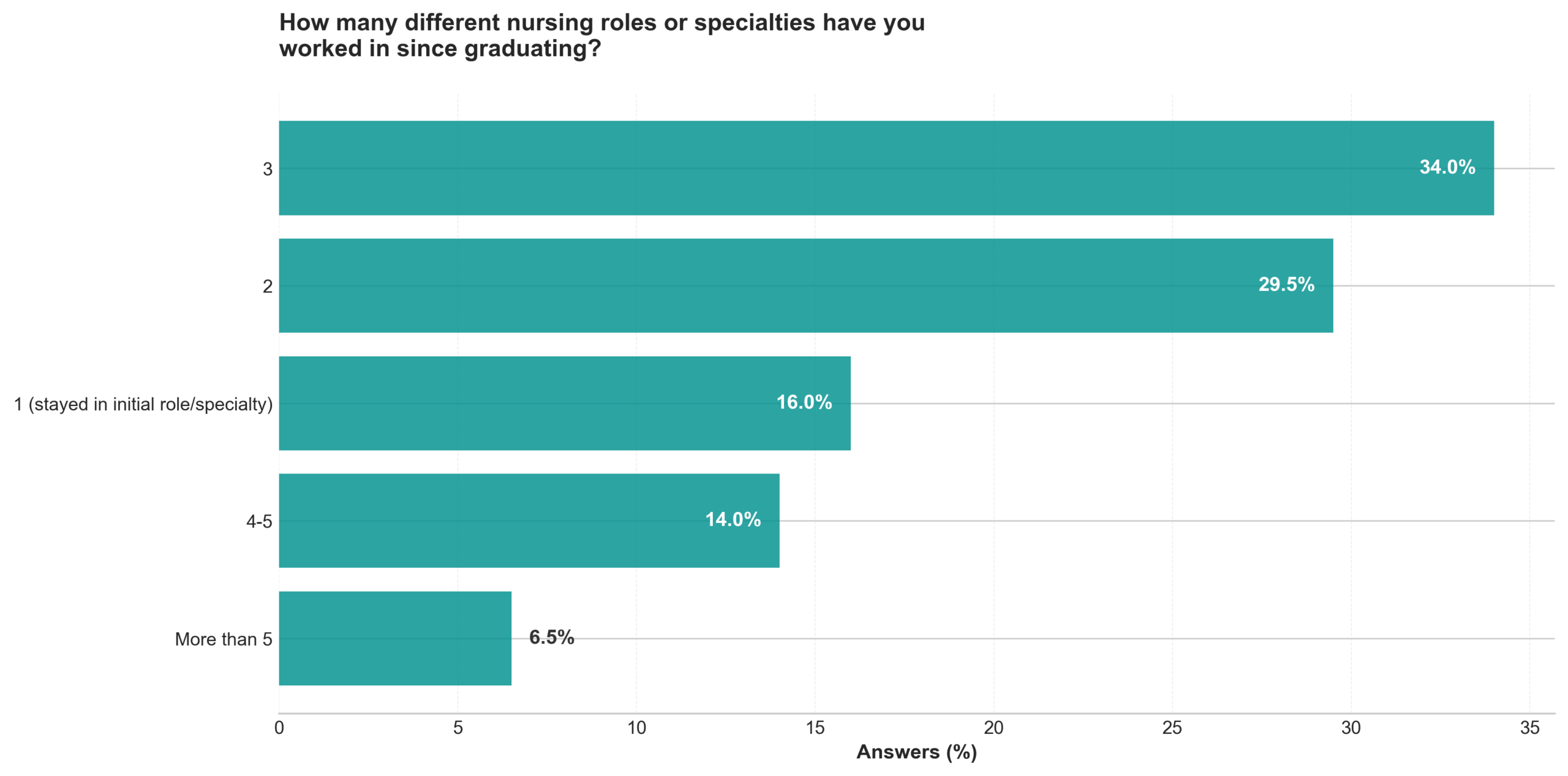
34% of college-educated nurses in the US have worked in three different nursing roles or specialties since graduating

Role-changing in nursing is certainly not unusual:

How many different nursing roles or specialties have you worked in since graduating?


Of our audience, 34% say they have worked in three different nursing roles or specialties since graduating from college. A slightly lower percentage (30%) say they have worked in two roles. 16% have only worked in their initial role or specialty, while 14% have experience in four to five different roles. Only a small percentage (7%) have worked in more than five roles or specialties since graduating.

There are various reasons why some nurses remain in their initial role while others diversify their careers to work in different roles. Some may choose not to specialize because they derive enough satisfaction from their initial role. Others might not be able to afford the additional studies required for specialization.

Among those who have worked in several different roles, some may be motivated by the challenge of learning new things or want to advance their career for the sake of accomplishment, prestige, and better earnings.

According to Nurse Journal, the top five specialty career choices for nurses include certified registered nurse anesthetist, adult-gerontology nurse practitioner, certified nurse midwife, family nurse practitioner, and women’s health nurse practitioner.

84% of respondents noted one or more changes in their roles or specialties since graduation, and while the full weight of this statistic depends on the number of years since graduation, the fact that comparatively few nurses remain in the same position still highlights one of the many benefits of a nursing degree: it helps to prepare nurses for a variety of possible roles. 

Completing such a degree could also assist prospective nurses in better discerning the type (or types) of work they wish to pursue within their chosen field, potentially increasing the likelihood of their remaining in that speciality or role. Greater stability would benefit the field, as nurses would bring years of experience to their roles, benefiting not only their own patients but also younger, mentee nurses. 

It is also worth noting that, according to a recent AMN Healthcare survey of 12,171 nurses, 61% of respondents planned to change their current position or employment status within 12 months, which seems to confirm a high level of turnover and role-shifting within the nursing field. 

Which Statement Best Describes Job Availability In Your Nursing Career?

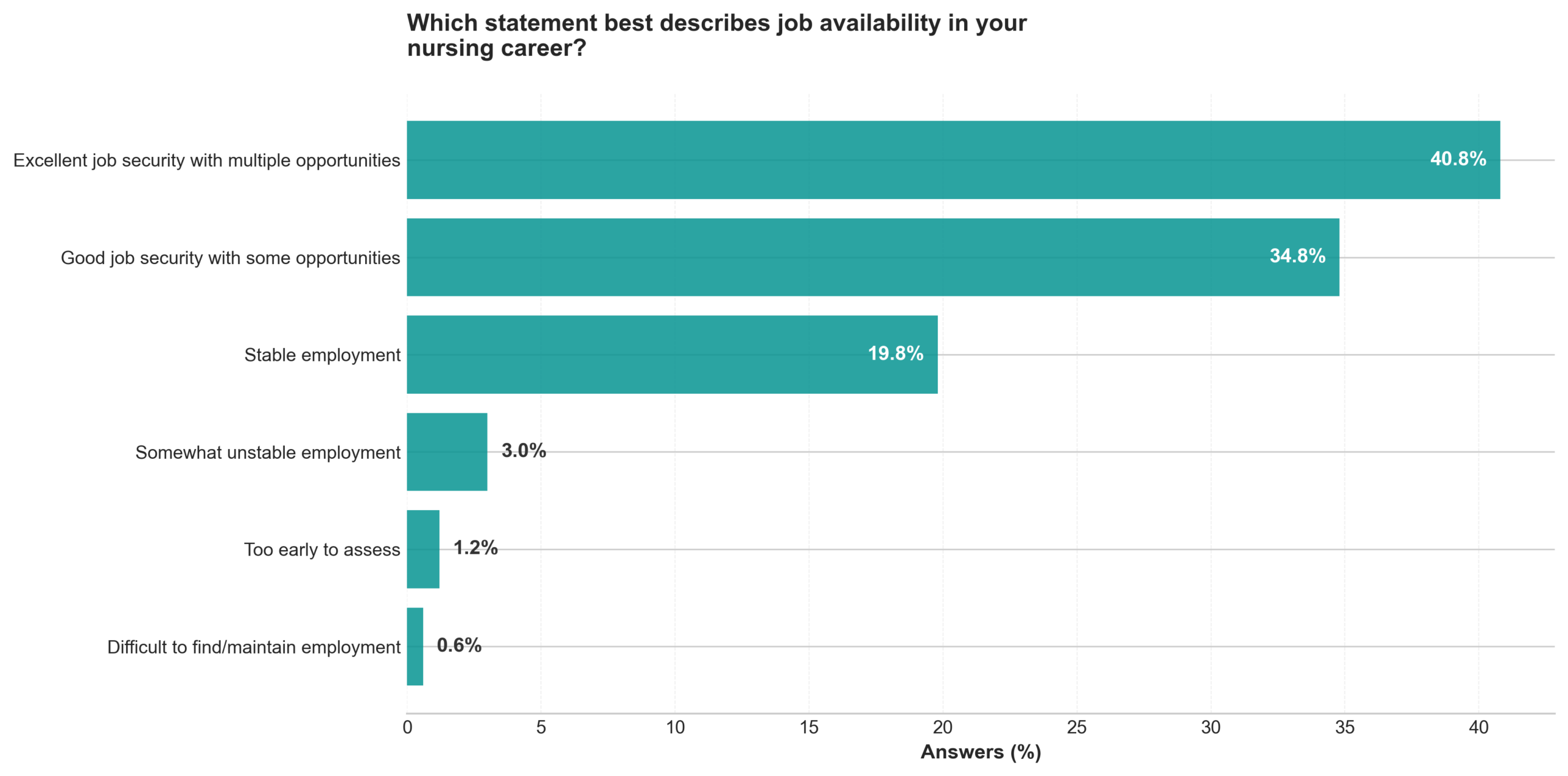
41% of college-educated nurses in the US say “excellent job security with multiple opportunities” best describes job availability in their nursing career

There are different experiences when it comes to job availability:

Of our audience, 34% say they have worked in three different nursing roles or specialties since graduating from college. A slightly lower percentage (30%) say they have worked in two roles. 16% have only worked in their initial role or specialty, while 14% have experience in four to five different roles. Only a small percentage (7%) have worked in more than five roles or specialties since graduating. There are various reasons why some nurses remain in their initial role while others diversify their careers to work in different roles. Some may choose not to specialize because they derive enough satisfaction from their initial role. Others might not be able to afford the additional studies required for specialization. Among those who have worked in several different roles, some may be motivated by the challenge of learning new things or want to advance their career for the sake of accomplishment, prestige, and better earnings. According to Nurse Journal, the top five specialty career choices for nurses include certified registered nurse anesthetist, adult-gerontology nurse practitioner, certified nurse midwife, family nurse practitioner, and women’s health nurse practitioner. 84% of respondents noted one or more changes in their roles or specialties since graduation, and while the full weight of this statistic depends on the number of years since graduation, the fact that comparatively few nurses remain in the same position still highlights one of the many benefits of a nursing degree: it helps to prepare nurses for a variety of possible roles. Completing such a degree could also assist prospective nurses in better discerning the type (or types) of work they wish to pursue within their chosen field, potentially increasing the likelihood of their remaining in that speciality or role. Greater stability would benefit the field, as nurses would bring years of experience to their roles, benefiting not only their own patients but also younger, mentee nurses. It is also worth noting that, according to a recent AMN Healthcare survey of 12,171 nurses, 61% of respondents planned to change their current position or employment status within 12 months, which seems to confirm a high level of turnover and role-shifting within the nursing field. Which Statement Best Describes Job Availability In Your Nursing Career? 41% of college-educated nurses in the US say “excellent job security with multiple opportunities” best describes job availability in their nursing career Which statement best describes job availability in your nursing career?

Job availability hasn’t been an issue for almost half of our audience (40%), who say they have excellent job security with multiple opportunities. Considering the shortage of nurses in the US mentioned above, it’s not surprising that this percentage has had a positive experience so far. 35% have had a somewhat similar experience, saying they have good job security with some opportunities.

Another 20% say they have stable employment, while just 3% say they have somewhat unstable employment, and 1% say it’s too early in their careers for them to assess job availability.

Surprisingly, a fifth of our audience didn’t mention having job opportunities, and a small percentage said their employment isn’t stable. According to the Health Resources and Services Administration, there was a 1% increase in the number of registered nurses but a 3% increase in demand between 2022 and 2025. With a deficit of around 295,800 nurses around the country, nurses should have no trouble finding stable employment and exciting career opportunities.

It is well worth noting that over 95% of respondents identified their employment security as stable or better, with over 75% claiming good or excellent security. A dramatic majority of college educated nurses, then, indicate strong job security.

The Benedictine hallmark of stability means that our monks and, by extension, our college community, remain dedicated to living out the Abbey’s mission, rooted in this particular place. The needs of our county, our state, and our country inform the prayers and work of Belmont Abbey and its apostolate, Belmont Abbey College, as we seek to serve our home. Responding to the healthcare crisis and the growing shortage of nurses in our communities, Belmont Abbey both welcomed the construction of a new hospital on Abbey land and established a Nursing program steeped in Benedictine values. It is our hope that this will contribute materially to the health and wellbeing of the place we have called home for 150 years.


What Is The Primary Opportunity Your Nursing Degree Has Opened For You?

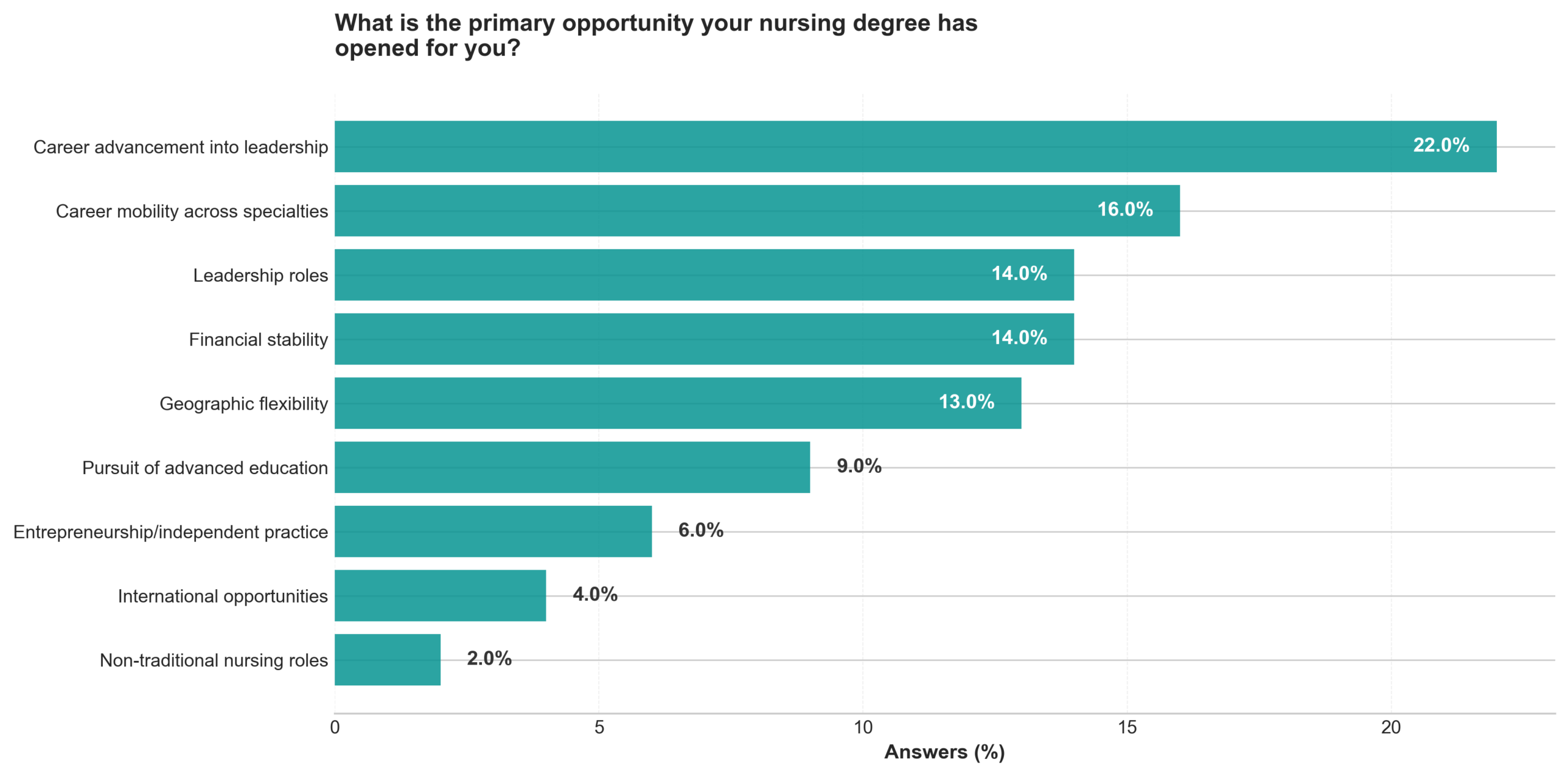
22% of college-educated nurses in the US say career advancement into leadership is the primary opportunity their nursing degree has opened for them

A nursing degree can open doors to an impressive range of career opportunities:

What is the primary opportunity your nursing degree has opened for you?


For 22% of our audience, the primary opportunity their nursing degree opened was career advancement into leadership. According to CareRev, these positions may include nurse manager, charge nurse, director of nursing, chief nursing officer, clinical nurse leader, or nurse educator, among others. 16% of our audience say their degree has provided them with career mobility across specialties, suggesting they benefit from diversity while potentially working their way into leadership positions.

For 14%, the primary opportunity has been financial stability, while another 14% mention leadership roles. 13% say geographic flexibility is their main opportunity, suggesting they have been able to work in different locations around the US.

The pursuit of advanced education is what 9% of our audience name, and 6% say their main opportunity is entrepreneurship or an independent practice. Among the entrepreneurial roles nurses can fulfill are medical spa nurse, career coach, script consultant, home health nurse, specialist care provider, and wellness coach.

As for the rest of our audience, 3% say their degrees opened international opportunities, implying they’ve been able to work in countries such as Australia, Canada, or the UAE, and 2% say they’ve had the chance to work in non-traditional nursing roles.

Belmont Abbey College is committed to forming young men and women for leadership across a variety of fields, among which healthcare occupies an essential place. The healthcare industry needs nurses who are prepared to face the profound challenges and pressures of their vital work, equipped not only with the necessary skills, knowledge, and hands-on experience to treat their patients, but also the ethical grounding to evaluate complex circumstances and respond to these with clarity and compassion. 

While a nursing degree, in itself, opens up leadership opportunities, the Abbey’s B.S. in Nursing seeks to provide the best possible foundation for assuming these leadership roles. State of the art labs, expert instructors, and rigorous coursework are all critical, but so is a foundation in the Benedictine hallmarks that have inspired men and women in a centuries-long tradition of service to the Good. Great leaders combine expertise with integrity and wisdom, and Belmont Abbey College designed our Nursing program to help our students develop as exceptional professionals and virtuous servant leaders.


If You Could Start Over, Would You Still Choose Nursing As A Career?

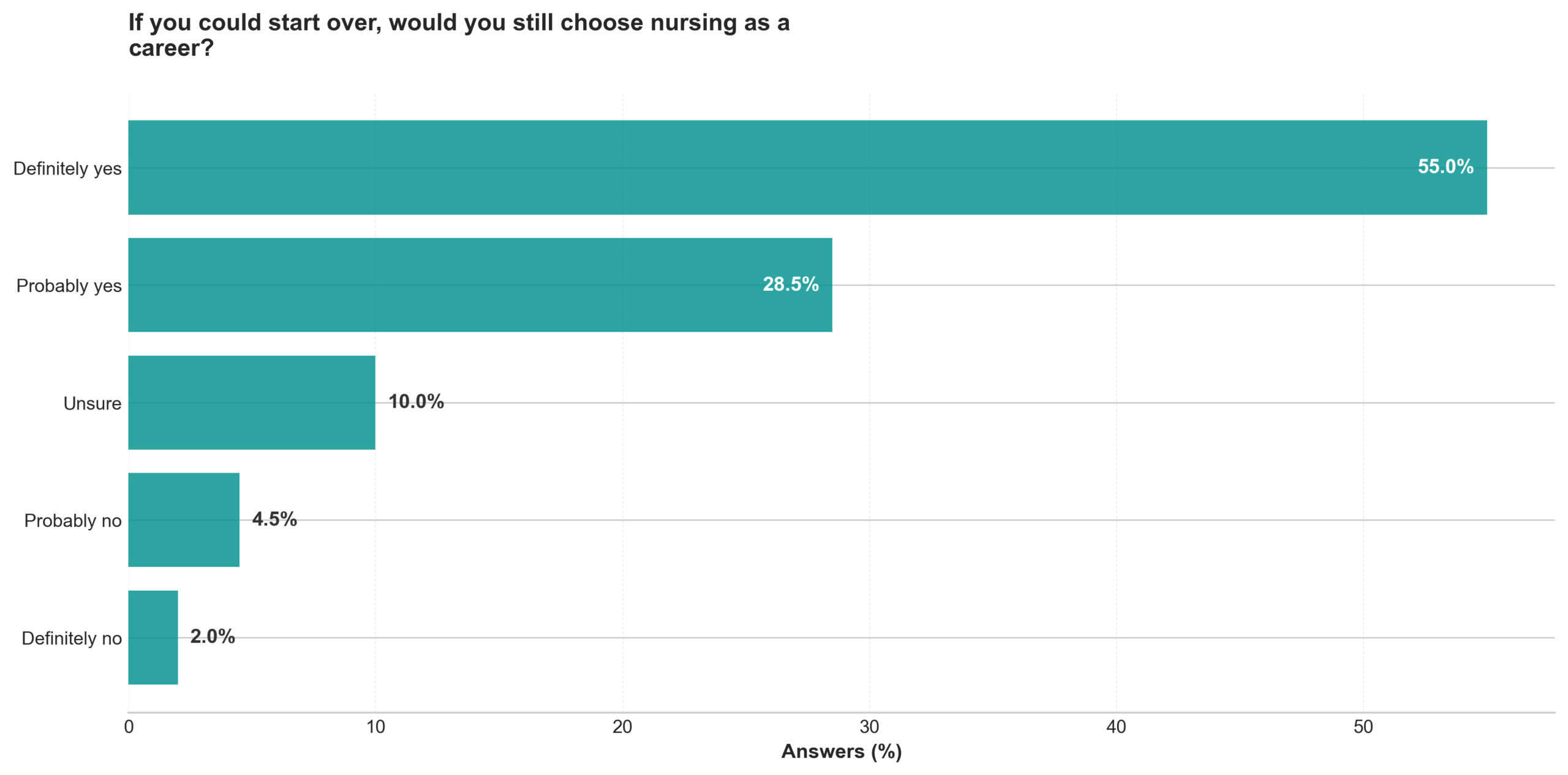
55% of college-educated nurses in the US say they would definitely still choose nursing as a career if they could start over

Even an opportunity to start over doesn’t change everyone’s career path:

If you could start over would you still choose nursing as a career?

Things don’t always work out as planned, and that’s as true for career choices as it is for anything else in life. On the topic of whether they would still choose nursing as a career if they could start over, 55% of our audience say they definitely would, although 29% are less confident, saying they probably would. This implies these segments of our audience enjoy a great degree of job satisfaction, even if the work they do presents challenges from time to time.

While 10% say they’re unsure they would choose the same career, 5% say they probably wouldn’t. Only 2% say they definitely would not choose nursing again. The attitudes of these audience segments may be due to their experiencing job dissatisfaction.

Research published by the HRSA in 2024 revealed that the percentage of nurses who expressed some dissatisfaction with their job increased from 11% in 2017 to 20% in 2022, with nurses with patient care responsibilities experiencing a greater decline in satisfaction than those without these responsibilities.

Additionally, job satisfaction declined in 20 of the 21 clinical specialties in the same period. The most common reasons nurses gave for switching nursing jobs after December 31, 2021, included burnout, staff shortages, and a stressful work environment.

Comparing participants’ dissatisfaction rate (16.5% answering unsure or in the negative) with the 20% identified by HRSA’s research, it is worth noting that nurses with a college degree seem to express somewhat lower rates of dissatisfaction with their career choice. Whether attributable to more comprehensive preparation or better opportunities, a degree seems to increase the likelihood of satisfaction in Nursing.


How Likely Are You To Recommend Nursing As A Career To Prospective Students?

39% of college-educated nurses in the US say they are extremely likely to recommend nursing as a career to prospective students

Nursing as a recommended career comes highly rated:

How likely are you to recommend nursing as a career to prospective students?

Above, we saw how well over half of our audience would still choose nursing if they could start over. Unsurprisingly, our audience also has largely positive feelings about recommending nursing as a career to prospective students.

39% say it’s extremely likely, and 34% say it’s very likely they would recommend it. 17% weren’t as certain, saying they’re somewhat likely to recommend it. The enthusiasm of these audience members may be due to job satisfaction and their own appreciation of the role nurses play in society. It may also be due to the potential for career diversity and growth, as evident in some of the statistics above.

In comparison, only 5% are uncertain, saying they’re neither likely nor unlikely to recommend a nursing career, while 4% say they’re somewhat unlikely to recommend it. Just 1% say they’re extremely unlikely to recommend nursing, and less than 1% say they are very unlikely to do so. This highlights how many enjoy their careers compared to those who do not.

The fact that 73% of respondents consider themselves extremely or very likely to recommend nursing to prospective students is a strong indicator of career satisfaction. This statistic suggests that college educated nurses enter the field well prepared for its challenges. 

Interestingly, only 10.5% of respondents are unsure or unlikely to recommend nursing to prospective students, which is a markedly smaller percentage than the 16.5% who registered ambivalent or negative feelings about their own choice. This discrepancy may suggest that individual regret has more to do with personal circumstances than with disillusionment about the field of nursing itself.

The Bottom Line

These statistics provide thought-provoking insights into the experiences and perceptions of college-educated nurses in the US. For most of our audience, nursing is a rewarding career that offers plenty of scope for growth, development, and specialization, even if it presents a range of challenges.

Encouragingly, most graduates find work relatively soon, if not immediately, after graduating, with many of these nurses being employed in their desired roles. Still, those considering a nursing career need to be fully aware of the advantages and disadvantages involved so they can make an informed decision, bearing in mind the profession’s vocational nature.

Prospective students should also be aware that, given the projected shortage of nurses in the US, they may encounter challenging working conditions. Even so, as many nurses would agree, the rewards of the profession far outrank the downsides.

Methodology

Sourced from an independent Artios poll of 500 college-educated nurses in the United States. Responses are collected within a 95% confidence interval and 5% margin of error.

About the data:

  • 72% of college-educated nurses in the United States are between the ages of 22 and 44.
  • 55% identify as male and 45% as female.
  • 72% are employed full-time.
  • 81% speak no second language, while 13% speak Spanish.
  • 40% earn between $75,000 and $149,999 annually.
  • 55% are classified as white and 27% African American.
  • The highest number (10%) is based in New York.

Filed Under: Academics, Home, Insights, Nursing

  • « Go to Previous Page
  • Page 1
  • Page 2
  • Page 3
  • Page 4
  • Interim pages omitted …
  • Page 92
  • Go to Next Page »
BAC logo

Contact

100 Belmont-Mt. Holly Road
Belmont, NC 28012

ADMISSIONS: 1-704-461-7500
FINANCIAL AID: 1-704-461-7000
MAIN NUMBER: 1-704-461-6700
FAX: 704-461-6220

info@bac.edu

Quick Links

  • DIRECTIONS TO THE COLLEGE
  • SUPPORT THE COLLEGE
  • TITLE IX
  • CAMPUS DIRECTORY
  • BELMONT ABBEY MONASTERY
  • THE CATHOLIC SHOPPE
  • CAMPUS SAFETY
  • COLLEGE BOOKSTORE
  • PRESS INQUIRIES
  • ADMISSION INFORMATION
  • VISIT
  • CAMPUS MAP
  • EMPLOYMENT OPPORTUNITIES
  • PERFORMING ARTS

100 Belmont-Mt. Holly Road
Belmont, NC 28012

ADMISSIONS: 1-888-222-0110
MAIN NUMBER: 1-704-461-6700
FAX: 704-461-6220

info@bac.edu

Copyright ©2026 Belmont Abbey College | Minutes from Charlotte, we are ranked one of the top comprehensive colleges in the South by US News and World Report. Since 1876, the mission of Belmont Abbey College is the education of students from diverse religious, ethnic, and cultural backgrounds in the liberal arts tradition as guided by our catholic intellectual heritage and inspired by the 1500-year-old Benedictine monastic tradition. | Privacy Policy | Designed by Fuzati
NewmanGuide USNews StudyDotCom
Copyright ©2026 Belmont Abbey College | Minutes from Charlotte, we are ranked one of the top comprehensive colleges in the South by US News and World Report. Since 1876, the mission of Belmont Abbey College is the education of students from diverse religious, ethnic, and cultural backgrounds in the liberal arts tradition as guided by our catholic intellectual heritage and inspired by the 1500-year-old Benedictine monastic tradition. | Privacy Policy | Designed by Fuzati
Copyright ©2026 Belmont Abbey College | Privacy Policy | Designed by Fuzati
Honors Readyapply Desktop 1

Are you a current North Carolina High School student?

YES!
NO!
EXPLORE ADMISSIONS
Honors Readyapply Desktop 1

So that we can take you to the right application form, tell us: are you a current North Carolina High School student?

YES! APPLY NOW*
NO! APPLY NOW
EXPLORE ADMISSIONS

*You will be taken to the College Foundation of North Carolina to create a free account to apply.

Find Your Admissions Counselor
What type of student are you?(Required)
Are you a transfer student?

Your Admissions Counselor is:

Caroline Hohensee, Graduate and Online CoordinatorCaroline Hohensee
Graduate and Online Coordinator

carolinehohensee@bac.edu
Office: 704-461-6838

Your Admissions Counselor is:

John Blalock, Director of AdmissionsJohn Blalock
Director of Admissions

johnblalock@bac.edu

Your Admissions Counselor is:

Ethan McEntire, Admissions CounselorEthan McEntire
Admissions Counselor

ethanmcentire@bac.edu
Office: 704.954.8837

Your Admissions Counselor is:

Emily Hogan, Abbey Online CounselorEmily Hogan
Online Admissions Counselor

emilyhogan@bac.edu

Your Admissions Counselor is:

Angela LoyaAngela Loya
Admissions Counselor

angelaloya@bac.edu
Schedule a Conversation

Office: 704-461-5026
Mobile: 704-336-0265

Your Admissions Counselor is:

Elizabeth WelchElizabeth Welch
Transfer Admissions Counselor

elizabethwelch@bac.edu
Schedule a Conversation
Office: 704-461-7216 Mobile: 704-544-7758

Your Admissions Counselor is:

Julia Bournos, Assistant Director of AdmissionsJulia Bournos
Assistant Director of Admissions

Schedule a Conversation
juliabournos@bac.edu
Office: 704.461.6830 Mobile: 704.336.0289

Your Admissions Counselor is:

Alysa Miller, Admissions CounselorAlysa Miller
Admissions Counselor

alysamiller@bac.edu

Your Admissions Counselor is:

Frank Marie
Admissions Counselor

frankmarie@bac.edu
Also of Interest
  • College Academic Calendar in North Carolina
  • Dual Enrollment Program in Belmont
  • Academic Application Process in North Carolina
  • Menu Arrow About Us
  • Menu Arrow Academics
  • Menu Arrow Admissions
  • Menu Arrow Financial aid
  • Menu Arrow Campus Life
  • Menu Arrow Athletics
  • Menu Arrow Alumni
 
  • CATALOG
  • DEPOSIT
  • WELLNESS CENTER
  • CAMPUS DINING
  • GIVE
  • INCOMING STUDENTS
  • BOOKSTORE
  • LIBRARY
  • About Us
  • Mission and Vision
  • Abbey News
  • College Leadership
  • College Advancement
  • Basilica & Monastery
  • Benedictine Volunteer Corps
  • Library
  • Performing Arts
  • Belmont House
  • Accreditation
  • Academics
  • Undergraduate
  • Graduate
  • Abbey Online
  • Honors College
  • Faculty
  • Academic Calendar
  • Catalog
  • Career Services
  • Academic Resources
  • Transcripts & Diplomas
  • Admissions
  • Visits & Events
  • Premier Scholarship Programs
  • Info for School Counselors
  • Apply
  • Contact Admissions
  • Make Your Deposit
  • Financial Aid
  • Tuition & Fees
  • FAFSA Information
  • Premier Scholarship Programs
  • Contact Financial Aid
  • CARES Act
  • Campus Life
  • Campus Ministry
  • Residence Life
  • Student Activities
  • Clubs & Organizations
  • Wellness Center
  • Campus Safety
  • Parents Connect
  • Dining
  • Athletics
  • Belmont Athletics Teams
  • Recruit Central
  • Alumni
  • Homecoming
  • Resources
  • Reflections & Courses
  • Alumni News
  • Transcripts and Diplomas
  • Support the Abbey
  • Menu Arrow About Us
    • About Us
    • Mission and Vision
    • Abbey News
    • College Leadership
    • College Advancement
    • Basilica & Monastery
    • Benedictine Volunteer Corps
    • Library
    • Performing Arts
    • Belmont House
    • Accreditation
  • Menu Arrow Academics
    • Academics
    • Undergraduate
    • Graduate
    • Abbey Online
    • Honors College
    • Faculty
    • Academic Calendar
    • Catalog
    • Career Services
    • Academic Resources
    • Transcripts & Diplomas
  • Menu Arrow Admissions
    • Admissions
    • Visits & Events
    • Premier Scholarship Programs
    • Info for School Counselors
    • Apply
    • Contact Admissions
    • Make Your Deposit
  • Menu Arrow Financial Aid
    • Financial Aid
    • Tuition & Fees
    • FAFSA Information
    • Premier Scholarship Programs
    • Contact Financial Aid
    • CARES Act
  • Menu Arrow Campus Life
    • Campus Life
    • Campus Ministry
    • Residence Life
    • Student Activities
    • Clubs & Organizations
    • Wellness Center
    • Campus Safety
    • Parents Connect
    • Dining
  • Menu Arrow Athletics
    • Athletics
    • Belmont Athletics Teams
    • Recruit Central
  • Menu Arrow Alumni
    • Alumni
    • Homecoming
    • Resources
    • Reflections & Courses
    • Alumni News
    • Transcripts and Diplomas
    • Support the Abbey
My Abbey
Useful Links
 
  • CATALOG
  • WELLNESS CENTER
  • GIVE
  • BOOKSTORE
FacebookYoutubeXInstagramLinkedIn
  • DEPOSIT
  • CAMPUS DINING
  • INCOMING STUDENTS
  • LIBRARY


Useful links
  • Homecoming
  • Bookstore
  • Athletics Website
  • Incoming Students
  • Transcripts
  • Wellness Center
  • Make a Deposit
  • Majors and Minors
  • Benny Pack
  • Shuttle Schedule
    VISIT GET INFO APPLY GIVE