• Skip to main content
 

Belmont Abbey College

The Catholic College of the South

  • VISIT
  • Academics
  • Admissions
  • APPLY
  • GET INFO
  • Search
  • My abbey
  • GIVE

MACLE

March 25, 2026 By radefolaju Leave a Comment

Classical Education Statistics USA 2025 | Belmont Abbey College

Classical education is often discussed in abstract or idealized terms, shaped by tradition, philosophy, and historical reputation rather than by students’ lived experiences. Public conversations tend to focus on what classical education ought to be, leaving less room for how it is actually delivered, understood, and applied by graduates as they move through advanced, text‑centered classical study and into professional environments.

To better understand the realities of classical education in the United States, we polled 500 university- or college-level classical education graduates to get a practical look at where and how classical education is taught, which subjects and frameworks receive the most emphasis, and how this form of study shapes careers, skills, and long-term satisfaction beyond graduation.

Index

  • 39% of university or college-level classical education graduates graduated with a classical or liberal arts degree from a state or public university.
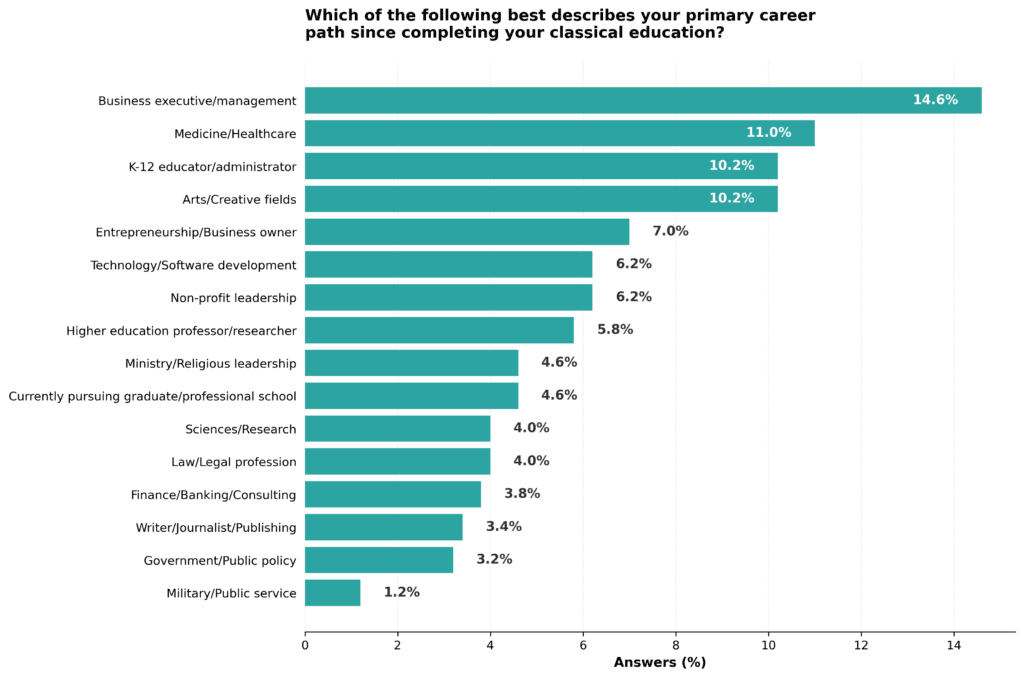
  • Our survey shows that a classical education prepares students for virtually any career, with the largest proportion of respondents pursuing a business executive or management position.
  • A preponderance of university or college-level classical education graduates describe their institution’s curricular approach to the Western canon as providing comprehensive coverage across ancient, medieval, and modern periods.
  • 80.5% of university or college-level classical education graduates’ institutions taught the quadrivium or trivium either informally, formally, or systematically.
  • The variety of responses among university or college-level classical education graduates indicated that classical education had the potential for balance across the major disciplines.
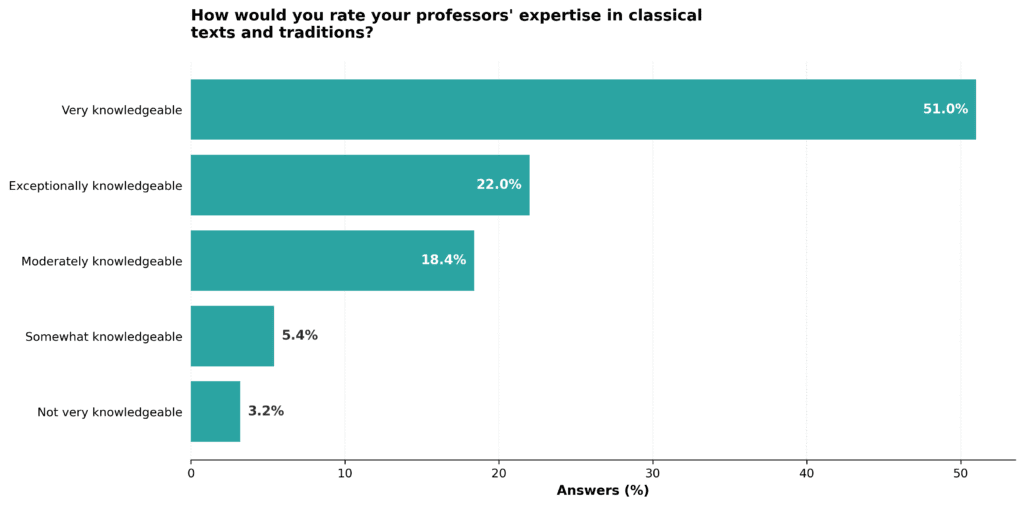
  • 73% of university or college-level classical education graduates rate their professors’ expertise in classical texts and traditions as exceptionally to very knowledgeable.
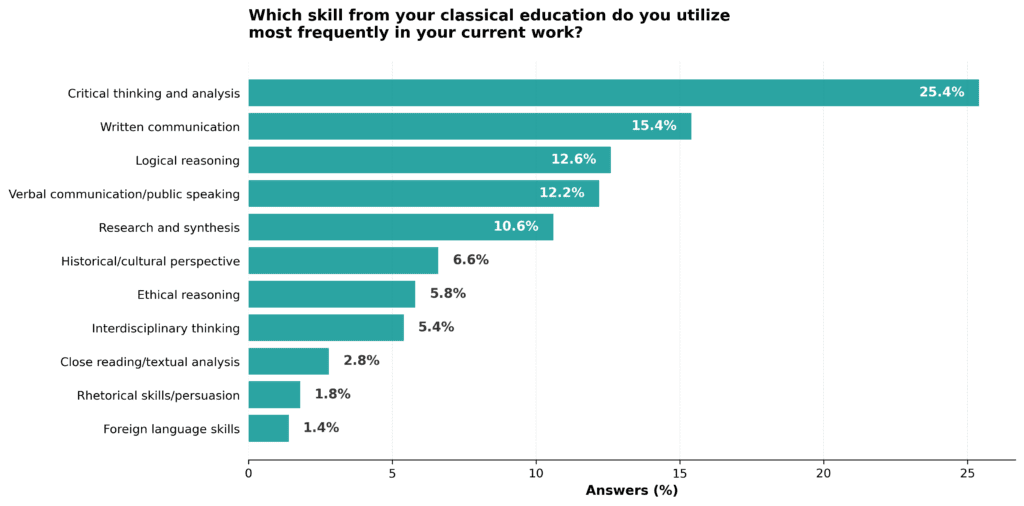
  • Of the many professional benefits to classical formation, the preponderance of university or college-level classical education graduates make most consistent use of the critical thinking and analysis skills they developed through their education.
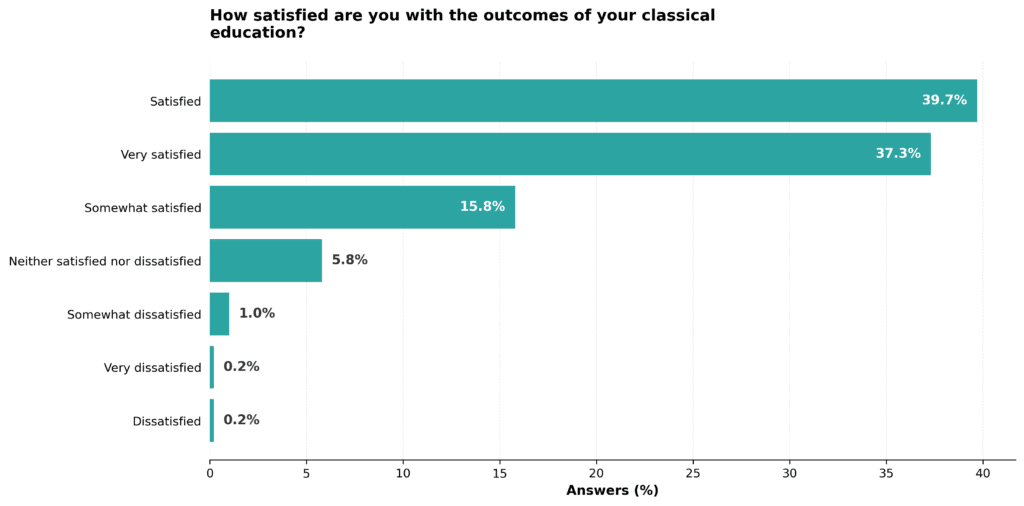
  • 77% of university or college-level classical education graduates are satisfied with the outcomes of their education.
  • 67% of university or college-level classical education graduates are extremely likely or very likely to recommend classical education to prospective students.
  • 76.4 % of university or college-level classical education graduates would likely still choose classical education if they were to start over.
  • Classical Study Shaping Modern Careers
  • About The Data

Which Type Of Institution Did You Graduate From With Your Classical Or Liberal Arts Degree?

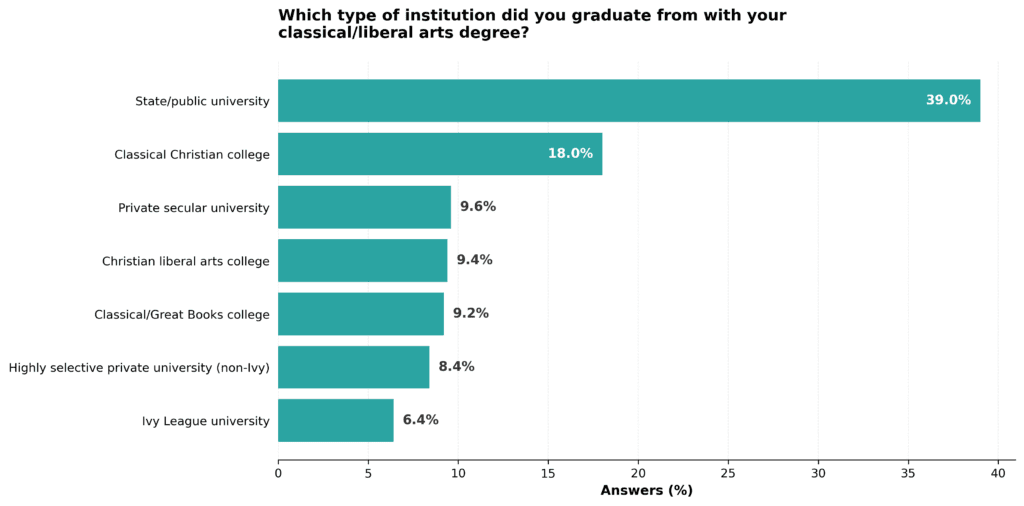
39% of university or college-level classical education graduates graduated with a classical or liberal arts degree from a state or public university.

Graduates obtained their degrees from different types of institutions:

Which type of institution did you graduate from with your classicalliberal arts

The many different types of higher educational institutions in the US are reflected in our polled group’s answers. 39% graduated with a classical or liberal arts degree from a state or public university, while 18% say they graduated from a classical Christian college; possibly for the reasons mentioned above.

Interestingly, while these institutions remain popular and prestigious, they’re fewer in number than other institutions. According to the National Center for Education Statistics, there are approximately 1,900 to 2,000 public postsecondary institutions in the US, including four-year universities and community colleges. However, these are outnumbered by the 3,900 to 4,000 degree-granting private colleges in total.

As for the rest of our audience, 10% say they graduated from a private secular university, while another 9% say their alma mater is a classical or Great Books college. An additional 9% say they received their degrees from a Christian liberal arts college, again highlighting preferences for faith-based institutions. Only 6% name an Ivy League university, while the remaining 8% say they graduated from a highly selective private university (non-Ivy). The latter two types of institutions are known for their exclusivity due to stringent entrance requirements and high tuition costs.

A Note from the Abbey:

The fact that only 27.4% of respondents attended a Classical Christian or Christian liberal arts college, while 39.1% attended a State or public university and 9.6% a Private secular university, suggests two important features of the Classical education landscape.

First, the value of a classical education does not require adherence to any particular faith but is readily demonstrable through reason and experience. Second, the additional benefit to framing classical education within the Christian tradition, a rich and deeply intellectual tradition that has preserved and sustained the classical tradition itself for centuries, still presents an underutilized opportunity. Even taking into consideration the additional 8.4% of respondents who attended highly selective private universities – some proportion of which may also be Christian institutions – well under half (and potentially under one-third) of respondents received a classical education in the Christian tradition.

Read more about the Christian approach to Truth, Goodness, and Beauty in classical education here >>


Which Best Describes Your Institution’s Approach To The Western Canon Curriculum?

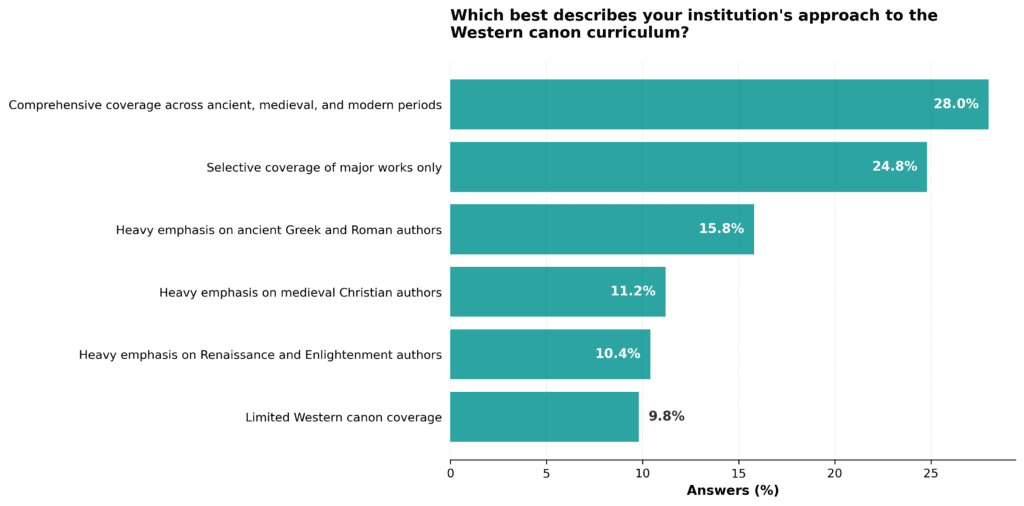
A preponderance of university or college-level classical education graduates describe their institution’s approach to the Western canon curriculum as providing comprehensive coverage across ancient, medieval, and modern periods.

Curriculum approaches differ somewhat:

Which best describes your institutions approach to the Western canon curriculum

Approaches to the Western canon curriculum are as varied as the institutions attended by the US university or college-level classical education graduates in our poll. Slightly more than a quarter (27%) of our audience says their institution provides comprehensive coverage across ancient, medieval, and modern periods, while slightly less than a quarter (24%) says their institution offers selective coverage of major works only. The latter approach may be due to these institutions’ need to cover a vast period of history in a shorter timeframe – i.e, within two years, rather than four.

15% say their institution emphasizes ancient Greek and Roman authors heavily, while 12% say the emphasis at their institution leans heavily on medieval Christian authors, which may be because those institutions are faith-based. 9% say their institution offers limited coverage of the Western canon, which may be due to inclusivity or decolonization efforts, while another 9% say their institution places heavy emphasis on Renaissance or Enlightenment authors.

It’s interesting that roughly a quarter of our audience received comprehensive coverage over a variety of historical periods, while all other segments received education emphasizing particular works or periods. There’s something to be said for expanding the scope of the Western canon. According to EBSCO, the major reasons for doing so include broadening perspectives by including authors with different views informed by different experiences, to correct the historical exclusion of women, people of color, and minority cultures from the traditional Western canon, to better reflect contemporary society, and to promote literary innovation.

A Note from the Abbey:

While the incarnational reality of human experience certainly invites us to engage a variety of authors and perspectives in the centuries-long and ever lively pursuit of Truth, Beauty, and Goodness, it is important not to neglect the foundational texts of Western culture, which have formed our societies and guided our thinkers for generations.

Thanks to the universal element of human nature, we can ask the same essential questions that Homer and Plato did; we can empathize with the fears and desires of Jane Austen’s characters and follow John Locke’s train of thought. But it is also true that our understanding, as we explore the continued conversation of human culture, ideas, and ideals, deepens and grows richer as we engage with the authors who influenced each other across centuries.

In the great, ongoing conversation that is Western culture, we become more effective and active participants when we understand what others have said and how the greatest authors of antiquity influenced those who came after them: how Enlightenment thinkers influenced the Romantics or how twentieth-century authors responded in their turn.


Which Classical Framework Did Your Institution Teach Most Systematically?

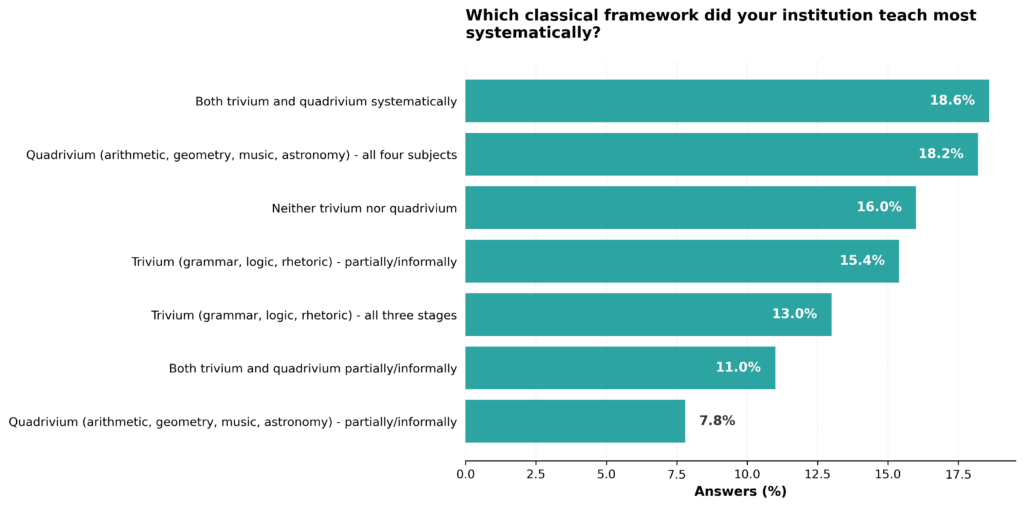
80.5% of university or college-level classical education graduates’ institutions taught the quadrivium or trivium at least informally, formally, or systematically.

Classical frameworks were taught in varying ways:

Which classical framework did your institution teach most systematically

The many different institutions attended by our audience teach classical frameworks in varied ways. Three approaches stood out from the rest. 18% say their institution teaches all four subjects of quadrivium (arithmetic, geometry, music, and astronomy) most systematically, while another 18% say their institution teaches both trivium and quadrivium systematically. This suggests that at least some institutions still value a thoroughly traditional approach to teaching classical frameworks, aiming to do so as comprehensively as possible.

14% of those we polled say their institution teaches trivium partially or informally, while another 14% say they were taught all three stages of trivium systematically. However, 11% say their institution has a partial or informal approach to teaching both trivium and quadrivium, and 7% say their institution teaches quadrivium partially or informally. Another 18% say their institution teaches neither trivium (grammar, logic, rhetoric) nor quadrivium systematically.

That so few institutions take a systematic approach to teaching trivium or quadrivium is possibly due to much of the content of these subjects being outdated when compared to modern STEM and humanities, which many institutions prefer to focus on. It’s highly likely that teaching students modern subjects increases the scope of their potential career opportunities after graduation.

A Note from the Abbey:

The trivium and quadrivium, which comprise the liberal arts, and from which the tradition of classical education springs, offer an essential foundation to any career or vocation because they aim at forming the student for human excellence: to seek the Good and develop our natural gifts. In particular, the trivium – Grammar, Logic, and Rhetoric – cultivate critical thinking, communication, and ordered thought, all of which contribute immeasurably not only to STEM fields but also to personal and professional life as a whole.

Often, systematic approaches, especially to the trivium, occupy primary and secondary school curricula. Systematic instruction in grammar, logic, and rhetoric all lend themselves to the kind of student formation preceding the college or university level, which tends to embrace application, analysis, and synthesis to a greater degree. This may be why comparatively few colleges and universities, in the experience of those polled, employ a systematic approach to these subjects. Classical programs could certainly engage the trivium in robust ways without systematically addressing it.

It is perhaps more interesting to note the comparative lack of systematic attention to the quadrivium, which naturally succeeds the trivium in terms of curricula. The liberal arts traditionally include not only grammar, logic, and rhetoric, but also arithmetic, geometry, music, and astronomy, but many liberal arts programs tend to focus on philosophy, theology, history, literature, and other areas of the humanities. In fact, it would be worth exploring how closely the humanities and the liberal arts have become associated in common parlance, thus effectively comparing ancient and contemporary understandings of what is necessary and sufficient to a full liberal arts education.


Which Single Subject Area Received The Greatest Emphasis As A Core Component Of Your Institution Classical Education Program?

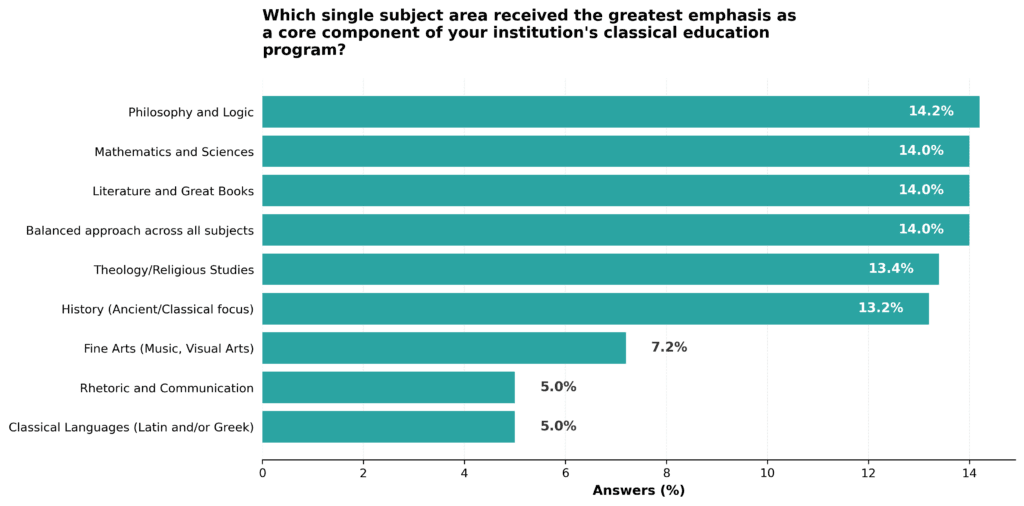
A majority of university or college-level classical education findings show that classical education had the potential for balance across the major disciplines.

Core components of classical education systems show specific areas of focus:

Which single subject area received the greatest emphasis as a core component of

The single subject areas that received the greatest emphasis as a core component of the classical education program vary significantly from institution to institution. Interestingly, no single subject area emerged as a clear leader in our poll. 14% say theology or religious studies received the greatest emphasis, possibly due to them studying at a faith-based institution, while another 14% say their institution places the greatest emphasis on philosophy and logic, highlighting reason, thought, and metaphysics from a secular perspective.

For another 14%, the emphasis is on mathematics and sciences (whether thoroughly classical or modern STEM is unclear), while, for yet another 14%, it’s on literature and Great Books. An additional 14% say their institution places the most emphasis on history, with the focus being on ancient and classical history.

Yet another 14% say their institutions take a balanced approach across all subjects, offering a well-rounded classical education. Only 9% say their institution emphasizes fine arts (music and visual arts) over other subjects. As for the remainder of our audience, 5% say the greatest emphasis is on rhetoric and communication, while another 5% say classical languages, including Latin and/or Greek.

The continued teaching of Latin, which has long been regarded as a dead language, remains a topic of debate in educational institutions. Even though there are no first-language Latin speakers, and the language isn’t used in everyday conversations, there are significant benefits to studying it.

Among these benefits is the advantage that knowledge of Latin offers when studying other languages, particularly other inflected languages such as German or Russian and Romance languages such as Portuguese, Romanian, Spanish, or Italian. The study of Latin can help students in various professions in which many terms or phrases have Latin origins. Additionally, learning Latin allows students to read numerous classical works in their original language, the impact of which can be profound.

A Note from the Abbey:

Classical study approaches great works and ideas as more than artifacts of historic interest. Students read and explore Plato, Aristotle, Rousseau, Dostoevsky, and others not simply because these individuals were significant to their own cultures and times but also because of the essential continuity between past and present.

Certainly those living in ancient Greece or nineteenth century Russia view the world and their place in it differently than contemporary American students do, but across eras and cultures, there are also universals rooted in human nature, objective reality, and natural law. Across all human experience, the driving question of what it means to be human and to live well remains comprehensible. Within and through all cultural expressions, we grapple with the same essential questions, recognizing our own limitations, fears, desires, and characters in the humanity of those who lived across the world thousands of years ago.

By a similar token, no language that connects us to these great thinkers can ever be fully dead.

Particularly within the Catholic liberal arts community, the Latin language has enjoyed a certain renaissance even outside its ongoing liturgical use in the Church. A “Living Latin” contingent advocates for conversational use of the classical tongue, and during international conferences and gatherings of both an ecclesial and scholarly nature, Latin sometimes provides the necessary bridge in communication by offering a common language.


How Would You Rate Your Professors’ Expertise In Classical Texts And Traditions?

73% of university or college-level classical education graduates rate their professors’ expertise in classical texts and traditions as exceptionally to very knowledgeable.

Overall, classical knowledge is high amongst professors:

How would you rate your professors expertise in classical texts and traditions

The thought that we live in a country where even some university or college professors are not particularly knowledgeable about various aspects of their areas of expertise is concerning. However, we were pleased to see that most university- or college-level classical education graduates polled hold a high regard for their professors’ expertise in classical texts and traditions. 50% say their professors are very knowledgeable, while 23% describe their professors as exceptionally knowledgeable.

The rest of our audience was somewhat less generous in their assessments, with 18% saying their professors are moderately knowledgeable and 5% saying theirs are somewhat knowledgeable. Only 3% say their professors are not very knowledgeable.


Which Of The Following Best Describes Your Primary Career Path Since Completing Your Classical Education?

Our survey shows that a classical education prepares students for virtually any career with the largest proportion of respondents pursuing a business executive or management position.

Career paths reflect similar trends for graduates:

Which of the following best describes your primary career path since completing

A classical education can open doors to a wide range of career opportunities or provide a solid foundation for studies in preparation for various professions. 16% of those we polled say their primary career path since completing their education has been that of a business executive or in management, suggesting their courses may have emphasized subjects such as mathematics or philosophy.

For 8%, their career path has been in technology or software development, both of which are built on the foundations of logic. Another 8% followed a career in nonprofit leadership, while an additional 8% entered ministry or religious leadership. It’s likely these graduates studied at a faith-based university or college for this purpose.

Yet another 8% say their career path has been in medicine or healthcare. K-12 educator or administrator best describes the path of 8%, while an additional 8% became higher education professors or researchers, indicating they opted for further studies after completing their bachelor’s degrees. 8% became entrepreneurs or business owners, another 8% say they’re currently pursuing graduate or professional school, and 8% found employment in the arts or creative fields.

A Note from the Abbey:

The fact that classical graduates go on to a comparatively wide variety of careers indicates that this education provides an effective foundation across numerous fields and disciplines. The kinds of skills that classical, liberal arts education cultivates are profound assets to many careers because they develop fundamental human capacities and understandings.

At its best, classical study forms essential analytic and communication skills, while the Socratic seminars typical of classical programs exercise creativity, intellectual honesty, empathy, and collaboration. The greater proportion of business executive and management employees among the classical graduates polled perhaps highlights this character of classical education, which blends interpersonal, communication, and critical thinking skills so effectively.

Alongside the broad applicability of classical programs, it is also worth noting that institutions that combine a classical or liberal arts approach with options for more career-specific programs might have particular impact. For this reason, in addition to the full, eight-semester complement of Great Books courses, Belmont Abbey’s Honors College offers alternative credit level options, which enable students to study Great Books as a major or a minor while simultaneously completing another major, reaping the significant benefit of classical formation alongside a more field-specific education.


Which Skill From Your Classical Education Do You Utilize Most Frequently In Your Current Work?

28% of university or college-level classical education graduates use the critical thinking and analysis skills they learnt from their education most frequently in their work.

Multiple skills are used by graduates in the workplace:

Which skill from your classical education do you utilize most frequently in your

Classical education equips students with a range of skills that can be put to good use in a variety of job roles. More than a quarter (28%) of the university or college-level classical education graduates we polled say the skill they use most frequently in their current work is critical thinking and analysis. This finding is unsurprising, as the World Economic Forum’s Future of Jobs Report 2025 reveals that 69% of employers regard analytical thinking as an essential skill. The second most mentioned skill is written communication (17%), followed by verbal communication or public speaking (11%).

Another 11% say they use research and synthesis skills most frequently, and yet another 11% say they use logical reasoning, which is reinforced by subjects such as mathematics, the sciences, philosophy, and logic. The skills mentioned by the remainder of our audience include interdisciplinary thinking (6%), historical/cultural perspectives (6%), ethical reasoning (6%), and close reading or textual analysis (6%).


How Satisfied Are You With The Outcomes Of Your Classical Education?

77% of university or college-level classical education graduates are satisfied with the outcomes of their education.

The majority are satisfied with their education:

How satisfied are you with the outcomes of your classical education

Our poll found that the majority of university or college-level classical education graduates were relatively satisfied with the outcomes of their education. 39% say they’re very satisfied, while another 37% say they’re satisfied, and 16% say they’re somewhat satisfied.

This suggests that the education they received played a role in opening doors to various careers and allowing them to advance in their chosen career pathways. Only 6% say they are neither satisfied nor dissatisfied. No respondents reported dissatisfaction at any level.


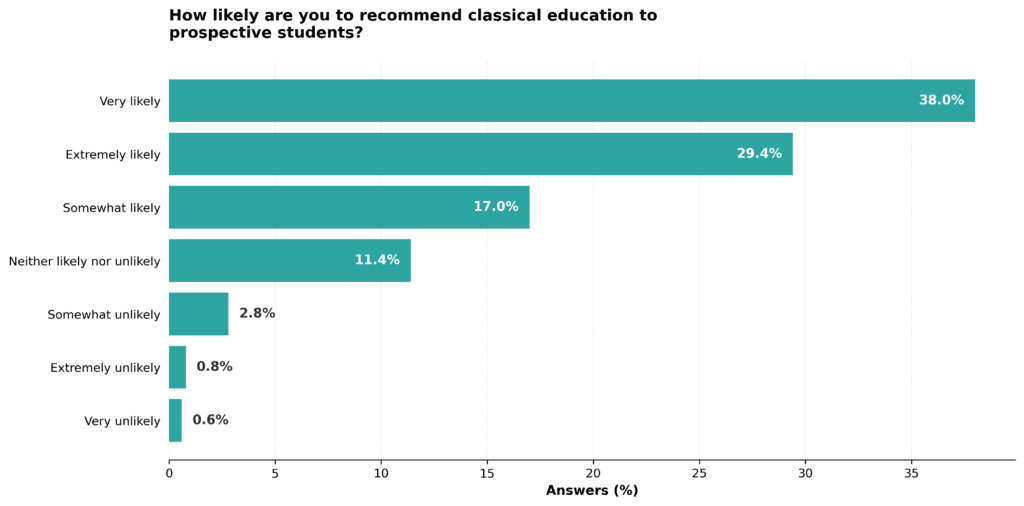
How Likely Are You To Recommend Classical Education To Prospective Students?

67% of university or college-level classical education graduates are extremely likely or very likely to recommend classical education to prospective students.

Classical education comes highly recommended:

How likely are you to recommend classical education to prospective students

Given the high levels of satisfaction, the skills graduates use, and the varied career paths mentioned earlier in this article, it’s not surprising that the majority of those we polled are happy to recommend classical education to prospective students. More specifically, 38% say they’re very likely, while 29% say they’re extremely likely to recommend it. 17% say they’re somewhat likely to make a recommendation.

However, not everyone in our audience was as committed or enthusiastic about classical education, with 11% saying they’re neither likely nor unlikely and 2.8% saying they’re somewhat unlikely to recommend it.

Regardless of whether graduates encourage or discourage prospective students to choose this academic path, it must be recognized that recommendations by people carry weight. 92% of consumers trust recommendations from friends or family, and 84% trust recommendations from peers, over adverts.


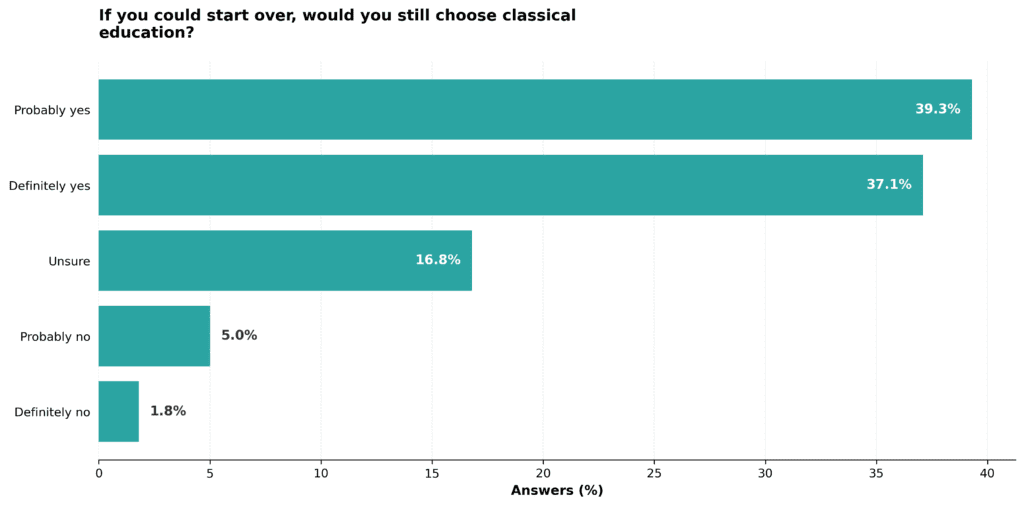
If You Could Start Over, Would You Still Choose Classical Education?

76.4 % of university or college-level classical education graduates would likely still choose classical education if they were to start over.

Classical education remains a top choice:

If you could start over would you still choose classical education

We weren’t surprised to find that the majority of our audience believes they made the right decision regarding their higher education and that, given the opportunity, most would be likely to choose classical education again. Among those who say they would, the degrees of certainty were either ‘probably’ (39%) or ‘definitely’ (37%).

16% of those we polled say they’re unsure, while 5% say they probably wouldn’t, and 1.8% say they definitely wouldn’t choose classical education if they could start over. Those who express uncertainty or refusal are likely among the graduates who expressed neutrality when asked about their level of satisfaction, and those who aren’t likely to recommend classical education to prospective students.

This suggests that, for at least some graduates, the courses they studied, or their career trajectories, did not meet their expectations. It’s also possible their responses were influenced by their experiences as students, such as which subjects were emphasized or how knowledgeable their professors were.

A Note from the Abbey:

It is interesting to consider these three final questions side by side, since even though only 1.4% of participants expressed dissatisfaction with the outcomes of their education (and only 5.8% indicated ambivalence), 6.8% of participants anticipate they would choose not to pursue classical education if they could start over (with an additional 16.8% unsure), while only 4.2% of participants were unlikely to recommend classical education to prospective students (and 11.4% remained ambivalent).

Since the outcomes of classical education received overwhelmingly positive acknowledgement, the effectiveness of such programs and the personal enrichment attendant on this formation seem not to be at issue. It seems probable, rather, that some external factor or factors exert pressure on those participants who would – despite admitted satisfaction with the outcomes – choose a different course if faced with the same decision. The fact that the number of participants unlikely to recommend classical education to prospective students remains smaller than the number who would choose differently for themselves also suggests that personal factors are more likely at issue than the value of the education itself. Such factors might well involve the cost of education and the rising problem of student debt. If participants were swayed primarily by changing attitudes toward education itself, we would expect roughly the number to provide negative responses to both of the final questions.


Classical Study Shaping Modern Careers

Overall, it’s easy to see that classical education in the United States continues to prove its relevance in a rapidly changing world. Grounded in enduring texts, disciplined reasoning, and a broad intellectual tradition, it equips graduates with adaptable skills that extend well beyond the classroom.

Whether applied in leadership, professional practice, or lifelong learning, the principles of classical study remain a strong foundation for thoughtful engagement, ethical decision-making, and meaningful contribution across careers and communities.


About The Data

Sourced from an independent Artios poll of 500 University or college-level classical education graduates in the US. Responses are collected within a 95% confidence interval with a 5% margin of error.

Graduate demographics:

  • 55% of university or college-level classical education graduates in the US are between the ages of 22 and 44.
  • 56% are employed full-time
  • 51% identify as female and 49% as male
  • 20% earn between $50,000 and $74,999
  • 85% speak no second language
  • 67% are classified as white
  • The highest number (12%) is in Florida.

Filed Under: Abbey News, Honors College News, MACLE

November 14, 2024 By radefolaju Leave a Comment

Should I get my master’s degree…? 6 Reasons we don’t take the leap

Have you considered going back to school for your master’s? Certainly, it can be a daunting prospect, but the truth is that most of the things that hold us back from the adventure of a graduate degree aren’t quite the deal-breakers we imagine…

In case you’re wondering whether or not to take the next step, here are the top six reasons we don’t pursue the higher education that could change our lives and careers.

We think…

  1. It’s too expensive. By now we’re used to hearing about prohibitively expensive education and overwhelming burdens of student debt. However, not every program comes with this kind of cost. Belmont Abbey’s School of Graduate and Professional Studies conscientiously maintains affordable rates and meaningful financial aid options in order to ensure that its master’s programs remain accessible to young professionals.
  2. I don’t have time. We all lead busy lives, so it can be difficult to see where a degree program might fit on a daily basis. Certainly, graduate studies require a time commitment, but Belmont Abbey master’s students find that the program’s flexible online structure not only presents manageable requirements but also strengthens the skills and strategies that bring new levels of fruitfulness to your time outside of coursework.
  3. I won’t be able to balance my full-time job. While career and classes both require time and attention, Belmont Abbey’s flexible online graduate programs are designed for the full-time professional. The nature of a master’s degree, moreover, recognizes professional goals and networks as essential elements of the program. In fact, remaining actively engaged in a career throughout your graduate studies can actually help enrich and contextualize coursework by uniting it with consistent, hands-on experience. Ultimately, the Abbey’s graduate degrees aim to enhance career success and take you to the next level without demanding that you put your job or life on hold.
  4. I won’t be able to balance my home life. Because we love our families and honor our responsibilities to them, we should evaluate the demands that our prospective studies might make on life at home. We know that creating personal and family balance during our graduate studies will present challenges like any meaningful commitment. And yet, graduates of Belmont Abbey’s master’s programs demonstrate time and again that the flexible nature of the online coursework and the responsive accessibility of professors help encourage and sustain successful balance. It’s also important to remember that your loved ones want to see you succeed and that your family, as they accompany you on this educational journey, can be a true source of strength.
  5. It’s too late at this point. Whether you’re fresh out of college or bringing years of career experience to the decision, it’s never too late to pursue the personal excellence and increased expertise of a graduate degree. The benefits to your personal and professional development remain profoundly relevant at any stage of your career.
  6. It’s just not worth it. There are many reasons why this last is a tempting but ultimately unsatisfactory conclusion. A graduate degree is not everyone’s calling, but if it’s yours, the benefits to your earning power, advancement, career satisfaction, personal development, and community relationships remain profound and substantial. In fact, to explore 10 reasons to complete your graduate degree, click here.

Although none of the above should prevent you from pursuing the transformative education to which you are called, going back to school will always present challenges and require the discipline of sacrifice. Just remember that education is an investment in the future – your own and your community’s – and when we respond to a genuine calling with generosity and love, the blessings are always greater than we can anticipate.

When you’re ready to take the next step, Belmont Abbey College is here to help. Explore our flexible, affordable online graduate degree programs and discover how a master’s could change your life and your career! Click here to check out our MBA, MSN, MS in Data Analytics, or MA programs in Classical and Liberal Education, Communication, or Leadership.

Filed Under: Abbey News, Abbey Online, Home, MACLE, MBA Tagged With: graduate degrees, masters

November 13, 2024 By radefolaju Leave a Comment

Is a Master’s Worth it?

Wondering why you should get a master’s degree? Explore these 10 reasons to take your education to the next level.

Getting your master’s can be a daunting prospect, especially for busy professionals seeking to maintain balance amid work, family, and personal commitments. It’s worth pausing to consider, however, what a graduate degree could mean for you – especially since assessing the benefits can help shed light on what you want from your career and your life as a whole.

So… if you are a working professional, what ARE the benefits of earning a master’s?

Ultimately, a master of arts or sciences empowers you to:

  1. Further discern your calling by engaging meaningfully with an area of personal or professional interest. A degree program can clarify unexplored possibilities for growth within your chosen field, highlighting the industry needs and opportunities that invite your unique contribution . Graduate programs offer more opportunities to engage your field at the cutting edge as professors provide context and guide you in making original contributions to the academic and professional conversation. Even more than an undergraduate degree, graduate studies position you to recognize and embrace the possibilities of your field or discipline.
  2. Increase your earning power. Full-time, 25-34 year old professionals with a master’s degree earn a 20% higher median salary than those whose highest level of education remains at the undergraduate level, according to the National Center for Education Statistics. Completing your master’s qualifies you to climb the salary scale with greater confidence.
  3. Learn from – and join – experts in your chosen field. Graduate professors combine education, training, and experience in a way that uniquely qualifies them to provide the formative guidance you need to excel both personally and professionally. They have dedicated their exceptional knowledge and skills to helping you achieve success, ultimately facilitating your growth toward new levels of collaboration in your discipline or field.
  4. Alongside a verified standard of knowledge, skill, and critical thought, a master’s degree demonstrates your disciplined commitment to a field. A master’s signals not only that you are prepared for enhanced responsibilities and greater opportunities, but also that you are willing to embrace challenges, learn new skills, and develop your potential. Colleagues and supervisors recognize this, and the recognition transforms your professional landscape.
  5. Expand your professional network through the connections and opportunities available within a college community. Even beyond hands-on learning, research, thesis development, and conferences, the institutional life of a college includes a community of alumni, professors, and peers who can provide support and invaluable connection. In terms of resources for higher education and advancement, graduate degree programs remain particularly attuned to the active professional life since by its nature it seeks to prepare serious and aspiring participants for meaningful work in their chosen fields.
  6. Raise your promotion potential. Don’t let your education level keep you from career advancement, especially in an industry where education thresholds might otherwise curb your upward mobility or hold you back from the leadership only you can offer. A master’s degree demonstrates expertise that qualifies you to rise more quickly and confidently than you otherwise might have.
  7. Learn together with other motivated seekers. Aside from the professional advantages of earning your master’s – which includes a network of peers aspiring to more profound collaboration in their fields – the personal benefits of a learning community shouldn’t be underestimated. Engaging in the shared pursuit of excellence and exploring the depths and challenges of a chosen field offer a basis for lasting friendships and community, especially at the graduate level, where conversations seek and support original contributions at the very forefront of a discipline or industry.
  8. Open up new career opportunities. As you grow and develop both personally and professionally within a master’s program, the career opportunities open to you grow commensurately, providing new challenges and satisfactions that can increase your sense of accomplishment and overall well-being. A master’s degree embraces a wide new range of careers and levels of advancement that might otherwise remain out of reach.
  9. Embrace your God-given potential. When you develop your capacities and gifts to their full potential, you participate in God’s creative work and embrace His will. Of course, formal education isn’t the only way to do this, but it can be a powerful means of responding to the vision of our Creator and taking on the vocation that is our particular calling in life. With the expertise of a master’s degree, you invite new possibilities of creative and active participation in God’s plan for your life.
  10. Transform your community. Remember that embracing your calling benefits not just you but also your entire community. Your gifts transform the world and change the lives of those around you, so developing them through a graduate degree program has truly unimaginable effects. Find out what it can mean for you!

Consider investing in yourself, your career, and your community. Take the next step today by exploring Belmont Abbey’s flexible, affordable online graduate degree programs, whether our MBA, MSN, MS in Data Analytics, or MA programs in Classical and Liberal Education, Communication, or Leadership. Click here to learn more.

Filed Under: Abbey News, Abbey Online, Home, MACLE, MBA Tagged With: graduate degrees, masters

November 12, 2024 By radefolaju Leave a Comment

What can I do with a Master of Arts in Classical and Liberal Education?

Belmont Abbey College’s Master of Arts in Classical and Liberal Education (MACLE) provides essential formation for professionals in Classical K-12 education: whether teachers, administrators, curriculum and resource creators, or homeschooling network leaders.

If your calling lies in classical education, this flexible, affordable online degree program with a 10-12 month completion date offers personal and professional development uniquely capable of transforming your vocation.

  • As a classical K-12 teacher, you will develop the skills and understanding to inspire students with a shared love of the True, the Good, and the Beautiful. By grounding yourself in a pedagogy specifically designed to engage students directly with the riches of the Great Books tradition, you will not only encourage active participation, critical and creative thinking, and thoughtful and genuine communication: you will change students’ lives.
  • As a classical K-12 administrator, you will learn how best to support classroom instructors and their students, cultivating an authentic community oriented toward learning. Fruitful classroom seminars are only possible where a safe, ordered, and healthy community is free to grow and to engage with the Good, so classical education requires men and women like you who address the essential needs of an academic institution with wisdom and prudence.
  • As a resource or curriculum creator, you will provide classical educators at all grade levels and across communities with renewed access to the timeless riches of the Western canon, facilitating profound encounters with the great conversation in which generations have engaged as they seek the True, the Good, and the Beautiful. Curricular support extends this conversation and helps teachers to challenge their students, offer context, and explore further questions, scaffolding the skills by which students will discover ever more fully how to learn and engage.
  • As a leader in a homeschool network, you will bring the depths of the Great Books tradition into the first of all schools, the home, by providing the tools and support that parents and fellow educators need to fulfill the mission they have so generously embraced. By taking such direct and active roles in their children’s schooling and their community as a whole, homeschooling educators model the joyful responsibility of lifelong learning in pursuit of wisdom, and offering leadership in such a community entails a profound contribution to the good of our society and culture.

Belmont Abbey designed its Master of Arts in Classical and Liberal Education in collaboration with the CiRCE Institute, ICLE, and the Veterum Sapientia Institute, all leaders in the classical education movement who are committed to forming men and women like you in the best that liberal arts tradition has to offer. In addition to exploring the Trivium and Quadrivium as foundations of classical education, the MACLE candidate gains critical pedagogical training while engaging questions of faith and reason, poetry and philosophy, civic understanding, and the human condition.

As an educator invested in the mission of classical education, you will have the opportunity to more deeply pursue Truth, Goodness, and Beauty while making the fruits of this journey available to your students and colleagues – ultimately inspiring them in their own journeys and nourishing the active community of seekers that lies at the heart of classical and liberal education.

If you are an educator seeking to grow personally and professionally, consider what an MA in Classical and Liberal Education could mean for your calling. Click here to explore the possibilities.

Filed Under: Abbey Excellence, Abbey News, Alumni News, Home, MACLE

May 30, 2024 By Sarah Bolton Leave a Comment

Belmont Abbey College Partners with the Veterum Sapientia Institute to Elevate Graduate Offering

Belmont Abbey College Partners with the Veterum Sapientia Institute to Elevate Graduate Offering

FOR IMMEDIATE RELEASE – Belmont, N.C. (May 30, 2024) – Today Belmont Abbey College announces a new partnership with the Veterum Sapientia Institute (VSI). Aimed at enhancing learning opportunities for students interested in the Master of Arts in Classical and Liberal Education (MACLE), individuals seeking this degree can complete all required credits for graduation at Belmont Abbey, or 12 of the required 30 credits through VSI’s Teaching Credential in Latin Pedagogy. Intended for individuals with a passion for the Latin and Greek languages, this new certification is designed to give current and aspiring teachers the tools to make their Latin classes more interactive, and integrate the Catholic faith into their student learnings. This is the first-of-its-kind credential to teach Latin in an integrated, Catholic approach using active pedagogy from the only pontifically-approved institution for Latin and Greek language study in the United States. Belmont Abbey and VSI welcome the inaugural cohorts for their respective programs in the Fall of 2024. 

VSI’s new Teaching Credential in Latin Pedagogy aligns with Belmont Abbey’s overall mission and the aim of the Master’s in Classical and Liberal Education to develop future generations of educators who believe in the education of the whole person- mind, body, and spirit. Dr. Christine Boor, The Vilma György Pallos Endowed Chair of Classical and Liberal Education, speaks to the importance of this partnership. “This collaboration marks a significant milestone for both institutions as we join forces to expand academic offerings, foster innovative learning, and prepare graduates for success in the classical education space,” said Boor. 

Developed with administrators, educators, and non-profit leaders in mind, the MACLE follows an online, synchronous format with 30 credit hours required for graduation. This program offers students who are enrolled in Belmont Abbey’s MACLE program the ability to fulfill partial credits through VSI, the Institute for Catholic Liberal Education (ICLE) and the Center for Independent Research on Classical Education (CiRCE). “We developed this program with the foremost goal of formation in Classical Education, but believe that these partnerships provide a personalized component to each student’s degree program,” said Boor. Belmont Abbey College is currently accepting MACLE applications for the Fall 2024 semester. The deadline to apply is July 15, 2024. Get program information and apply here. 

“We are thrilled to embark on this collaborative journey with Belmont Abbey College,” said Christopher Owens, CEO at Veterum Sapientia Institute. “This partnership will not only enrich the academic experience for our students, but also empower them in the schools in which they are serving or will serve. Together, we are shaping the future of Catholic education and creating innovative pathways for our students to study the wisdom received from our Catholic tradition,” said Owens. The Veterum Sapientia Institute exists to form Catholics in their cultural and spiritual birthright by teaching living Latin and Greek languages. Committing to becoming the premier institute for this purpose, VSI is a renowned organization for pedagogical education in Latin and Greek. Click here for more information on VSI’s Teaching Credential in Latin Pedagogy.

Press Inquiry Contact: Julia Long, Director of Enrollment Marketing, julialong@bac.edu or 423-827-8727

Download Now. 

Filed Under: Abbey Excellence, Abbey News, Alumni News, Home, MACLE Tagged With: alumni, commencement, Graduation

  • Page 1
  • Page 2
  • Go to Next Page »
BAC logo

Contact

100 Belmont-Mt. Holly Road
Belmont, NC 28012

ADMISSIONS: 1-888-222-0110
MAIN NUMBER: 1-704-461-6700
FAX: 704-461-6220

info@bac.edu

Quick Links

  • DIRECTIONS TO THE COLLEGE
  • SUPPORT THE COLLEGE
  • TITLE IX
  • CAMPUS DIRECTORY
  • BELMONT ABBEY MONASTERY
  • THE CATHOLIC SHOPPE
  • CAMPUS SAFETY
  • COLLEGE BOOKSTORE
  • PRESS INQUIRIES
  • ADMISSION INFORMATION
  • VISIT
  • CAMPUS MAP
  • EMPLOYMENT OPPORTUNITIES
  • PERFORMING ARTS

100 Belmont-Mt. Holly Road
Belmont, NC 28012

ADMISSIONS: 1-888-222-0110
MAIN NUMBER: 1-704-461-6700
FAX: 704-461-6220

info@bac.edu

Copyright ©2026 Belmont Abbey College | Minutes from Charlotte, we are ranked one of the top comprehensive colleges in the South by US News and World Report. Since 1876, the mission of Belmont Abbey College is the education of students from diverse religious, ethnic, and cultural backgrounds in the liberal arts tradition as guided by our catholic intellectual heritage and inspired by the 1500-year-old Benedictine monastic tradition. | Privacy Policy | Designed by Fuzati
NewmanGuide USNews StudyDotCom
Copyright ©2026 Belmont Abbey College | Minutes from Charlotte, we are ranked one of the top comprehensive colleges in the South by US News and World Report. Since 1876, the mission of Belmont Abbey College is the education of students from diverse religious, ethnic, and cultural backgrounds in the liberal arts tradition as guided by our catholic intellectual heritage and inspired by the 1500-year-old Benedictine monastic tradition. | Privacy Policy | Designed by Fuzati
Copyright ©2026 Belmont Abbey College | Privacy Policy | Designed by Fuzati
BAC150WhiteVertical

Celebrate 150 Years of Belmont Abbey College

As we celebrate our 150th anniversary, we invite you to honor our founders by supporting Belmont Abbey College and continuing the mission they began, educating students in the liberal arts and sciences so that in all things God may be glorified.

Give Today »
Honors Readyapply Desktop 1

Are you a current North Carolina High School student?

YES!
NO!
EXPLORE ADMISSIONS
Honors Readyapply Desktop 1

So that we can take you to the right application form, tell us: are you a current North Carolina High School student?

YES! APPLY NOW*
NO! APPLY NOW
EXPLORE ADMISSIONS

*You will be taken to the College Foundation of North Carolina to create a free account to apply.

Find Your Admissions Counselor
What type of student are you?(Required)
Are you a transfer student?
This field is hidden when viewing the form

Your Admissions Counselor is:

Caroline Hohensee, Graduate and Online CoordinatorCaroline Hohensee
Graduate and Online Coordinator

carolinehohensee@bac.edu
Office: 704-461-6838

Your Admissions Counselor is:

John Blalock, Director of AdmissionsJohn Blalock
Director of Admissions

johnblalock@bac.edu

Your Admissions Counselor is:

Emily Hogan, Abbey Online CounselorEmily Hogan
Online Admissions Counselor

emilyhogan@bac.edu

Your Admissions Counselor is:

Angela LoyaAngela Loya
Admissions Counselor

angelaloya@bac.edu
Schedule a Conversation

Office: 704-461-5026
Mobile: 704-336-0265

Your Admissions Counselor is:

Elizabeth WelchElizabeth Welch
Transfer Admissions Counselor

elizabethwelch@bac.edu
Schedule a Conversation
Office: 704-461-7216 Mobile: 704-544-7758

Your Admissions Counselor is:

Julia Bournos, Assistant Director of AdmissionsJulia Bournos
Assistant Director of Admissions

Schedule a Conversation
juliabournos@bac.edu
Office: 704.461.6830 Mobile: 704.336.0289

Your Admissions Counselor is:

Alysa Miller, Admissions CounselorAlysa Miller
Admissions Counselor

alysamiller@bac.edu

Your Admissions Counselor is:

Frank Marie
Admissions Counselor

frankmarie@bac.edu
Also of Interest
  • College Academic Calendar in North Carolina
  • Dual Enrollment Program in Belmont
  • Academic Application Process in North Carolina
  • Menu Arrow About Us
  • Menu Arrow Academics
  • Menu Arrow Admissions
  • Menu Arrow Financial aid
  • Menu Arrow Campus Life
  • Menu Arrow Athletics
  • Menu Arrow Alumni
 
  • CATALOG
  • DEPOSIT
  • WELLNESS CENTER
  • CAMPUS DINING
  • GIVE
  • INCOMING STUDENTS
  • BOOKSTORE
  • LIBRARY
  • About Us
  • Mission and Vision
  • Abbey News
  • College Leadership
  • Basilica & Monastery
  • Library
  • Performing Arts
  • Accreditation
  • Academics
  • Undergraduate
  • Graduate
  • Abbey Online
  • Honors College
  • Faculty
  • Academic Calendar
  • Catalog
  • Career Services
  • Academic Resources
  • Transcripts & Diplomas
  • Admissions
  • Visits & Events
  • Premier Scholarship Programs
  • Info for School Counselors
  • Apply
  • Contact Admissions
  • Make Your Deposit
  • Financial Aid
  • Tuition & Fees
  • FAFSA Information
  • Premier Scholarship Programs
  • Contact Financial Aid
  • CARES Act
  • Campus Life
  • Campus Ministry
  • Residence Life
  • Student Activities
  • Clubs & Organizations
  • Wellness Center
  • Campus Safety
  • Parents Connect
  • Dining
  • Athletics
  • Belmont Athletics Teams
  • Recruit Central
  • Alumni
  • Homecoming
  • Resources
  • Reflections & Courses
  • Alumni News
  • Transcripts and Diplomas
  • Contact College Advancement
  • Support the Abbey
  • Menu Arrow About Us
    • About Us
    • Mission and Vision
    • Abbey News
    • College Leadership
    • Basilica & Monastery
    • Library
    • Performing Arts
    • Accreditation
  • Menu Arrow Academics
    • Academics
    • Undergraduate
    • Graduate
    • Abbey Online
    • Honors College
    • Faculty
    • Academic Calendar
    • Catalog
    • Career Services
    • Academic Resources
    • Transcripts & Diplomas
  • Menu Arrow Admissions
    • Admissions
    • Visits & Events
    • Premier Scholarship Programs
    • Info for School Counselors
    • Apply
    • Contact Admissions
    • Make Your Deposit
  • Menu Arrow Financial Aid
    • Financial Aid
    • Tuition & Fees
    • FAFSA Information
    • Premier Scholarship Programs
    • Contact Financial Aid
    • CARES Act
  • Menu Arrow Campus Life
    • Campus Life
    • Campus Ministry
    • Residence Life
    • Student Activities
    • Clubs & Organizations
    • Wellness Center
    • Campus Safety
    • Parents Connect
    • Dining
  • Menu Arrow Athletics
    • Athletics
    • Belmont Athletics Teams
    • Recruit Central
  • Menu Arrow Alumni
    • Alumni
    • Homecoming
    • Resources
    • Reflections & Courses
    • Alumni News
    • Transcripts and Diplomas
    • Contact College Advancement
    • Support the Abbey
My Abbey
Useful Links
 
  • CATALOG
  • WELLNESS CENTER
  • GIVE
  • BOOKSTORE
FacebookYoutubeXInstagramLinkedIn
  • DEPOSIT
  • CAMPUS DINING
  • INCOMING STUDENTS
  • LIBRARY


Useful links
  • Homecoming
  • Bookstore
  • Athletics Website
  • Incoming Students
  • Transcripts
  • Wellness Center
  • Make a Deposit
  • Majors and Minors
  • Benny Pack
  • Shuttle Schedule
    VISIT GET INFO APPLY GIVE