• Skip to main content
 

Belmont Abbey College

The Catholic College of the South

  • VISIT
  • Academics
  • Admissions
  • APPLY
  • GET INFO
  • Search
  • My abbey
  • GIVE

Insights

August 31, 2026 By radefolaju Leave a Comment

Nursing Education Statistics: USA

As a Benedictine institution rooted in the hallmarks of stability, hospitality, community, and love, Belmont Abbey College has brought to the field of nursing education an unwavering emphasis on exceptional, compassionate, and ethical care. It has been our joy to form nurses who enter the healthcare system well prepared to meet the growing needs of our Gaston County home and beyond.

As part of our dedication to advancing the field and providing the highest quality education to future nurses, Belmont Abbey recently commissioned a study to explore the experience of college-educated nurses within the healthcare industry after graduation. It is our hope that these findings will contribute to an essential and ongoing conversation that bears with such urgency on the health of our communities.

Nursing Education Statistics: US 2026

In the US, there are various educational pathways you can follow if you want to take the standardized National Council Licensure Examination (NCLEX)-RN and become a nurse. These include a diploma, an associate degree, a bachelor’s degree, a master’s degree, a PhD program, and doctoral programs. With so many options, it’s natural for those considering a nursing career to wonder which path they should follow and whether their potential career choice is worth it.

To gain a better understanding of nursing education, we sourced data from an independent poll of 500 college-educated nurses in the US. The responses to various questions ranged from the expected to the surprising and beyond. Here’s what we found.

Index

  • A Bachelor of Science in Nursing (BSN) is the highest level of education completed by 44% of college-educated nurses in the US
  • 18% of college-educated nurses in the US say pediatric nursing best describes their primary career path since completing their nursing degree
  • 34% of college-educated nurses in the US have worked in three different nursing roles or specialties since graduating
  • 41% of college-educated nurses in the US say “excellent job security with multiple opportunities” best describes job availability in their nursing career
  • 22% of college-educated nurses in the US say career advancement into leadership is the primary opportunity their nursing degree has opened for them
  • 31% of college-educated nurses in the US find making a difference in people’s lives the most rewarding
  • For 32% of college-educated nurses in the US, maintaining work-life balance is the primary challenge
  • 25% of college-educated nurses in the US secured their desired nursing role within six months of graduating
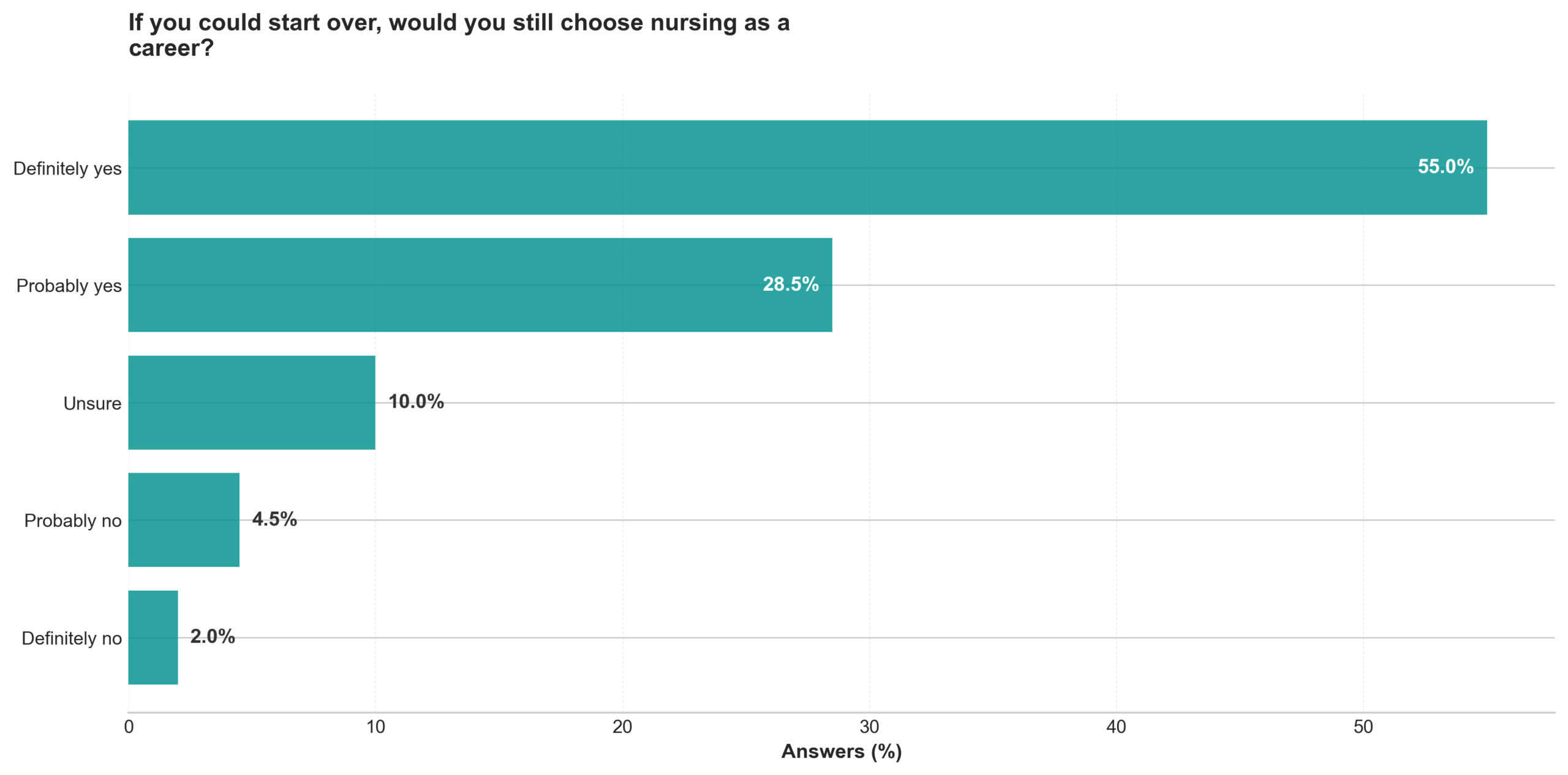
  • 55% of college-educated nurses in the US say they would still choose nursing as a career if they could start over
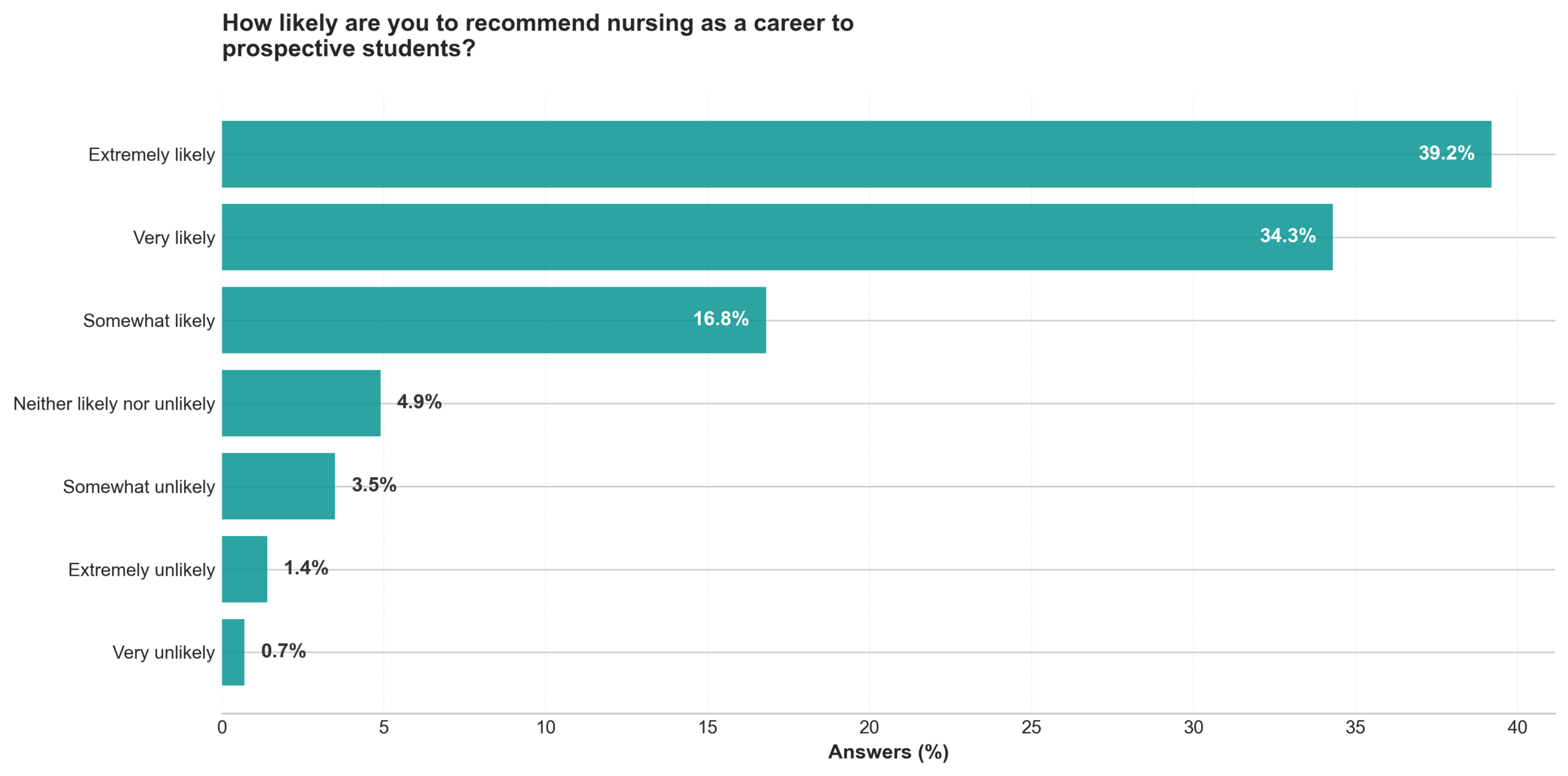
  • 39% of college-educated nurses in the US say they are extremely likely to recommend nursing as a career to prospective students
  • 19% of college-educated nurses in the US say the most important advice they would give to those considering a nursing career is to find strong mentors early
  • The Bottom Line
  • Methodology

What Is Your Highest Level Of Education Completed?

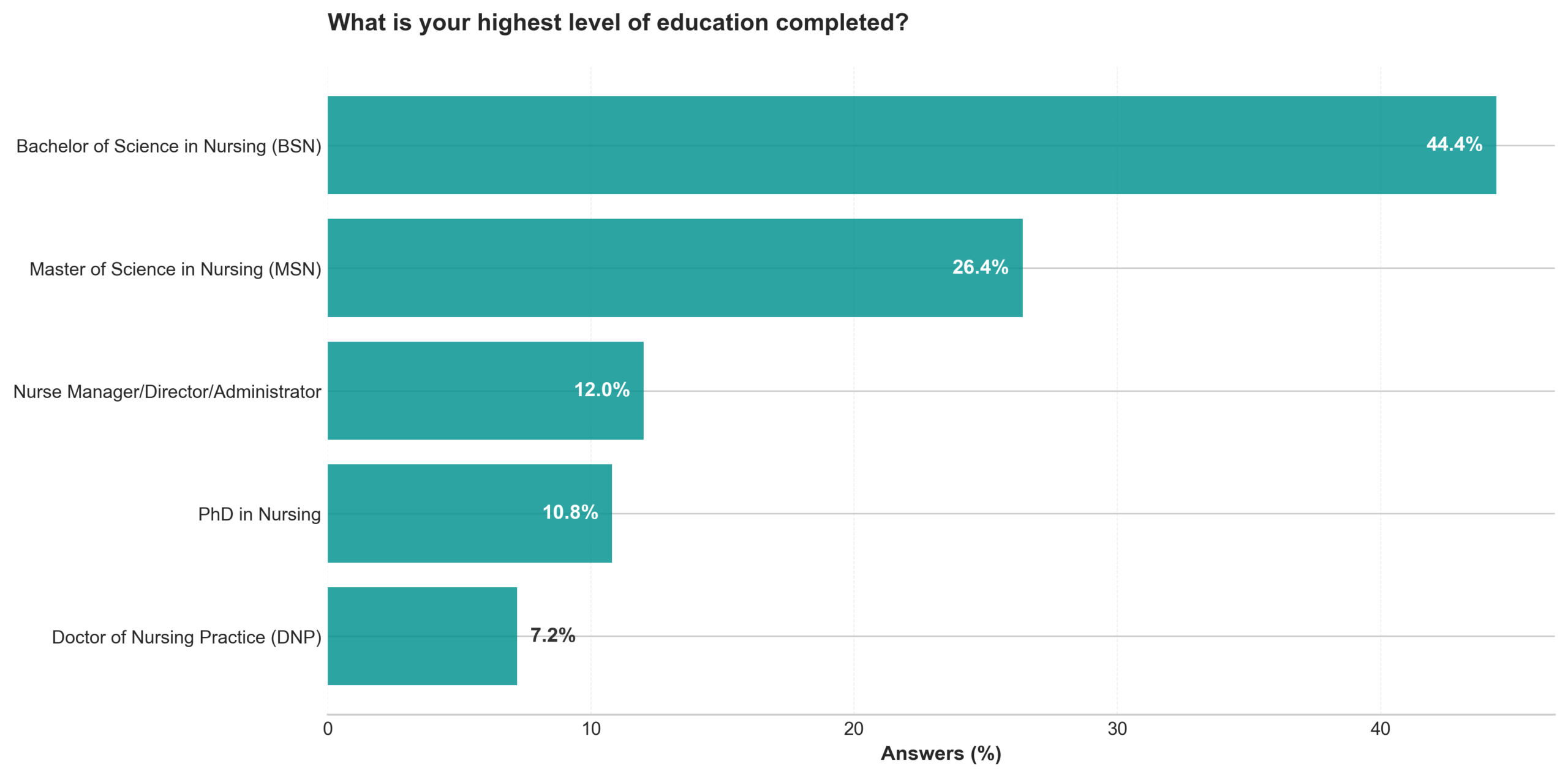
A Bachelor of Science in Nursing (BSN) is the highest level of education completed by 44% of college-educated nurses in the US

The nurses in our poll have different levels of education:

Q1 What is your highest level of education completed

The highest level of education completed by almost half (44%) of our audience is a Bachelor of Science in Nursing (BSN). The popularity of this qualification may be due to it offering higher earning potential and more career opportunities than an Associate Degree in Nursing (ADN). For 26%, their highest education level is a Master of Science in Nursing (MSN), which is an entry-level degree for advanced roles such as nurse educator and clinical nurse leader.

12% have completed nurse manager, director, or administrator courses, and 11% have a PhD in nursing. Only 7% have completed a Doctor of Nursing Practice (DNP) qualification. This suggests slightly more than half of our audience is focused on building their careers to advance beyond basic nursing roles.

Our findings are somewhat different from those published by the American Association of Colleges of Nursing (AACN), indicating nurses’ education levels in 2022. That year, 72% of the registered nurse workforce had a baccalaureate or higher degree as their highest level of nursing education, as this would give them better career prospects. 72% of employers strongly prefer baccalaureate-prepared nurses, while 28% require new hires to have a bachelor’s degree. 17% had a master’s degree and 3% had doctoral degrees.


How Many Different Nursing Roles Or Specialties Have You Worked In Since Graduating?

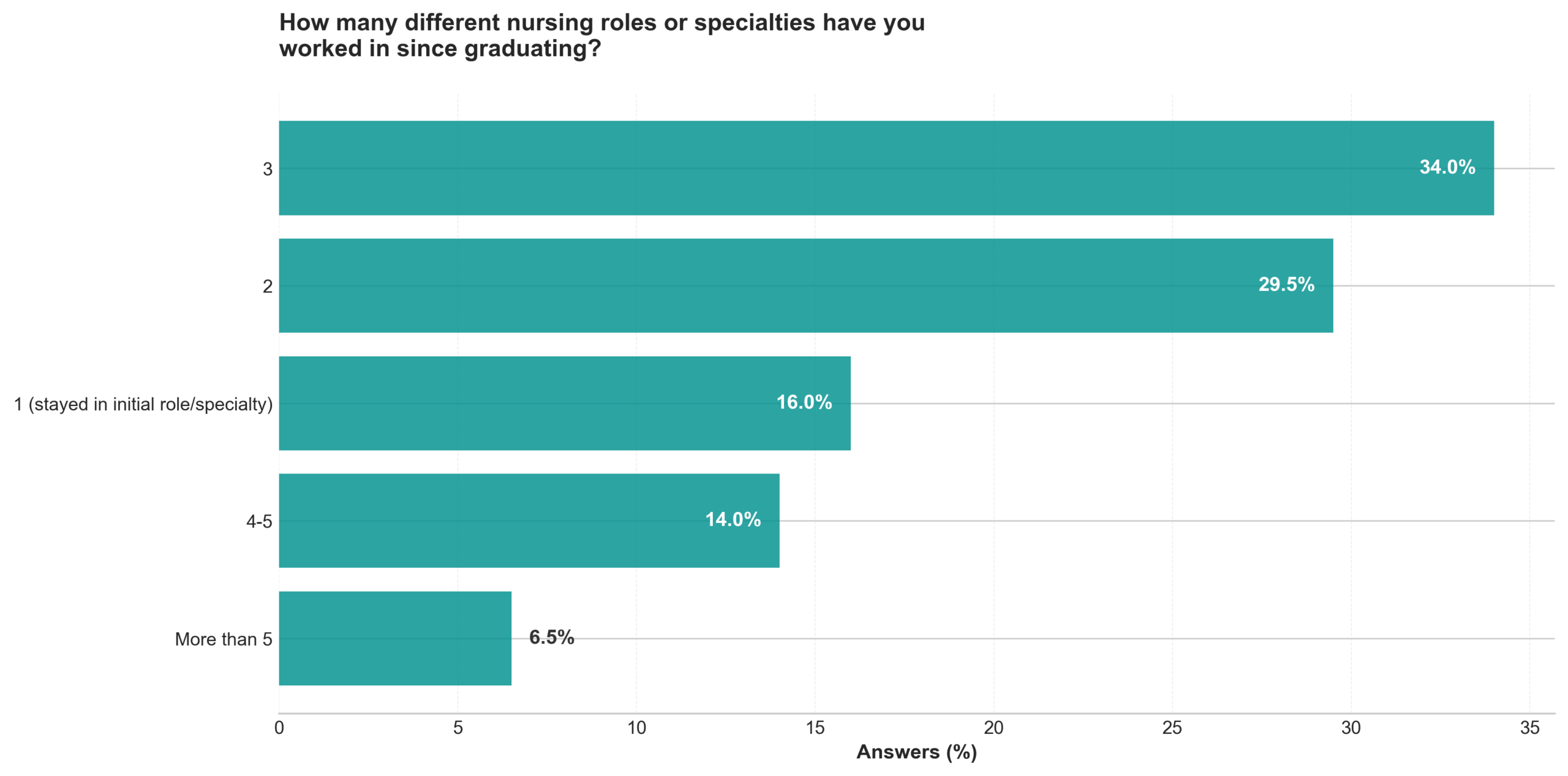
34% of college-educated nurses in the US have worked in three different nursing roles or specialties since graduating

Role-changing in nursing is certainly not unusual:

How many different nursing roles or specialties have you worked in since graduating?


Of our audience, 34% say they have worked in three different nursing roles or specialties since graduating from college. A slightly lower percentage (30%) say they have worked in two roles. 16% have only worked in their initial role or specialty, while 14% have experience in four to five different roles. Only a small percentage (7%) have worked in more than five roles or specialties since graduating.

There are various reasons why some nurses remain in their initial role while others diversify their careers to work in different roles. Some may choose not to specialize because they derive enough satisfaction from their initial role. Others might not be able to afford the additional studies required for specialization.

Among those who have worked in several different roles, some may be motivated by the challenge of learning new things or want to advance their career for the sake of accomplishment, prestige, and better earnings.

According to Nurse Journal, the top five specialty career choices for nurses include certified registered nurse anesthetist, adult-gerontology nurse practitioner, certified nurse midwife, family nurse practitioner, and women’s health nurse practitioner.

84% of respondents noted one or more changes in their roles or specialties since graduation, and while the full weight of this statistic depends on the number of years since graduation, the fact that comparatively few nurses remain in the same position still highlights one of the many benefits of a nursing degree: it helps to prepare nurses for a variety of possible roles. 

Completing such a degree could also assist prospective nurses in better discerning the type (or types) of work they wish to pursue within their chosen field, potentially increasing the likelihood of their remaining in that speciality or role. Greater stability would benefit the field, as nurses would bring years of experience to their roles, benefiting not only their own patients but also younger, mentee nurses. 

It is also worth noting that, according to a recent AMN Healthcare survey of 12,171 nurses, 61% of respondents planned to change their current position or employment status within 12 months, which seems to confirm a high level of turnover and role-shifting within the nursing field. 

Which Statement Best Describes Job Availability In Your Nursing Career?

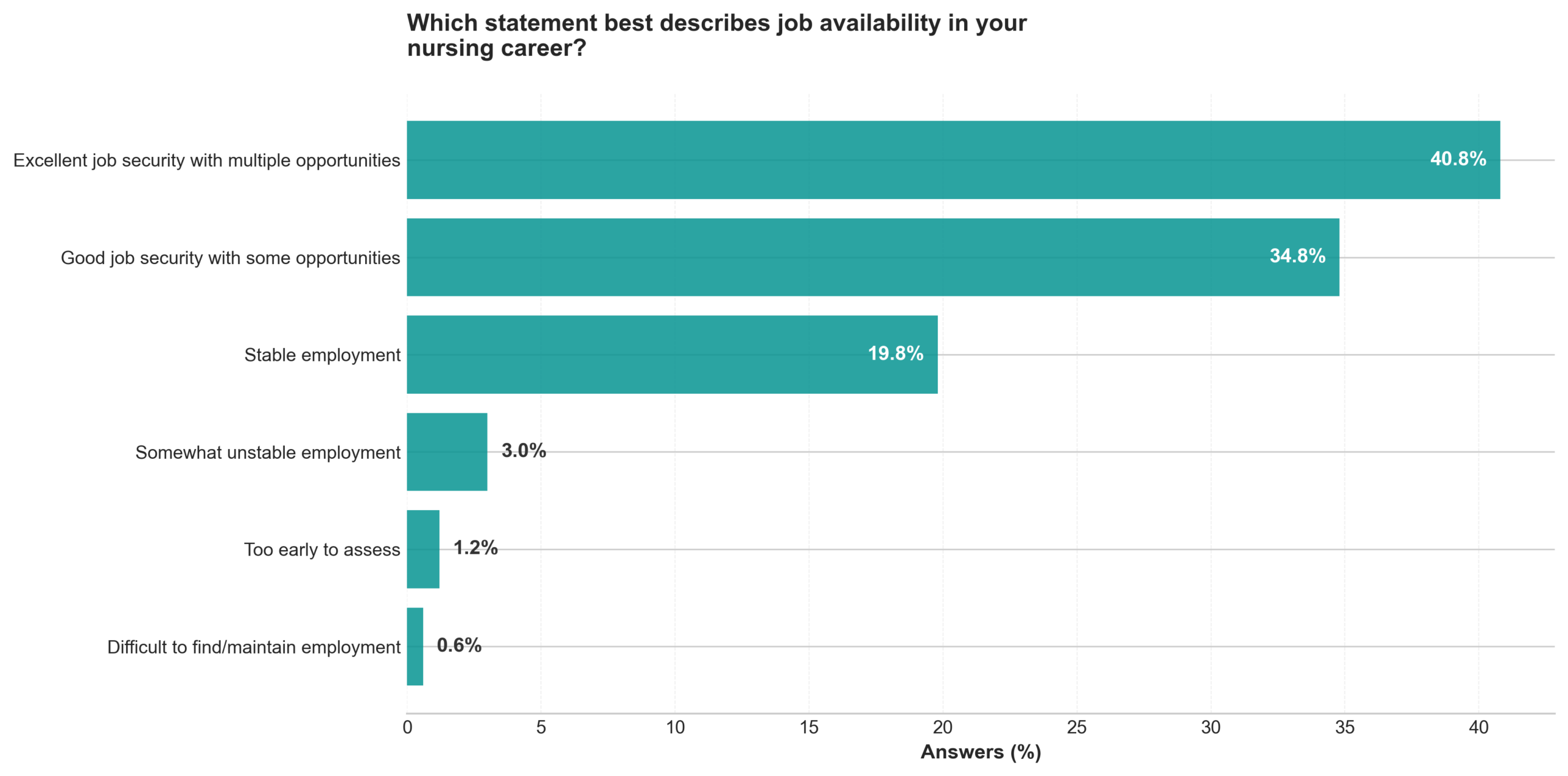
41% of college-educated nurses in the US say “excellent job security with multiple opportunities” best describes job availability in their nursing career

There are different experiences when it comes to job availability:

Of our audience, 34% say they have worked in three different nursing roles or specialties since graduating from college. A slightly lower percentage (30%) say they have worked in two roles. 16% have only worked in their initial role or specialty, while 14% have experience in four to five different roles. Only a small percentage (7%) have worked in more than five roles or specialties since graduating. There are various reasons why some nurses remain in their initial role while others diversify their careers to work in different roles. Some may choose not to specialize because they derive enough satisfaction from their initial role. Others might not be able to afford the additional studies required for specialization. Among those who have worked in several different roles, some may be motivated by the challenge of learning new things or want to advance their career for the sake of accomplishment, prestige, and better earnings. According to Nurse Journal, the top five specialty career choices for nurses include certified registered nurse anesthetist, adult-gerontology nurse practitioner, certified nurse midwife, family nurse practitioner, and women’s health nurse practitioner. 84% of respondents noted one or more changes in their roles or specialties since graduation, and while the full weight of this statistic depends on the number of years since graduation, the fact that comparatively few nurses remain in the same position still highlights one of the many benefits of a nursing degree: it helps to prepare nurses for a variety of possible roles. Completing such a degree could also assist prospective nurses in better discerning the type (or types) of work they wish to pursue within their chosen field, potentially increasing the likelihood of their remaining in that speciality or role. Greater stability would benefit the field, as nurses would bring years of experience to their roles, benefiting not only their own patients but also younger, mentee nurses. It is also worth noting that, according to a recent AMN Healthcare survey of 12,171 nurses, 61% of respondents planned to change their current position or employment status within 12 months, which seems to confirm a high level of turnover and role-shifting within the nursing field. Which Statement Best Describes Job Availability In Your Nursing Career? 41% of college-educated nurses in the US say “excellent job security with multiple opportunities” best describes job availability in their nursing career Which statement best describes job availability in your nursing career?

Job availability hasn’t been an issue for almost half of our audience (40%), who say they have excellent job security with multiple opportunities. Considering the shortage of nurses in the US mentioned above, it’s not surprising that this percentage has had a positive experience so far. 35% have had a somewhat similar experience, saying they have good job security with some opportunities.

Another 20% say they have stable employment, while just 3% say they have somewhat unstable employment, and 1% say it’s too early in their careers for them to assess job availability.

Surprisingly, a fifth of our audience didn’t mention having job opportunities, and a small percentage said their employment isn’t stable. According to the Health Resources and Services Administration, there was a 1% increase in the number of registered nurses but a 3% increase in demand between 2022 and 2025. With a deficit of around 295,800 nurses around the country, nurses should have no trouble finding stable employment and exciting career opportunities.

It is well worth noting that over 95% of respondents identified their employment security as stable or better, with over 75% claiming good or excellent security. A dramatic majority of college educated nurses, then, indicate strong job security.

The Benedictine hallmark of stability means that our monks and, by extension, our college community, remain dedicated to living out the Abbey’s mission, rooted in this particular place. The needs of our county, our state, and our country inform the prayers and work of Belmont Abbey and its apostolate, Belmont Abbey College, as we seek to serve our home. Responding to the healthcare crisis and the growing shortage of nurses in our communities, Belmont Abbey both welcomed the construction of a new hospital on Abbey land and established a Nursing program steeped in Benedictine values. It is our hope that this will contribute materially to the health and wellbeing of the place we have called home for 150 years.


What Is The Primary Opportunity Your Nursing Degree Has Opened For You?

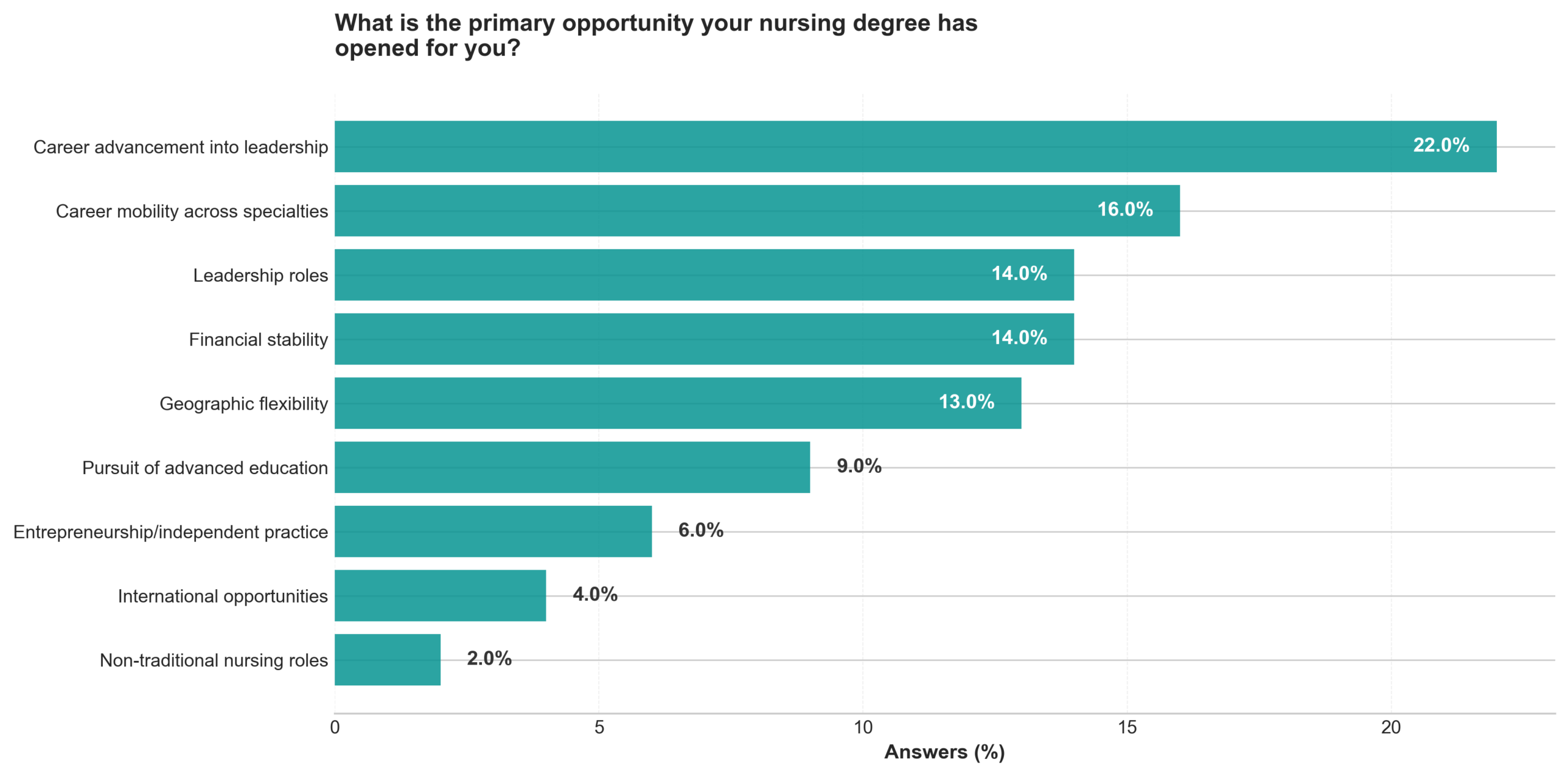
22% of college-educated nurses in the US say career advancement into leadership is the primary opportunity their nursing degree has opened for them

A nursing degree can open doors to an impressive range of career opportunities:

What is the primary opportunity your nursing degree has opened for you?


For 22% of our audience, the primary opportunity their nursing degree opened was career advancement into leadership. According to CareRev, these positions may include nurse manager, charge nurse, director of nursing, chief nursing officer, clinical nurse leader, or nurse educator, among others. 16% of our audience say their degree has provided them with career mobility across specialties, suggesting they benefit from diversity while potentially working their way into leadership positions.

For 14%, the primary opportunity has been financial stability, while another 14% mention leadership roles. 13% say geographic flexibility is their main opportunity, suggesting they have been able to work in different locations around the US.

The pursuit of advanced education is what 9% of our audience name, and 6% say their main opportunity is entrepreneurship or an independent practice. Among the entrepreneurial roles nurses can fulfill are medical spa nurse, career coach, script consultant, home health nurse, specialist care provider, and wellness coach.

As for the rest of our audience, 3% say their degrees opened international opportunities, implying they’ve been able to work in countries such as Australia, Canada, or the UAE, and 2% say they’ve had the chance to work in non-traditional nursing roles.

Belmont Abbey College is committed to forming young men and women for leadership across a variety of fields, among which healthcare occupies an essential place. The healthcare industry needs nurses who are prepared to face the profound challenges and pressures of their vital work, equipped not only with the necessary skills, knowledge, and hands-on experience to treat their patients, but also the ethical grounding to evaluate complex circumstances and respond to these with clarity and compassion. 

While a nursing degree, in itself, opens up leadership opportunities, the Abbey’s B.S. in Nursing seeks to provide the best possible foundation for assuming these leadership roles. State of the art labs, expert instructors, and rigorous coursework are all critical, but so is a foundation in the Benedictine hallmarks that have inspired men and women in a centuries-long tradition of service to the Good. Great leaders combine expertise with integrity and wisdom, and Belmont Abbey College designed our Nursing program to help our students develop as exceptional professionals and virtuous servant leaders.


If You Could Start Over, Would You Still Choose Nursing As A Career?

55% of college-educated nurses in the US say they would definitely still choose nursing as a career if they could start over

Even an opportunity to start over doesn’t change everyone’s career path:

If you could start over would you still choose nursing as a career?

Things don’t always work out as planned, and that’s as true for career choices as it is for anything else in life. On the topic of whether they would still choose nursing as a career if they could start over, 55% of our audience say they definitely would, although 29% are less confident, saying they probably would. This implies these segments of our audience enjoy a great degree of job satisfaction, even if the work they do presents challenges from time to time.

While 10% say they’re unsure they would choose the same career, 5% say they probably wouldn’t. Only 2% say they definitely would not choose nursing again. The attitudes of these audience segments may be due to their experiencing job dissatisfaction.

Research published by the HRSA in 2024 revealed that the percentage of nurses who expressed some dissatisfaction with their job increased from 11% in 2017 to 20% in 2022, with nurses with patient care responsibilities experiencing a greater decline in satisfaction than those without these responsibilities.

Additionally, job satisfaction declined in 20 of the 21 clinical specialties in the same period. The most common reasons nurses gave for switching nursing jobs after December 31, 2021, included burnout, staff shortages, and a stressful work environment.

Comparing participants’ dissatisfaction rate (16.5% answering unsure or in the negative) with the 20% identified by HRSA’s research, it is worth noting that nurses with a college degree seem to express somewhat lower rates of dissatisfaction with their career choice. Whether attributable to more comprehensive preparation or better opportunities, a degree seems to increase the likelihood of satisfaction in Nursing.


How Likely Are You To Recommend Nursing As A Career To Prospective Students?

39% of college-educated nurses in the US say they are extremely likely to recommend nursing as a career to prospective students

Nursing as a recommended career comes highly rated:

How likely are you to recommend nursing as a career to prospective students?

Above, we saw how well over half of our audience would still choose nursing if they could start over. Unsurprisingly, our audience also has largely positive feelings about recommending nursing as a career to prospective students.

39% say it’s extremely likely, and 34% say it’s very likely they would recommend it. 17% weren’t as certain, saying they’re somewhat likely to recommend it. The enthusiasm of these audience members may be due to job satisfaction and their own appreciation of the role nurses play in society. It may also be due to the potential for career diversity and growth, as evident in some of the statistics above.

In comparison, only 5% are uncertain, saying they’re neither likely nor unlikely to recommend a nursing career, while 4% say they’re somewhat unlikely to recommend it. Just 1% say they’re extremely unlikely to recommend nursing, and less than 1% say they are very unlikely to do so. This highlights how many enjoy their careers compared to those who do not.

The fact that 73% of respondents consider themselves extremely or very likely to recommend nursing to prospective students is a strong indicator of career satisfaction. This statistic suggests that college educated nurses enter the field well prepared for its challenges. 

Interestingly, only 10.5% of respondents are unsure or unlikely to recommend nursing to prospective students, which is a markedly smaller percentage than the 16.5% who registered ambivalent or negative feelings about their own choice. This discrepancy may suggest that individual regret has more to do with personal circumstances than with disillusionment about the field of nursing itself.

The Bottom Line

These statistics provide thought-provoking insights into the experiences and perceptions of college-educated nurses in the US. For most of our audience, nursing is a rewarding career that offers plenty of scope for growth, development, and specialization, even if it presents a range of challenges.

Encouragingly, most graduates find work relatively soon, if not immediately, after graduating, with many of these nurses being employed in their desired roles. Still, those considering a nursing career need to be fully aware of the advantages and disadvantages involved so they can make an informed decision, bearing in mind the profession’s vocational nature.

Prospective students should also be aware that, given the projected shortage of nurses in the US, they may encounter challenging working conditions. Even so, as many nurses would agree, the rewards of the profession far outrank the downsides.

Methodology

Sourced from an independent Artios poll of 500 college-educated nurses in the United States. Responses are collected within a 95% confidence interval and 5% margin of error.

About the data:

  • 72% of college-educated nurses in the United States are between the ages of 22 and 44.
  • 55% identify as male and 45% as female.
  • 72% are employed full-time.
  • 81% speak no second language, while 13% speak Spanish.
  • 40% earn between $75,000 and $149,999 annually.
  • 55% are classified as white and 27% African American.
  • The highest number (10%) is based in New York.

Filed Under: Academics, Home, Insights, Nursing

August 18, 2026 By radefolaju Leave a Comment

Relational and Collaborative: Professor Travis Feezell on His Career and the MA in Leadership Program

Relational and Collaborative: Professor Travis Feezell on His Career and the MA in Leadership Program

In 1992, Travis Feezell became an assistant college baseball coach and quickly worked his way up to head coach. It was his first leadership position in higher education. At the time, he had an admittedly simplistic view of what a leader should do and be.

“I thought leadership was about command and control,” Feezell said about that period in his career. “I’m going to tell you what to do and how to do it. And, when you break the rules, there are going to be consequences. Frankly, I think it was an utter failure in leadership on my part.”

In the three and a half decades since, Feezell has taken on a number of other leadership roles. He has served colleges, universities, and consulting firms as everything from a leadership consultant to a president and provost. However, Feezell’s job title is not the only thing that has changed over the years. His leadership philosophy has evolved as well and is now much more nuanced, empathetic, and effective.

As an associate professor in Belmont Abbey College’s Master of Arts (MA) in Leadership program, Feezell is now sharing his hard-earned wisdom with the next generation of leaders in every sector.

Real-Life Lessons and the Unexpected Path to Leadership

Feezell’s initially rigid attitude about leadership was shaken when the father of one of the players on the baseball team he coached passed away unexpectedly. Feezell delivered the news.

“What leadership demanded in that moment was a humane relationship with this person,” Feezell said. “He needed to be supported.”

As the player’s coach, Feezell knew he should be among the people the young man could count on. Feezell then decided that he should be there not only for this particular person but for anyone on his team who needed him. It was a pivotal moment that taught him the value of a person-first approach to leadership.

Discovering a Passion for Leadership

Equipped with a new outlook on the role of a leader and an intimate knowledge of college athletics, Feezell became his school’s athletic director. In this position, he got more involved with general college operations.

“I was also running the postgraduate scholarship program for the entire institution, looking at Rhodes scholarships and Marshall scholarships for our students,” Feezell said, adding that he was also involved with running the school’s art gallery. “At the same time, I’m picking up a doctoral degree in higher education and sport.”

During this period, Feezell also taught classes on sports ethics, sports history, and sport leadership at various institutions on a part-time basis. In 2008, he brought his talents to Belmont Abbey College, where he had the chance to teach classes on organizational leadership and deepen his understanding of the field.

“That was my first full-time teaching gig, and I ultimately became a tenured professor,” Feezell said. “Within a year, I was the interim athletic director. Within another year, I was the interim dean of the business school.”

At this point, Feezell was largely filling roles as needed. He loved teaching, but the more he worked on the administrative side of higher education, the more he came to love that, as well. A colleague who was then a college president encouraged him to make the pivot.

There and Back Again: Leaving and Returning to Belmont Abbey

In 2014, Feezell left Belmont Abbey to pursue his new calling as provost and chief academic officer at a university in Arkansas. He then became president of a college in Nebraska.

But while leaving Belmont Abbey College allowed Feezell to pursue new opportunities and grow as a leader, it still held a special place in his heart. When the school needed a provost in 2020, he jumped at the chance to return.

“The spirit of the Benedictine community is the thing that attracts me and keeps me here,” Feezell said. “These are beautiful people, beautifully directed to serve the community. It’s an incredibly special place.”

After taking on the provost position, Feezell oversaw Belmont Abbey’s internal operations related to enrollment, student affairs, marketing, and institutional research. Just as importantly, he helped guide the school’s first steps into the world of graduate business education and expand its online offerings.

One of the programs born out of this effort was the MA in Leadership program, which was launched in 2022. Helping to design this program gave Feezell the chance to put his leadership skills to work in a new way.

Designing the MA in Leadership Program: A Curriculum That Fills a Gap

In deciding which master’s programs to launch, Feezell and his colleagues have devoted much time and energy to figuring out what type of education today’s leaders need. The team decided to launch a Master of Business Administration program, but Feezell believes that that type of program is not relevant to every rising leader’s goals.

“An MBA program tends to have a quantitative bent,” Feezell said. “It grounds people in quantitative analysis, and that’s not for everyone. Some people are thinking, ‘How do I become a more influential, effective organizational leader?’”

The MA in Leadership program was designed to serve students with that question in mind. While the program features a class on data analytics, the focus is placed more on team and change management, ethical decision-making, and effective communication, teaching students skills that, in Feezell’s experience, are essential to leading any kind of organization.

According to Feezell, “Leadership is messy, complex, and it can be nasty at some points. It’s motivational and collaborative.”

Returning to the Classroom Full Time

During his time as provost at Belmont Abbey College, Feezell had continued to teach when he could. In 2024, he decided to step back from administration and start teaching full-time again. Today, MA in Leadership students can find him teaching Leading Effectively in Nonprofit Environments and the introductory Foundations of Leadership course.

“I think students come into that class thinking I’m going to teach them how to command and control,” he said of Foundations of Leadership. “I try to spend a significant amount of time just saying I’m not sure that’s what leadership is about.”

Feezell and his students talk about principles such as motivation, celebrating employees’ achievements, and modeling behavior as a leader.

“The other thing that becomes an emphasis in the class is the notion that leadership is a relational activity,” Feezell said. “We don’t lead things, we lead people. We’re in a relationship with them.”

Bringing Meaning and Connection to an Online Format

Feezell’s belief in the relational nature of leadership informs his approach as an instructor in the online and asynchronous MA in Leadership program. In addition to reaching out to students individually, he also uploads a video each week so students can respond to him or each other with their own video.

“The video might be on the topic we’re studying, what’s due that week, or I might be posing a question,” Feezell said. “There is constant conversation.”

Feezell also often asks students to apply their new skills to case studies and exercises about situations they might face as leaders. Students then discuss each other’s solutions and share insights based on their own experiences.

“For me, learning happens in the engagement both with the material and also the conversation that’s happening around it,” he said.

However, Feezell knows he is not alone in his efforts to engage with students in the MA in Leadership program. He is proud of what the program has become and how his colleagues continue to make the students’ experience impactful.

“Sometimes master’s degrees revolve around earning a credential,” he said. “I get that and understand it. Maybe that’s what attracts people to some of our programs at Belmont Abbey. But I think students are transformed by our programs. They can be changed for the better and become better leaders who have better self-awareness.”

Become the Forward-Thinking Leader Your Organization Needs

In the MA in Leadership program at Belmont Abbey College, experienced instructors such as Travis Feezell help students transform into leaders who can navigate any obstacle effectively and ethically.

In as few as 12 months, students in the program complete coursework that covers values-based and servant leadership, strategic decision-making, organizational behavior, and other principles they can take to any industry. Designed for working professionals, the program is delivered in an asynchronous online format that balances convenience with depth and personalized support.

To find out more about the MA in Leadership program, request information from Belmont Abbey College today.

Recommended Readings

Belmont Abbey College Launches Graduate Certificate in Catholic Educational Leadership
Belmont Abbey College Launches Ten New Specializations in a Fully Online Business Studies Undergraduate Program for Working Professionals
What Can You Do With a Leadership Degree?

Filed Under: Abbey Excellence, Abbey News, Academics, Faculty, Feezell, Insights, MAL

August 12, 2026 By radefolaju Leave a Comment

Subsidiarity, Mission, and the Moral Foundation of Commercial Society

Cambridge University Press recently published an article co-authored by Emmett McGroarty, Executive Director of the Belmont House on Capitol Hill.

In this article, he discusses civic virtue, economic enterprise, and the costs of government centralization. Keep reading to explore the abstract, or scroll down for the link to the full text:

The theory of this essay is (i) that Tocquevillian democracy functions as a work shed in which the citizen actively builds society and, in the process, develops virtues; (ii) that the citizen brings those virtues to the workplace to the benefit of that enterprise and commercial society; (iii) that those virtues are particularized in the workplace; and (iv), without democracy, capitalism’s inculcation of virtue in the person is incomplete. Tocquevillian democracy encourages the citizen to shun the inward focus of individualism in favor of a disposition critical to both capitalism and democracy: the disposition to create positive associations with others, external and internal to an enterprise or association. Tocquevillian democracy complements capitalism, ameliorating human vices of greed and selfishness. Imbued with an outward-looking disposition, the market agent is encouraged to suppress individualism and selfishness and instead embrace a mission of service to society. Government centralization, particularly the usurpation of local power, has negative consequences which affect commercial society, impairing the moral formation of the market agent and the worker.

To read the full article, click here >>

Filed Under: Abbey Excellence, Abbey News, Academics, Belmont House, Cultivation Blog, Home, Insights

August 5, 2026 By radefolaju Leave a Comment

Father James Leads Students on an Annual Medical Mission Trip

Last year, our own Father James Raber, OSB led two medical mission trips to the Dominican Republic, one in September and one in March. Serving in clinics and providing essential medical support, groups of eight and sixteen Belmont Abbey students, including many enrolled in our Nursing program, took up the call to love and sacrifice by ministering to the needs of their Caribbean brothers and sisters.

By establishing this new Abbey tradition, Father continues the same legacy of service that inspires seniors to join the Benedictine Volunteer Corps (BVC) each year. While the BVC entails a nine month commitment, these intensive medical mission trips open additional life-changing service opportunities to even more Abbey students.

Read on to learn more about these medical missions, featured in a recent Catholic Register article:

Ignatian retreat campus in the Caribbean serves as hub for medical missions

By: Tom Tracy, OSV News
Originally Published in The Catholic Register

SANTIAGO DE LOS CABALLEROS, DOMINICAN REPUBLIC

When Benedictine Father James Raber asked last year if he could bring three or four student volunteers along to an annual medical mission in the Caribbean he got a nice surprise.

“I thought it would be great if I could bring several Belmont Abbey (College) students here as part of a mission trip — and they offered me a dozen spots,” said Father Raber, chaplain at Belmont Abbey College in North Carolina.

“And one thing I absolutely love to do is see the students interact with the patients,” he added.

The priest and his students joined up with a larger U.S, medical volunteer delegation last year operating out of the expansive campus of the Institute for Latin American Concern, or ILAC, in Santiago de los Caballeros.

A four-decades old Catholic-affiliated retreat-style property founded in the 1970s by two Jesuit missionaries originally from Cuba, teams of volunteer medical specialists, surgeons, dentists and support staff integrate with local Mission ILAC staff and medical volunteers in their care for hundreds of patients in the context of Ignatian spirituality.

“It is a wonderful thing to be able to work with people who help with the mission: I am saying Mass for them, leading ecumenical reflections and hearing confessions often in the evening when there is some down time,” Father Raber told OSV News, adding that he enjoys being a priestly presence in the pediatric clinics and interacting with young families who have registered months in advance to see a medic.

“There are also people who are going to be going under for surgery who need anointing of the sick and that is offered as well,” the priest said.

Although the Belmont Abbey delegation only stayed less than a week, Mission ILAC operates year-round as a global gathering point for international medical volunteers and as a resource for often neglected rural northern reaches of the Dominican Republic and its proximity to Haiti’s border.

There are remote mountain villages with communities of Haitians living there without documents and other rural villages throughout the northwestern Dominican Republic. Consequently, Mission ILAC center coordinates medical outreach to those places where no governmental or private organization reaches.

Over the years, volunteer medics and students from Ivy League and other U.S. institutions have utilized the ILAC campus for Spanish-language courses, medical training and enrichment programs, including most notably Jesuit-run Creighton University, which earlier this year opened a 3,000-square-foot, high-tech classroom and communal space.

The Creighton facility will reportedly increase opportunities for its student engagement in research, economic development and environmental sustainability across the Dominican Republic’s communities where Creighton has health partnerships.

Student doctors, nurses and medics on overseas medical mission experiences often work alongside world-class medical professionals and are rewarded with hands-on experiences, cross-cultural patient interaction and career changing inspiration.

Katherine Calvet, a Florida resident and one of the Belmont Abbey College students who has made several mission trips to Santiago de los Caballeros, said ILAC helped her focus her educational decisions early on while still a freshman at Belmont.

“I thought it would be an opportunity to serve the people of the Dominican Republic and share my passion for helping others,” said Calvet, who is now an undergraduate at Florida State University.

Her trips to ILAC were in concert with the Miami-based Cuban Association of the Order of Malta, which makes twice annual ILAC missions providing outpatient surgeries, pediatrics, family medicine, cardiology, dentistry and more.

“I fell in love with medicine very quickly within the first two hours of working with one of the doctors and I definitely have passion for medicine now,” Calvet told OSV News. “In triage we saw very high blood pressures and very high blood glucose levels.”

One of the senior doctors helping staff the Malta-sponsored mission in 2025 was Dr. Grant Phillips, associate director of a residency program at Altoona Family Physicians Residency Program at University of Pittsburgh Medical Center.

“I’ve been coming here for about 10 or 15 years,” said Phillips, who participated in an end-of-day ecumenical debriefing at ILAC’s on-site chapel following a long day. He also trains student volunteers during his consultations.

“I have a lot of gratitude both to the patients — because they carry the burden of the disease — and the people who brought me down here and allowed me to get fulfillment by helping the people here. This is a life changing experience.”

Some of the medics will venture into the nearby mountain communities.

Mission ILAC maintains a network of community leader “cooperadores de salud” (“cooperators of health”), composed of men and women from their own rural communities who promote better healthcare access along with improvement of agricultural techniques as a way of maintaining rural community wellness and reducing mass migration to the cities.

It is now estimated that four-fifths of the Dominican population now live in one of several urban centers, creating a strain on infrastructure. Many others have left the country altogether in recent decades.

Making her 31st trip to ILAC with the Order of Malta was Dr. Jane Cohen, a primary care physician at Mount Sinai Medical Center in Miami Beach and a veteran volunteer at ILAC who said she comes at her own expense.

“I have met people from all over the U.S. and all over the world who have improved my life and taught me things I couldn’t have learned elsewhere,” Cohen said.

Cohen makes a point of attending ILAC ecumenical sessions where she shares her experiences with colleagues. She expressed gratitude to her husband back home who allows her to take vacation time and even go off the grid into the village communities.

“I decided I wanted to go out into the campos three hours by car up a rickety mountain pathway to see people who either couldn’t get to us or needed our help there and they were so welcoming,” she said.

There were 56 people in that particular community and the medical team saw about half of them as patients. On a second day they stopped at two communities of Haitians, living there without documents.

“I was trying to teach some of the medical students to see the ‘progression of disease'” and not overreach for solutions, she said, noting that many patients in the U.S. are shuffled off to the emergency room or sent out for time-consuming testing.

“For years I was coming here speaking to other internal medicine doctors like myself who realized that our services are better rendered in the office preventing people from getting admitted to the hospital,” Cohen added.

Filed Under: Abbey Excellence, Abbey News, Academics, Cultivation Blog, Home, Insights

August 4, 2026 By radefolaju Leave a Comment

What Can You Do With a Leadership Degree?

What Can You Do With a Leadership Degree?

Transformational leaders guide organizations through change, manage teams effectively, and deliver on organizational goals. Earning a leadership degree helps professionals develop the skills they need to take on leadership responsibilities.

Prospective graduate students have options such as a master’s degree in business administration, management, or public administration. What’s the benefit of earning a leadership degree? With its emphasis on organizational behavior and leadership principles, a Master of Arts (MA) in Leadership program is designed to prepare current and future leaders for people-driven management roles.

What Is a Master’s Degree in Leadership?

A master’s degree in leadership program trains students to lead organizations by employing effective and ethical principles. Students learn how to adapt to changing business conditions, understand organizational dynamics, and implement strategic plans. They also develop people-focused leadership skills, with an emphasis on employee development, management, and engagement.

Coursework in a leadership degree program covers business, human resources, psychology, and management topics. While enrolled in a graduate-level leadership program, students explore organizational leadership theories and learn how to apply these theories in practice.

Rather than emphasizing a particular industry or career path, a leadership degree program is intended to develop transferable skills that apply across industries and roles.

What Will You Learn in a Master’s in Leadership Program?

The curriculum for a master’s in leadership program includes coursework in strategic human resources management, nonprofit leadership, and organizational change management.

Students in a master’s in leadership program develop key skills in areas that include:

  • Strategic planning: Management roles require professionals with strong strategic decision-making skills in order for them to excel as leaders. Master’s in leadership students build their problem-solving, analytical reasoning, and risk assessment skills to identify patterns and develop proactive responses.
  • People management: Leaders need people management skills to attract and retain talent, resolve conflicts, and foster a positive work culture. Students in a leadership master’s program explore mentorship, motivation, and interpersonal communication while developing the skills needed to prioritize human needs.
  • Communication: Successful leaders draw on their communication skills to promote a positive workplace culture, understand stakeholders’ interests, and manage teams. Master’s in leadership programs enable professionals to cultivate effective communication skills through an emphasis on emotional intelligence, understanding their audience, and honing their communication styles.
  • Ethical leadership: Students explore the connections between ethics, organizational responsibility, and core values to develop ethical leadership skills. They study traits of ethical leaders, the role of transparency and accountability, and tactics for implementing value-driven policies.

Master’s in leadership students also learn how to critically evaluate programs, create action plans, and allocate resources. By studying organizational behavior, management principles, and team leadership theories, students prepare for decision-making roles in any type of organization.

Benefits of Earning a Master’s in Leadership

Leadership master’s programs focus on team dynamics, collaboration, and change management. This emphasis on people-driven management can benefit professionals in any industry.

Other benefits of earning a master’s in leadership include:

  • Nonprofit leadership preparation: A master’s degree program in leadership enables individuals to hone the strategic, change management, and communication skills needed for top roles in nonprofit organizations.
  • Career advancement: Leadership programs focus on helping professionals build valuable skills that can lead to their career advancement. With a master’s in leadership, professionals can move into management roles in their current field or transition into a new field.
  • Earning potential: Many of the positions professionals pursue with a leadership degree offer high salaries, including human resources manager, training and development manager, project manager, operations manager, healthcare services manager, sales manager, management analyst positions, and even executive roles like VP, director, and more.

According to a 2025 World Economic Forum survey of employers, the skills most often requested of today’s candidates are analytical thinking, leadership, social influence, and creative thinking skills.

Careers With a Master’s in Leadership Degree

What can you do with a leadership degree? Earning a master’s in leadership positions professionals for advanced roles in human resources, operations, or administration. Graduates also can advance in their career in an area such as marketing, sales, or finance.

Nonprofit Executive Director

Nonprofit executive directors hold the top role in their organization. They oversee daily operations, manage finances, and set long-term goals for the nonprofit. Executive directors work closely with staff and the executive board.

These roles require strategic planning and leadership skills, which a master’s in leadership program can help individuals strengthen. Nonprofit executive directors have a median annual salary of around $83,000, according to May 2026 Payscale data.

Healthcare Services Manager

Healthcare services managers, including hospital administrators, practice managers, and nursing home administrators, train and supervise administrative staff in healthcare organizations. They also oversee human resources, development, and operations efforts in the healthcare industry.

In addition to specialized knowledge of the healthcare field, these managers benefit from strong people management skills. Healthcare services managers earned a median annual salary of $117,960, according to May 2024 data from the U.S. Bureau of Labor Statistics (BLS).

Executive Roles

Executives manage strategic plans and policies in the for-profit, nonprofit, and public sectors. They implement organizational procedures that align with overall goals, manage daily operations, and identify opportunities to improve performance.

At the executive level, professionals apply their leadership skills as chief executive officers (CEOs), general managers, mayors, school superintendents, and city managers. Executives reported a median annual salary of $105,350, while CEOs have a median annual salary of $206,420, according to BLS data from May 2024.

Human Resources Manager

Human resources managers lead recruitment, benefits, and employee retention programs for their organization. They also help mediate employee disputes and staffing issues. In addition to supervising HR employees, HR managers work with executives on strategic planning initiatives.

A master’s in leadership program allows professionals to build the planning and management skills needed for leadership roles in HR. HR managers have a median annual salary of $140,030, according to May 2024 BLS data.

Training and Development Manager

Organizations rely on training and development managers to oversee their workforce development initiatives. These HR professionals conduct assessments, determine the organization’s workforce goals, and develop training programs to meet those goals. They also evaluate the training programs to determine their effectiveness.

A leadership degree program helps aspiring training and development managers develop the strategic planning and program evaluation skills required for the role. Training and development managers have a median annual salary of $127,090 as of May 2024, according to BLS data.

Management Analyst

Management analysts and management consultants evaluate an organization’s processes and policies to recommend improvements. They analyze organizational data, interview employees, and identify problems. Management analysts then recommend solutions, such as organizational changes or new policies.

A leadership degree program enables professionals to build the analytical and management skills needed for these roles. Management analysts have a median annual salary of $101,190 as of 2024, according to BLS data.

Operations Manager

Operations managers oversee an organization’s day-to-day operations, including the allocation of human resources. Also known as general managers or operations directors, these managers supervise projects, staff, and budgets. Operations managers evaluate performance indicators to determine the effectiveness of the organization’s strategies and implement improvements.

A master’s in leadership program helps individuals cultivate the organizational management skills required for operations manager and other top executive roles, such as operations director or chief executive officer positions. Operations managers had a median annual salary of $102,950 as of May 2024, according to BLS data.

Earn a Master’s in Leadership at Belmont Abbey College

Graduate-level leadership degree programs are designed to enable students to build the theoretical and practical tools they need to lead organizations. The fully online MA in Leadership program at Belmont Abbey College focuses on the skills required for transformational leadership roles.

A top-ranked Catholic college located outside of Charlotte, North Carolina, Belmont Abbey College has a reputation for excellence. The leadership master’s program emphasizes values-based leadership, organizational change management, and innovation. Students enrolled in the program analyze real-life business scenarios to develop the analytical and leadership skills needed to drive organizational growth.

Learn how the master’s in leadership program can help you advance in your career.


Recommended Readings

Servant Leadership vs. Transformational Leadership: Key Differences
How to Make Your Organization a Data-Driven Organization
How to Successfully Lead Through Change

Sources:

IMD, “The 8 Key Leadership Skills You Need to Know in 2026”
Indeed, “Master’s in Organizational Leadership vs. MBA: What’s the Difference?”
Payscale, Average Executive Director, Non-Profit Organization Salary
U.S. Bureau of Labor Statistics, Human Resources Managers
U.S. Bureau of Labor Statistics, Management Analysts
U.S. Bureau of Labor Statistics, Medical and Health Services Managers
U.S. Bureau of Labor Statistics, Top Executives
U.S. Bureau of Labor Statistics, Training and Development Managers
World Economic Forum, “The Future of Jobs Report 2025”

Filed Under: Academics, Insights, MAL

  • Page 1
  • Page 2
  • Page 3
  • Go to Next Page »
BAC logo

Contact

100 Belmont-Mt. Holly Road
Belmont, NC 28012

ADMISSIONS: 1-888-222-0110
FINANCIAL AID: 1-704-461-7000
MAIN NUMBER: 1-704-461-6700
FAX: 704-461-6220

info@bac.edu

Quick Links

  • DIRECTIONS TO THE COLLEGE
  • SUPPORT THE COLLEGE
  • TITLE IX
  • CAMPUS DIRECTORY
  • BELMONT ABBEY MONASTERY
  • THE CATHOLIC SHOPPE
  • CAMPUS SAFETY
  • COLLEGE BOOKSTORE
  • PRESS INQUIRIES
  • ADMISSION INFORMATION
  • VISIT
  • CAMPUS MAP
  • EMPLOYMENT OPPORTUNITIES
  • PERFORMING ARTS

100 Belmont-Mt. Holly Road
Belmont, NC 28012

ADMISSIONS: 1-888-222-0110
MAIN NUMBER: 1-704-461-6700
FAX: 704-461-6220

info@bac.edu

Copyright ©2026 Belmont Abbey College | Minutes from Charlotte, we are ranked one of the top comprehensive colleges in the South by US News and World Report. Since 1876, the mission of Belmont Abbey College is the education of students from diverse religious, ethnic, and cultural backgrounds in the liberal arts tradition as guided by our catholic intellectual heritage and inspired by the 1500-year-old Benedictine monastic tradition. | Privacy Policy | Designed by Fuzati
NewmanGuide USNews StudyDotCom
Copyright ©2026 Belmont Abbey College | Minutes from Charlotte, we are ranked one of the top comprehensive colleges in the South by US News and World Report. Since 1876, the mission of Belmont Abbey College is the education of students from diverse religious, ethnic, and cultural backgrounds in the liberal arts tradition as guided by our catholic intellectual heritage and inspired by the 1500-year-old Benedictine monastic tradition. | Privacy Policy | Designed by Fuzati
Copyright ©2026 Belmont Abbey College | Privacy Policy | Designed by Fuzati
Honors Readyapply Desktop 1

Are you a current North Carolina High School student?

YES!
NO!
EXPLORE ADMISSIONS
Honors Readyapply Desktop 1

So that we can take you to the right application form, tell us: are you a current North Carolina High School student?

YES! APPLY NOW*
NO! APPLY NOW
EXPLORE ADMISSIONS

*You will be taken to the College Foundation of North Carolina to create a free account to apply.

Find Your Admissions Counselor
What type of student are you?(Required)
Are you a transfer student?
This field is hidden when viewing the form

Your Admissions Counselor is:

Caroline Hohensee, Graduate and Online CoordinatorCaroline Hohensee
Graduate and Online Coordinator

carolinehohensee@bac.edu
Office: 704-461-6838

Your Admissions Counselor is:

John Blalock, Director of AdmissionsJohn Blalock
Director of Admissions

johnblalock@bac.edu

Your Admissions Counselor is:

Ethan McEntire, Admissions CounselorEthan McEntire
Admissions Counselor

ethanmcentire@bac.edu
Office: 704.954.8837

Your Admissions Counselor is:

Emily Hogan, Abbey Online CounselorEmily Hogan
Online Admissions Counselor

emilyhogan@bac.edu

Your Admissions Counselor is:

Angela LoyaAngela Loya
Admissions Counselor

angelaloya@bac.edu
Schedule a Conversation

Office: 704-461-5026
Mobile: 704-336-0265

Your Admissions Counselor is:

Elizabeth WelchElizabeth Welch
Transfer Admissions Counselor

elizabethwelch@bac.edu
Schedule a Conversation
Office: 704-461-7216 Mobile: 704-544-7758

Your Admissions Counselor is:

Julia Bournos, Assistant Director of AdmissionsJulia Bournos
Assistant Director of Admissions

Schedule a Conversation
juliabournos@bac.edu
Office: 704.461.6830 Mobile: 704.336.0289

Your Admissions Counselor is:

Alysa Miller, Admissions CounselorAlysa Miller
Admissions Counselor

alysamiller@bac.edu

Your Admissions Counselor is:

Frank Marie
Admissions Counselor

frankmarie@bac.edu
Also of Interest
  • College Academic Calendar in North Carolina
  • Dual Enrollment Program in Belmont
  • Academic Application Process in North Carolina
  • Menu Arrow About Us
  • Menu Arrow Academics
  • Menu Arrow Admissions
  • Menu Arrow Financial aid
  • Menu Arrow Campus Life
  • Menu Arrow Athletics
  • Menu Arrow Alumni
 
  • CATALOG
  • DEPOSIT
  • WELLNESS CENTER
  • CAMPUS DINING
  • GIVE
  • INCOMING STUDENTS
  • BOOKSTORE
  • LIBRARY
  • About Us
  • Mission and Vision
  • Abbey News
  • College Leadership
  • Basilica & Monastery
  • Library
  • Performing Arts
  • Accreditation
  • Academics
  • Undergraduate
  • Graduate
  • Abbey Online
  • Honors College
  • Faculty
  • Academic Calendar
  • Catalog
  • Career Services
  • Academic Resources
  • Transcripts & Diplomas
  • Admissions
  • Visits & Events
  • Premier Scholarship Programs
  • Info for School Counselors
  • Apply
  • Contact Admissions
  • Make Your Deposit
  • Financial Aid
  • Tuition & Fees
  • FAFSA Information
  • Premier Scholarship Programs
  • Contact Financial Aid
  • CARES Act
  • Campus Life
  • Campus Ministry
  • Residence Life
  • Student Activities
  • Clubs & Organizations
  • Wellness Center
  • Campus Safety
  • Parents Connect
  • Dining
  • Athletics
  • Belmont Athletics Teams
  • Recruit Central
  • Alumni
  • Homecoming
  • Resources
  • Reflections & Courses
  • Alumni News
  • Transcripts and Diplomas
  • Contact College Advancement
  • Support the Abbey
  • Menu Arrow About Us
    • About Us
    • Mission and Vision
    • Abbey News
    • College Leadership
    • Basilica & Monastery
    • Library
    • Performing Arts
    • Accreditation
  • Menu Arrow Academics
    • Academics
    • Undergraduate
    • Graduate
    • Abbey Online
    • Honors College
    • Faculty
    • Academic Calendar
    • Catalog
    • Career Services
    • Academic Resources
    • Transcripts & Diplomas
  • Menu Arrow Admissions
    • Admissions
    • Visits & Events
    • Premier Scholarship Programs
    • Info for School Counselors
    • Apply
    • Contact Admissions
    • Make Your Deposit
  • Menu Arrow Financial Aid
    • Financial Aid
    • Tuition & Fees
    • FAFSA Information
    • Premier Scholarship Programs
    • Contact Financial Aid
    • CARES Act
  • Menu Arrow Campus Life
    • Campus Life
    • Campus Ministry
    • Residence Life
    • Student Activities
    • Clubs & Organizations
    • Wellness Center
    • Campus Safety
    • Parents Connect
    • Dining
  • Menu Arrow Athletics
    • Athletics
    • Belmont Athletics Teams
    • Recruit Central
  • Menu Arrow Alumni
    • Alumni
    • Homecoming
    • Resources
    • Reflections & Courses
    • Alumni News
    • Transcripts and Diplomas
    • Contact College Advancement
    • Support the Abbey
My Abbey
Useful Links
 
  • CATALOG
  • WELLNESS CENTER
  • GIVE
  • BOOKSTORE
FacebookYoutubeXInstagramLinkedIn
  • DEPOSIT
  • CAMPUS DINING
  • INCOMING STUDENTS
  • LIBRARY


Useful links
  • Homecoming
  • Bookstore
  • Athletics Website
  • Incoming Students
  • Transcripts
  • Wellness Center
  • Make a Deposit
  • Majors and Minors
  • Benny Pack
  • Shuttle Schedule
    VISIT GET INFO APPLY GIVE